Trump's Lake America Order: A Symbolic Salvo in a Tariff War That's Redrawing North American Trade Lines
President Trump's executive order to rename Lake Ontario as Lake America is the latest escalation in a trade war with Canada that has already triggered 50% tariffs on both sides, disrupting cross-border supply chains and creating fresh volatility for investors. For wealth builders, this signals that geopolitical risk—not just interest rates or earnings—is now the dominant force shaping North American capital flows.
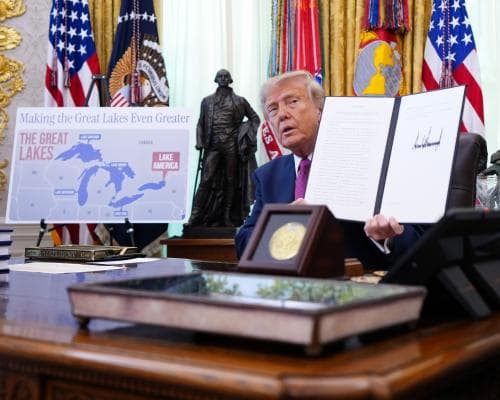
The pen may be mightier than the tariff, but in Donald Trump's White House, it's also a weapon of mass distraction. Summoning the press pool to the Oval Office on a day when trade talks with Canada had just collapsed, the president signed an executive order directing the Department of the Interior to rename Lake Ontario—a body of water that forms part of the U.S.-Canada border—as "Lake America." The move is pure theater, but it's theater with a pointed economic subtext: the United States' largest trading partner is now officially cast as the enemy.
"Canada treats us very badly," Trump told reporters, before launching into a familiar litany: "People oftentimes they'll ask me who's the worst to deal with on trade, and I said that's easy. Canada, they are the worst, and they feel entitled, and just we can't have that." The president's timing was no accident. This executive order lands just days after a 50% tariff on several Canadian imports kicked in on Saturday, with another round of 50% duties on Canadian steel, trucks, cars, and auto parts threatened for the new year. Canada's Prime Minister Mark Carney didn't blink—he retaliated with 25-50% tariffs on hundreds of U.S. goods, from agricultural products to consumer electronics. What began as a dispute over dairy quotas and digital services taxes has metastasized into a full-blown trade war between two economies that exchange roughly $800 billion in goods and services annually.
For the wealth desk, the numbers matter more than the name on the lake. The U.S. auto industry is the most exposed: Canadian-made vehicles and parts cross the border multiple times before final assembly, and a 50% tariff on those components would add thousands to the cost of every car sold in America. The steel and aluminum sectors are similarly intertwined, with Canadian producers supplying over 40% of U.S. aluminum imports. Throw in energy—Canada sends about 4 million barrels of oil per day to U.S. refineries—and you have a tariff war that touches every corner of the S&P 500, from industrials to consumer staples. The market's initial shrug at the news of the lake renaming was telling: investors have become desensitized to Trump's rhetorical flourishes, but they haven't priced in the full cost of a 50% tariff regime that could shave 0.5% to 1% off U.S. GDP growth by mid-2026.
This is not the first time Trump has used a body of water as a geopolitical cudgel. At the start of his second term, he issued an executive order to rename the Gulf of Mexico as the "Gulf of America," a move that drew mockery from cartographers but a knowing nod from traders. It signaled a willingness to weaponize symbols as much as tariffs. Today's order extends that playbook, but with a twist: Trump appeared to joke that there could be more to come. "We have a Gulf and we have a Lake—now all we need is an ocean. Maybe we'll have to change the name of the Atlantic and/or the Pacific. Maybe we'll change them both." The quip was vintage Trump, but the underlying message was dead serious: the United States is willing to upend a century of cooperative trade relations for political advantage.
For the ultra-wealthy, this is a moment to reassess portfolio geography. Canadian real estate, particularly in border cities like Windsor and Vancouver, has historically been a safe haven for U.S. investors seeking diversification. That calculus is shifting. The tariff war is already hitting Canadian manufacturing hubs, and a prolonged standoff could depress the Canadian dollar further against the greenback, eroding returns for U.S. investors holding Canadian assets. Conversely, U.S. energy infrastructure—pipelines, refineries, and export terminals—stands to benefit from reduced Canadian competition, though the sector faces its own headwinds from potential counter-tariffs on U.S. agricultural exports. The prudent move is to hedge: increase exposure to U.S. domestic producers, reduce reliance on cross-border supply chains, and keep a close eye on the next round of negotiations, which are reportedly scheduled for early next year.
The lake's new name may be a novelty, but the economic reality is anything but. Trump's trade war with Canada is a reminder that capital flows follow policy, not sentiment. And when a president is willing to rename a natural landmark as a negotiating tactic, the message to markets is clear: nothing is off the table. The smart money is already positioning for a protracted conflict, not a quick resolution. As one hedge fund manager put it this morning, "You don't rename a lake if you're planning to make nice." For investors, the takeaway is straightforward: buckle up, diversify across sectors and geographies, and keep a close watch on the White House's next move—whether it's a tariff, a treaty, or another body of water.