The Young Lens Behind Britain's Jazz Renaissance
At 26, Temi Adegbayibi has become the visual chronicler of London's new jazz golden age, shooting Ezra Collective from church pews to the Royal Albert Hall. His work captures the raw energy of a movement that is redefining British cool.
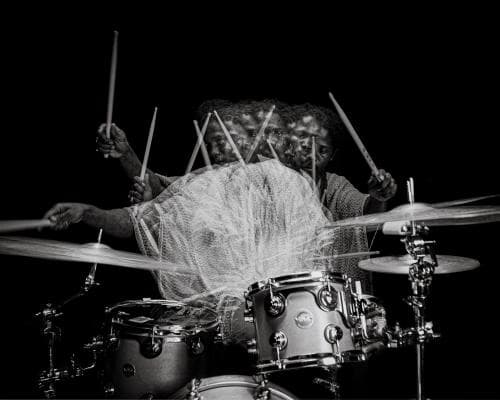
There is a moment in every great creative career when the amateur becomes the artist—when a single frame, a flash of light, a gesture caught mid-air, tells you that this is no longer a hobby. For Temi Adegbayibi, that moment arrived on a sun-drenched field at the Love Supreme jazz festival in Lewes, 2022. He was there to watch Ezra Collective, the London quintet that had just begun its meteoric rise, and he captured the band's bassist, TJ Koleoso, leaning back into his instrument as if it were the only thing holding him to the earth. That photograph, and another of the full band later used on an album sleeve, changed everything. 'I was like: Damn, I can actually do something with this,' Adegbayibi recalls. It is the kind of understated epiphany that separates those who merely take pictures from those who make history.
The 26-year-old photographer is, by his own admission, always on the move. When we speak, he is crossing London, then sprinting up the stairs to his desk, fitting our conversation into the interstitial spaces of a life split between freelance photography, film production, and a day job at the Royal Albert Hall. His portfolio reads like a who's who of contemporary British music—Jorja Smith, Basement Jaxx, Fireboy DML, and, of course, Ezra Collective—yet he remains refreshingly grounded. 'I've always had day jobs,' he says, with a laugh that suggests he finds the glamour of the stage as amusing as the rest of us. 'Most photographers back in the day weren't shooting for money, they were shooting for passion.' It is this ethos that has guided him from the pews of a north London church to the hallowed stage of the Royal Albert Hall, and it is this ethos that makes his work so compelling.
Adegbayibi grew up in Enfield, a borough of London that rarely makes the pages of glossy magazines but has produced some of the city's most vital cultural exports. His entry into photography was almost accidental: his cousin TJ Koleoso, Ezra Collective's bassist, asked him to photograph the church's worship band before a service. Adegbayibi shot there for two years, honing his eye in the low light of a Pentecostal congregation, before graduating to local gigs. He approached small artists, asked if he could photograph them, and built a body of work that was as much about community as it was about craft. 'The more I shot, the more confident I felt,' he says. 'Then more people reached out to me, based on my Instagram.' In an era when social media is often dismissed as a vanity project, Adegbayibi used it as a portfolio, a calling card, and a bridge to the artists who would define his generation.
The significance of his work lies not just in its technical proficiency but in its cultural timing. Britain is experiencing a golden age of jazz, a movement that has moved from the margins to the mainstream, headlining festivals, winning Mercury Prizes, and selling out venues like the Royal Albert Hall. Adegbayibi is its visual chronicler, capturing the sweat, the joy, and the sheer kinetic energy of a scene that refuses to be sedate. His photographs are not the stiff, posed portraits of yesteryear; they are alive, almost documentary in their intimacy, as if the viewer has been granted a backstage pass to a moment that will never come again. When Ezra Collective performed at the Royal Albert Hall in November 2023, Adegbayibi was there, his lens tracing the arc of a band that had grown from church services to the most prestigious stage in the country. That performance led to a solo exhibition, a testament to the growing recognition of his craft.
For collectors and connoisseurs of contemporary culture, Adegbayibi represents a new kind of luxury—not of material goods but of authenticity. In a world saturated with carefully curated images, his work offers something rare: a genuine, unvarnished look at the people and places that are shaping Britain's cultural landscape. His photographs are not merely records; they are artefacts of a movement that will be studied by future generations seeking to understand this moment in time. The market for such work is nascent but growing, with galleries and private collectors beginning to take notice of the young photographers who are documenting the jazz renaissance. Adegbayibi's images of Ezra Collective, in particular, are likely to become coveted pieces, not just for fans of the band but for anyone who appreciates the intersection of music and visual art.
What Adegbayibi signals about luxury taste is a shift away from the ostentatious and toward the meaningful. The ultra-wealthy have always collected art, but the new generation of collectors is drawn to work that tells a story, that captures a moment of cultural significance, that feels alive. Adegbayibi's photographs do exactly that. They are not investments in the traditional sense—at least not yet—but they are investments in a narrative, in a movement, in the energy of a generation that is redefining what British cool looks like. As he continues to shoot, from the intimate confines of a jazz club to the vast expanse of a festival stage, his work will only grow in resonance. The golden age of jazz is not a retrospective; it is happening now, and Temi Adegbayibi is its eye. For those who wish to own a piece of this moment, his photographs are the closest thing to a time machine—a way to hold on to the electricity of a live performance, the tilt of a bassist's head, the joy of a crowd lost in the music. In a world that moves too fast, his images slow us down, just long enough to remember why we fell in love with music in the first place.