Rolls-Royce's Bespoke Boom: Feathers, Bitcoin, and the New Young Money
At Goodwood, Rolls-Royce is rewriting the rules of luxury with custom commissions that range from 3,000 iridescent feathers to Bitcoin motifs. As the average buyer age drops to 43, the marque's bespoke division reveals how new tech wealth is reshaping British craftsmanship.
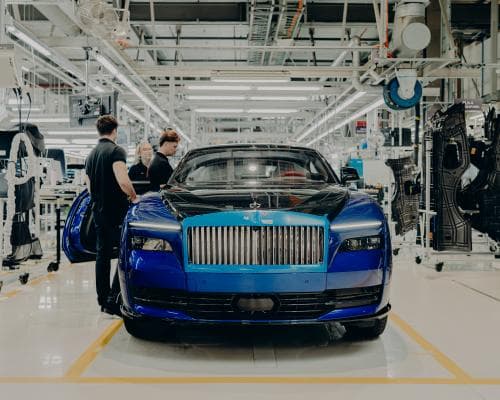
A Rolls-Royce has always been more than a car. It is a statement, a sculpture, a sanctuary. But the latest creations rolling out of Goodwood, West Sussex, are pushing the boundaries of personalisation into uncharted territory. Picture an interior lined with 3,000 iridescent feathers, each one hand-placed. Or a champagne cooler built seamlessly into the console. Or a car designed as a tribute to a couple's beloved dog. These are not whimsical fantasies; they are real commissions from a new generation of ultra-wealthy buyers who treat their Rolls as a canvas for self-expression.
The bespoke craze is not just a curiosity—it is a financial engine. Rolls-Royce's owner, BMW, is investing £300 million to nearly double the size of the Goodwood factory, a clear bet on the future of high-value customisation. The move is part of what the company calls 'securing our future here in the UK,' and it underscores how bespoke manufacturing has become a vital pillar of British industry. With the average buyer age now just 43—down from 56 in 2010—the demand for personalised luxury is being driven by a younger, tech-savvy clientele. 'Never has there been so much wealth created so quickly at such a young age,' says Julian Jenkins, Rolls-Royce's director of sales and brand. These are entrepreneurs from cryptocurrency, AI, and tech, and they know exactly what they want.
The craftsmanship required to fulfil these requests is staggering. Take the feather-lined interior: each feather is individually applied by hand, creating a shimmering, tactile surface that is as much art as upholstery. Or consider the Bitcoin symbol emblazoned on an inner door panel—a subtle nod to the source of the owner's fortune. Then there is the car built for a wealthy American couple, a rolling homage to their dog, complete with bespoke embroidery and perhaps even a paw-print motif. These are not off-the-shelf options; they are one-of-one creations that take months of collaboration between client and artisan. The price? Rolls-Royce doesn't disclose bespoke costs, but given that a standard Phantom starts around £400,000, these custom touches can easily add hundreds of thousands more.
This surge in bespoke demand reflects a broader shift in the luxury market. Collectors no longer want to simply own a rare object; they want to co-create it. The rise of the experience economy has extended to manufacturing, where the journey of commissioning a car is as important as the final product. For Rolls-Royce, this means expanding its team of artisans and engineers, and soon, its physical footprint. The Goodwood factory, already a showcase of British handiwork, will grow to accommodate the increasing complexity of requests. It is a rare piece of good news for UK manufacturing, which, despite decades of deindustrialisation, still accounts for about 9% of the economy. The bespoke sector, with its high margins and global clientele, is a bright spot that politicians from all sides are eager to champion.
What does this signal about the tastes of the new elite? For one, it is a move away from overt displays of wealth towards more personal, narrative-driven luxury. The Bitcoin symbol is a case in point: it is a code that only a certain tribe will recognise, a subtle flex that speaks to a community of crypto-entrepreneurs. Similarly, the feather interior is not about bling; it is about texture, craftsmanship, and a desire to surround oneself with the extraordinary. This is luxury as autobiography, where every detail tells a story about who you are and how you made your money. It is also a rejection of the homogeneous: in a world of mass-produced everything, the bespoke Rolls is the ultimate antidote.
As Rolls-Royce gears up for its next chapter, the question is how far bespoke can go. With younger buyers come bolder ideas, and the marque's artisans are already being asked to work with materials and motifs that would have been unthinkable a decade ago. The factory expansion will allow for more experimentation, more collaboration, and perhaps even more outlandish requests. But one thing is certain: the spirit of bespoke is alive and well at Goodwood, and it is driving a renaissance in British craftsmanship. For those who can afford it, the ultimate luxury is not just a car, but a car that is utterly, unmistakably yours. And for the rest of us, it is a fascinating window into the tastes of the new moneyed class—a class that is younger, tech-driven, and unafraid to ask for feathers.