The Vanishing Himalaya: When a Glacier Falls, the River Rises
A catastrophic flash flood on the Nepal-Tibet border reveals the fragile, dynamic world of high-altitude expeditions — where ice, rock, and water conspire in ways even the most seasoned travelers must now respect. For the ultra-wealthy trekking the Himalayas, this is the new geography of awe and peril.
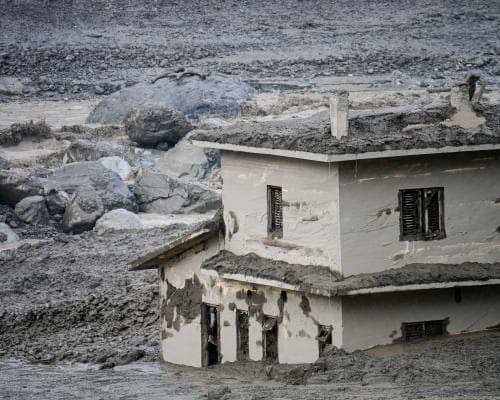
The first sign was not a sound but an absence. At 9:00 a.m. on a Wednesday, the Trishuli River — a sapphire ribbon that stitches Nepal to Tibet — began to swell with a violence no one had seen in a generation. Within thirty minutes, the water rose nine meters. Homes, bridges, and hydroelectric plants dissolved into a brown, churning slurry. By nightfall, more than a thousand people were missing, including trekkers from India, the US, the UK, and Australia. The cause, as scientists later confirmed, was not a monsoon storm or a seismic tremor, but something far more intimate with the ice: a glacier collapse.
For those who journey to the roof of the world, the Himalayas have always been a theater of extremes — a place where oxygen thins and ego expands. But this disaster, which tore through the Bhotekoshi River corridor, is a stark reminder that the mountains are not a static backdrop. They are alive, restless, and increasingly volatile. The International Centre for Integrated Mountain Development in Kathmandu reported that a tributary called the Lhende Khola had flooded twice in fourteen months, each time triggered by an ice-rock avalanche from a glacier on the Nepali side. The river, once a gentle companion for riverside lodges and tea houses, became a weapon.
What happened here is a phenomenon glaciologists call a glacial lake outburst flood — or GLOF, for short. When a glacier retreats, it leaves behind a basin of meltwater, often dammed by moraine (the rubble of rock and ice). If a chunk of the glacier calves into that lake, or if an avalanche of ice and rock slams into it, the dam can breach, releasing a torrent that can travel at highway speed. In this case, the trigger was an ice-rock avalanche that blocked the river, then released a sudden surge downstream. The US Geological Survey initially suspected a magnitude 4.4 earthquake, but the real culprit was the mountain itself, shedding its own skin.
For the luxury traveler, this is not a distant headline. The Trishuli River valley is a gateway to some of the most coveted expeditions on Earth — the Everest Base Camp trek, the Annapurna Circuit, and the nascent ultra-luxury heli-skiing and glacier-viewing itineraries that now ferry clients from Kathmandu to remote lodges in hours, not weeks. These journeys are sold on the promise of pristine solitude and raw nature. But raw nature, as this flood reminds us, does not negotiate. The water level rose nine meters in half an hour — the time it takes to finish a pour-over coffee at a five-star camp.
What does this mean for the discerning few who book these trips? Access, once the ultimate luxury, is now a matter of timing and intelligence. The most sophisticated operators are already adapting: they are hiring glaciologists as expedition guides, monitoring satellite imagery of glacial lakes in real time, and rerouting itineraries away from valleys that sit in the shadow of unstable ice. Some are even designing 'glacier-safe' lodges — built on high ground, with evacuation protocols that would make a Swiss bank blush. The price of such safety is steep, but for those who can afford it, it is the only way to experience the Himalaya without becoming a footnote in a disaster report.
This tragedy is also a signal of a broader shift in luxury travel. The ultra-wealthy are no longer content with static beach villas or safari tents. They want to witness the sublime — and the sublime is increasingly found at the edges of the world, where the Earth is most dramatic and most fragile. The Himalaya, with its 14 peaks above 8,000 meters, is the ultimate edge. But as the climate warms and glaciers retreat, the region is becoming a theater of unpredictability. The next frontier for luxury expeditions is not just altitude, but adaptability — the ability to move with the mountains, not against them.
For now, the Trishuli River is still running red with sediment, and the search for the missing continues. But even as the waters recede, the lesson for the privileged traveler is clear: the Himalaya are not a postcard. They are a living system, one that demands respect, preparation, and a willingness to listen to the ice. The most luxurious journey, in the end, is the one that brings you home — with a story that humbles you, and a memory that haunts you in the best possible way.