Peter Thiel Buys Casa Encantada: Inside the $130 Million Bel-Air Trophy Estate
Peter Thiel has emerged as the secret buyer of Casa Encantada, a 1938 Bel-Air masterpiece that sold at foreclosure auction for $130 million. The purchase signals a new era for one of America's most storied mansions—and a shrewd bet on rare real estate.
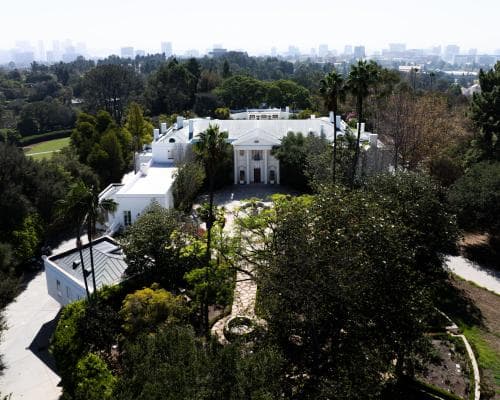
The bidding started quietly, under a tent in Pomona, at an open-air foreclosure auction. When the gavel fell in July, Casa Encantada—a 40,000-square-foot Deco-Hollywood fantasy in Bel-Air—had a new owner. But the name on the winning bid was hidden behind an LLC. Now, the Wall Street Journal has revealed the buyer: Peter Thiel, the venture capitalist and PayPal co-founder. The price? A staggering $130 million, the most expensive Los Angeles sale this year. For a man who already owns compounds in Hawaii and New Zealand, this isn't a home. It's a statement.
Casa Encantada is not just any mansion. Completed in 1938, it sits on 8.4 acres overlooking the Bel-Air Country Club, a green jewel in one of the world's most exclusive enclaves. The estate was built for Hilda Boldt Weber, a widow who spared no expense. Its Deco-Hollywood interiors include seven bedrooms, twenty bathrooms, multiple dining rooms and lounges, a walnut-paneled library, a tennis court, terraced gardens, and a 60-foot tiled swimming pool. A two-storey guesthouse completes the compound. Previous owners read like a roll call of American wealth: hotel magnate Conrad Hilton bought it in 1950; billionaire David Murdock purchased it in 1980 for a record $12.4 million; and in 2000, telecom mogul Gary Winnick paid $94 million—another record. Winnick later tried to sell for $225 million in 2019 and $250 million in 2023, making it the priciest home in the US at the time. He died in 2023 amid a mountain of debt, leading to the foreclosure auction. Thiel's $130 million is a bargain by comparison—a rare chance to own a piece of Los Angeles history at a discount.
For Thiel, the purchase is pure investment. He doesn't plan to live there. Instead, he'll upgrade the property, adding his own touches to a mansion that already boasts more bathrooms than most hotels. The move adds to a portfolio that spans three continents, from Miami to Washington, DC. But Casa Encantada is different. It's not just real estate; it's a trophy. In a city where billionaires collect homes like art, this one comes with provenance. The question is what Thiel will do with it. A private museum? A corporate retreat? Or simply a hedge against inflation? Whatever the answer, the sale signals a shift in the ultra-luxury market. While asking prices soared during the pandemic, buyers are now hunting for value—even at nine figures. Foreclosure auctions, once the domain of distressed properties, are now drawing billionaires. Thiel's purchase proves that even the wealthiest are willing to wait for a deal.
And what does this mean for luxury travel? Bel-Air has long been a haven for the discreet rich. The Hotel Bel-Air, with its swans and fountains, is a favourite of Hollywood royalty. But private estates like Casa Encantada offer something hotels can't: absolute privacy. For the ultra-wealthy, the new status symbol isn't a suite at the Aman—it's a compound with its own tennis court and guesthouse. Thiel's purchase underscores a trend: the wealthy are buying homes as investments, not just residences. They want assets that hold value, that can be upgraded, that tell a story. Casa Encantada, with its Conrad Hilton connection and Deco glamour, is the ultimate story. It's a piece of Old Hollywood that can be modernised without losing its soul. And for those who can't afford a $130 million mansion, the lesson is clear: in luxury travel, heritage matters. The most desirable destinations are those with a past.
So where do the wealthy go next? If Thiel's move is any indication, they're looking at foreclosure auctions and off-market deals. They're buying properties that need work, that have been overlooked, that come with a whiff of scandal. Bel-Air, with its winding roads and hidden estates, remains a top target. But so are other historic enclaves: Montecito, Palm Beach, the Hamptons. The key is rarity. You can't build more land in Bel-Air. You can't replicate a 1938 Deco masterpiece. And you can't buy Conrad Hilton's old house every day. Thiel knows this. That's why he spent $130 million on a mansion he may never sleep in. For him, it's not about the bedrooms or the pool. It's about the story. And in the world of ultra-luxury, story is everything.