The Unlikely Descent: Claressa Shields’ Middleweight Masterclass in Atlanta
Claressa Shields, the undisputed heavyweight queen, shed more than a dozen pounds to reclaim her middleweight throne in a six-round demolition of Kaye Scott, proving that true power isn’t about size—it’s about precision, patience, and an unyielding will. For those who follow the world’s most rarefied competitions, this wasn’t just a fight; it was a study in controlled reinvention.
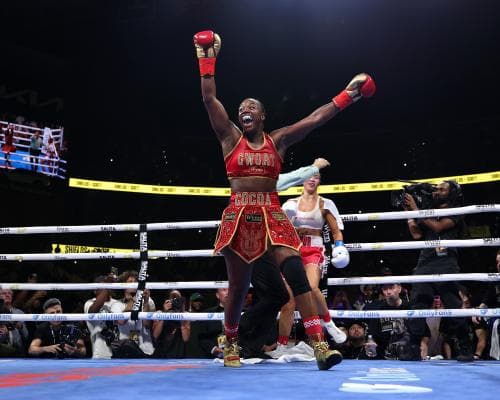
At 12:30 in the morning, while most of Atlanta slept, a woman who had spent the past year ruling the heavyweight division stepped into a ring at State Farm Arena and did something almost unheard of in modern combat sports: she went down in weight, not up, and made it look effortless. Claressa Shields, the double Olympic gold medalist and five-division world champion, had promised a return to her middleweight roots would be a homecoming, not a gamble. Against Australia’s Kaye Scott, she delivered on that promise with a performance that felt less like a fight and more like a masterclass in the art of subtraction—of weight, of doubt, of any lingering question about her place in the pantheon.
Shields, now 31, has never been one for the conventional path. After becoming the undisputed champion at 160 pounds in 2021, she did what no other fighter of her stature had attempted in over a century: she moved up through light-heavyweight and into the heavyweight ranks, where she now holds every major belt. But on this night, she reversed course, shedding over a dozen pounds in a matter of weeks—a descent that would have debilitated most athletes. The weight cut, which her team had choreographed with the precision of a Swiss watchmaker, was the talk of the boxing world. Would the speed remain? Would the power survive? The answer came in the opening round, when Shields began taking Scott’s measure with the calm of a collector appraising a rare vintage, then spent the next five rounds systematically dismantling her opponent’s defenses.
The craftsmanship on display was not brute force but surgical timing. Shields’ hand speed, honed over years of Olympic competition, allowed her to land first and escape counters with a dancer’s grace. Her body attack—a relentless, punishing rhythm—drained Scott, a decorated amateur who had turned professional only at 39, as the rounds wore on. By the sixth, the 42-year-old champion was spent, and when Shields dropped her with a flurry that seemed to come from nowhere, the end was inevitable. Scott’s corner, seeing their fighter unable to defend herself, threw in several towels—a rare and telling gesture of surrender. The referee waved it off at 1 minute 38 seconds, and Shields improved to 19-0 with her fourth knockout, while Scott fell to 5-2-1.
For the uninitiated, this might sound like just another title fight. But for those who understand the rarified air of elite competition, Shields’ feat is the equivalent of a Swiss watchmaker suddenly crafting a grand complication after years of making minimalist dress pieces—and doing it better than anyone else. Her promoter was quick to note that she is only the second heavyweight champion in more than 120 years to win a world title in a lower division, a statistical anomaly that places her in the company of legends like Bob Fitzsimmons. The fact that she did it against a game but outmatched opponent, in a division she once ruled as undisputed, only adds to the narrative of a woman who seems to collect championships the way others collect vintage cars.
In the collector’s market of combat sports, Shields is a blue-chip asset—rare, appreciating, and endlessly versatile. Her ability to move between weight classes with such fluidity is not just a physical achievement; it is a strategic one. It signals to promoters, sponsors, and fans that she can headline events in any weight class, from the heavyweight marquee to the middleweight classic. The fight itself, held in Atlanta’s State Farm Arena, drew a crowd that included a who’s who of boxing’s elite, all eager to see if the weight cut would dull her edge. It didn’t. If anything, it sharpened it. She was faster, more precise, and more dangerous than she had been at heavyweight, a testament to her team’s meticulous preparation and her own relentless discipline.
What does this mean for the luxury of sport? In a world where athletes often chase the biggest payday or the most convenient belt, Shields’ decision to go backward—to descend, not ascend—is a quiet rebellion against the logic of more. It is a reminder that true mastery lies not in accumulation but in refinement, in the ability to strip away the unnecessary and reveal the essential. For the ultra-wealthy who collect experiences, this is the equivalent of a private tasting of a 100-year-old single malt: rare, fleeting, and utterly unforgettable. Shields’ performance was not just a victory; it was a statement that the most valuable currency in any arena is not size or strength, but the will to reinvent oneself on your own terms.
As the early morning hours crept past, Shields stood in the center of the ring, her arms raised, the WBA and WBC middleweight belts draped over her shoulders like a bespoke suit. She had reclaimed her throne, but more importantly, she had proven that the most compelling stories are not about what you gain, but what you are willing to let go. For the rest of us, watching from the comfort of our curated lives, it was a masterclass in the art of the pivot—a reminder that the greatest luxury is the freedom to choose your own weight, in every sense of the word.