Hockney's Sleeping Dachshund Stanley Set to Fetch £2.5 Million at Christie's
A rare 1995 painting from David Hockney's beloved Dog Series, depicting his dachshund Stanley curled asleep on a cushion, arrives at Christie's with an estimate of £1.5–2.5 million. It is the first work from this intimate series ever to appear at auction, offering collectors a chance to own a piece of the artist's most personal subject matter.
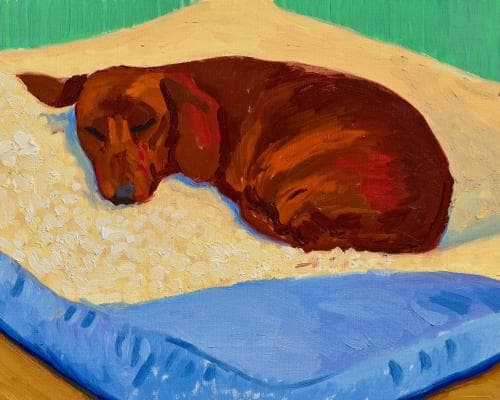
David Hockney's dachshunds, Stanley and Boodgie, were not merely pets—they were muses, mischief-makers, and the undisputed rulers of his Hollywood Hills home. Now, one of the most tender portraits from that canine reign is coming to auction for the first time. Dog Painting 17, painted in 1995, shows Stanley curled into a tight, contented ball on a cushion, fast asleep. Christie's estimates it will fetch between £1.5 million and £2.5 million when it goes under the hammer.
Hockney, who died in June at 88, was famously besotted with his two sausage dogs. He picked Stanley out as a puppy in 1987, naming him after Stan Laurel, and the dog became a constant companion. Boodgie arrived later, more reserved but equally adored. Friends were astonished when Hockney first announced he was getting a dog—he was peripatetic, always traveling, forever surrounded by visitors. But the dachshunds quickly became an essential part of his busy life on Montcalm Avenue, and he treated them not as accessories but as portrait subjects worthy of the same scrutiny he gave to his human sitters.
The Dog Series, comprising more than 40 works painted between 1994 and 1995, is a remarkable record of that devotion. Hockney observed the dogs with the same eye he brought to his famous pool paintings and double portraits—attentive, affectionate, and quietly radical in its simplicity. Dog Painting 17 is a prime example: the composition is intimate, the brushwork loose and warm, the subject utterly ordinary yet rendered with the care of a master. It is the first painting from this series ever to appear at auction, a fact that has Christie's specialists buzzing. "This is such an exciting painting for us," said Tessa Lord, Christie's head of postwar and contemporary art. "The rarity is kind of extraordinary."
For collectors, the appeal is obvious. Hockney is one of the most beloved and bankable artists of the past century, and his market has only strengthened since his death. Works from his most personal series rarely surface, and when they do, they tend to perform well. The estimate of £1.5–2.5 million is ambitious but not unreasonable for a museum-quality piece with impeccable provenance and a story that practically tells itself. The painting captures not just a dog but a moment—the quiet intimacy of an artist and his companion, frozen in oil.
The dachshunds were more than subjects; they were family. Hockney indulged them shamelessly. According to his authorised biographer Christopher Simon Sykes, house training was not a priority. One friend recalled the dogs defecating in his shoes. On a visit to Dennis Hopper's Frank Gehry-designed home in Venice, Los Angeles, Boodgie left a "gift" in the middle of the floor. Hockney's response, according to Sykes, was a shrug and a quip: "It'll be dry in the morning, luv, and you can just pick it up." That blend of irreverence and deep affection is exactly what makes the Dog Series so endearing—and so collectible.
In a market increasingly driven by narrative and provenance, Dog Painting 17 offers both. It is not just a Hockney; it is a Hockney with a heartbeat. The painting speaks to a rarefied kind of luxury—one defined not by price tags but by intimacy, by the quiet moments that money cannot buy but can, occasionally, be acquired. For the right collector, Stanley asleep on his cushion is more than a portrait of a dog. It is a window into the private world of one of the greatest artists of our time.
Christie's sale presents a rare opportunity to own a piece of that world. The painting will be offered alongside other postwar and contemporary works, but few will carry the same warmth or the same story. As Hockney himself might have said, it will be dry in the morning—but this one is likely to stay in the family for a long time to come.