Audi's $4 Billion Gamble: Why Gernot Döllner Shared a Stage with Donald Trump
Audi CEO Gernot Döllner's appearance alongside Donald Trump to announce a $4 billion Georgia factory has ignited a firestorm in Germany, exposing the uneasy intersection of luxury car money and divisive politics. The move signals a high-stakes bet on American manufacturing—and raises questions about the price of brand ambition.
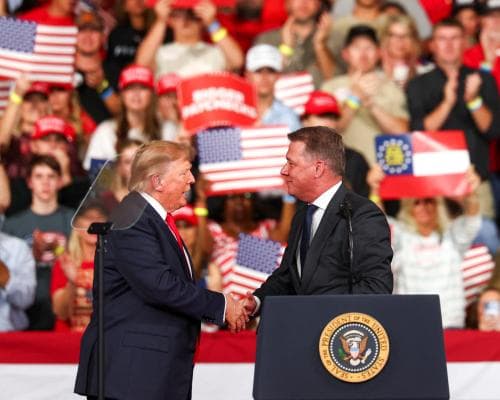
Sometimes the most revealing luxury accessory isn't a watch or a handbag—it's a stage shared with a polarizing political figure. Just days before the US midterms, Gernot Döllner, the CEO of Audi, stepped into the spotlight beside Donald Trump at a rally in Georgia. The occasion? A $4 billion investment to build Audi's first American factory, creating 4,500 jobs in the battleground state. For a brand synonymous with quiet German engineering, the moment was anything but discreet.
The backlash was immediate and fierce. Daniela Cavallo, head of the works council at Audi's parent company Volkswagen, didn't mince words. In internal communications leaked to German media, she described Trump's speech as riddled with "racism, sexism, transphobia [and] contempt for democracy" and said anyone who witnessed Döllner's active participation should "sink into the ground with shame." She accused management of being "turned into a puppet in the propaganda show of a highly dubious political figure." Isabel Cademartori, transport spokesperson for Germany's Social Democrats, called it a "disgrace," especially given Volkswagen's historical origins under the Nazi regime. The German government, for its part, declined to comment, calling it a business decision.
But this is about more than politics—it's about the high-wire act of luxury brands in an era when every move is scrutinized. Audi, a marque that built its reputation on understated excellence, now finds itself in the messy arena of American electoral politics. The $4 billion factory in Macon, Georgia, is set to produce the company's "biggest and most premium SUVs," according to Döllner's announcement. It's a bold bet on the US market, where luxury SUV demand remains insatiable. Yet the timing—and the optics—have turned a straightforward investment story into a reputational quandary.
For collectors and connoisseurs of fine automobiles, the question is whether this political cameo will tarnish the four rings. Audi's clientele prizes discretion, craftsmanship, and a certain aloofness from the fray. They buy these cars for their engineering, not their politics. But in an age where brand values are as important as horsepower, aligning with a figure as divisive as Trump is a risk. The company's German workforce, already facing tens of thousands of job cuts and plant closures, sees the move as a betrayal—a pivot to America while abandoning its roots.
The luxury car market is no stranger to political entanglements. From Ferrari's fleeting flirtations with politicians to Tesla's Elon Musk turning himself into a political lightning rod, the industry has seen how quickly a brand can become a proxy for its leader's views. But Audi's situation is different: Döllner isn't the founder or a majority owner; he's a steward of a legacy brand, accountable to workers, shareholders, and a public that expects a certain decorum. The rally appearance wasn't just a business announcement—it was a visual endorsement, and that's what stings.
What does this signal about the tastes and tensions of the ultra-wealthy? It suggests that even the most insulated luxury brands are being pulled into the culture wars. The wealthy may prefer to float above politics, but their money—and the factories it builds—are squarely in the fray. For Audi, the gamble is that American buyers will care more about the SUV's quilted leather and air suspension than the stagecraft in Georgia. But the backlash at home shows that reputation is a fragile thing, especially when it's built on decades of careful restraint.
As the dust settles, Döllner's decision will be studied in business schools and boardrooms alike. It's a reminder that in the curated world of luxury, every appearance is a statement, and every statement has a price. The $4 billion factory may well produce superb vehicles, but the cost to Audi's image—particularly among its German stakeholders—remains to be tallied. For now, the four rings are caught in a glare they never sought, and the road ahead looks anything but smooth.