Dolce & Gabbana's Sicilian Gamble: Inside the House That Refuses to Sell
As the luxury world consolidates, Dolce & Gabbana remains one of the last great independent houses—and it's betting its future on grandmothers, heritage lace, and a £400m debt clock. Saturday's 'Stravaganza Siciliana' show was less a runway than a survival manifesto.
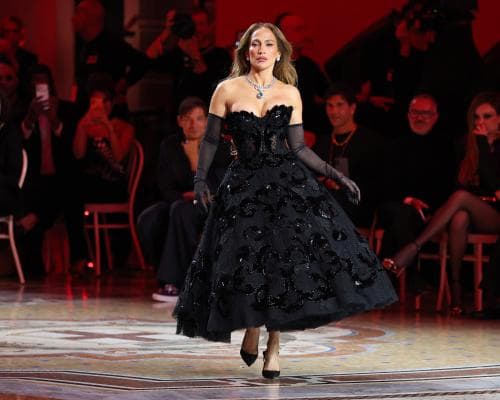
Milan Fashion Week has a way of making even the most seasoned observers feel like they've seen it all before. Then Jennifer Lopez walks in wearing a three-piece velvet suit and a baker-boy cap, and suddenly you remember why you fell in love with this circus in the first place. That was the scene on Saturday at Dolce & Gabbana's womenswear show, where Lopez—who had just days earlier closed the Vogue World runway in a black beaded bustier dress from the same house—took her front-row seat like a living reminder of the brand's superpower: making famous women look impossibly, unapologetically glamorous.
But behind the flashbulbs, the mood is more complicated. Dolce & Gabbana is carrying a debt pile approaching £400 million. In August, the company reached an agreement with its banks that gives it until March 2028 to settle—provided it executes a series of what are politely called 'extraordinary corporate transactions,' reportedly including the sale of some properties. It is one of the last major fashion houses still standing alone. Gucci and Bottega Veneta answer to Kering. Fendi belongs to LVMH. Dolce & Gabbana answers to Domenico Dolce and Stefano Gabbana, and to no one else. That independence is both its romance and its risk.
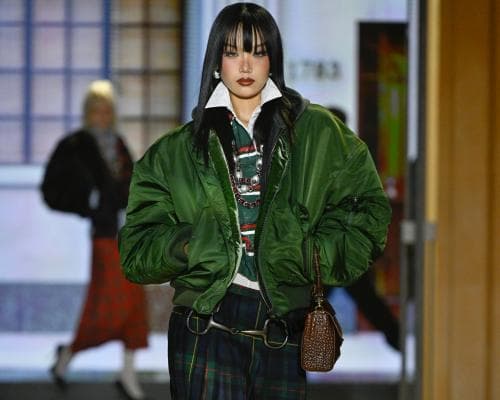
Saturday's show, titled 'Stravaganza Siciliana,' was designed to address both. The first job was to remind the faithful why they fell for the brand in the first place: the black lace, the corsetry, the Catholic iconography, the unabashed Italianità. The second job was harder—sketching a vision of the Gen Z customer the house desperately needs. A voiceover set the tone: women rooting through the wardrobes of their mothers and grandmothers. 'Women today do not look at it as though it were a museum,' the script read. 'They try things on, layer and mix. Grandmother dresses granddaughter.' On the catwalk, that translated into antique-inspired lace and crochet dresses and skirts, styled with cropped tweed jackets and cascades of jewellery. Less Sicilian widow, more upbeat ragazza with a vintage habit.
It's a clever pivot. The luxury market has cooled, and the brands still growing are the ones that can speak to both heritage and now. Dolce & Gabbana's archives are deep—founded in 1985, the house built its name on sharp tailoring, sensual femininity, and a very specific vision of Sicily as a place of sun-bleached stone and simmering passion. That vision once felt dangerous. Now it risks feeling dusty. The fix, as presented on Saturday, is not to abandon it but to let a new generation rummage through it. The grandmother's dress becomes the granddaughter's statement piece. The past becomes raw material, not relic.
Whether that's enough to satisfy the banks is another question. Selling property buys time, but time is only useful if sales follow. The brand's celebrity engine remains formidable—Lopez alone is worth more than most advertising budgets—but red-carpet moments don't always translate into ready-to-wear revenue. What Dolce & Gabbana needs is for younger shoppers to walk into a boutique and see themselves in the lace, not just in the after-party photos. The show's styling, with its mix of vintage-inspired layering and modern proportions, felt like a direct invitation: come play in our closet.
For collectors and connoisseurs, the house occupies a peculiar place. It is not Hermès, with its waiting lists and investment-grade leather. It is not Chanel, with its relentless price hikes. It is something more personal—a brand you wear because it makes you feel like a character in a film you'd like to star in. That emotional pull is an asset no conglomerate can buy. But it is also fragile. Independence means freedom to design without committee approval; it also means no deep-pocketed parent to absorb a bad season. The next three years will decide whether Dolce & Gabbana's singularity is its salvation or its undoing.
What Saturday made clear is that the house is not going quietly. The clothes were beautiful, the casting was smart, and the message was unmistakable: we are still here, we are still Sicilian, and we are still ours. In a luxury landscape increasingly dominated by three or four corporate giants, that is worth something. Whether it is worth £400 million is a question only the market—and the grandchildren—can answer.