Demna Rebuilds Gucci as a Cathedral of Commerce in Milan
At Milan fashion week, Demna staged his third Gucci collection inside a purpose-built boutique, arguing that the brand's future lies in 'luxury that wants to be seen.' It is a high-stakes bet to revive a house whose revenues nearly halved in three years.
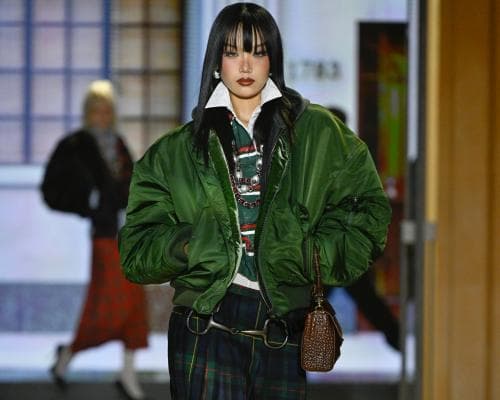
Milan fashion week's most exclusive shopping experience came with a cruel twist: nothing was for sale. On Friday, Demna transformed a convention centre into a sprawling replica of Gucci's new boutique concept — enormous stone columns, slabs of Paonazzo marble (convincingly fake), plush couches, and shelves lined with pieces from his previous collections. Sales assistants drifted among the guests, ready to answer questions but powerless to close a sale. Romeo Beckham, Bianca Jagger, Cardi B and Edward Norton looked on from the sofas. Some very important clients, one suspects, reached for their wallets out of pure reflex.
Demna — the mononymic designer who joined Gucci last July after a decade turning Balenciaga into a luxury powerhouse — has spent his first year, in his words, 'dedicated to understanding and formulating what Gucci stands for.' His conclusion, delivered via the set itself, is bracing: Gucci 'is about luxury that wants to be seen.' Not whispered. Not minimal. Seen. The show was his complete personal vision for the brand, and he staged it at the altar of commerce rather than in a theatre or a palazzo. The message was unmistakable. This is a house that intends to sell.
The stakes could hardly be higher. Until 2022, Gucci was thriving, owned by Kering and accounting for roughly half its sales. Then Sabato de Sarno executed a sharp U-turn away from Alessandro Michele's theatrical romanticism toward minimalism, and the brand plummeted. Over three years, revenue almost halved. Demna, who built his reputation on subversive, genre-bending collections, has been handed the task of making Gucci relevant again — not just critically, but commercially. There are hints he is on the right path. In July, Kering reported a return to growth, crediting his new collections. But the pressure to accelerate the turnaround is mounting by the quarter.
What makes the Milan staging so shrewd is how it reframes the luxury experience itself. The fake marble is not a cost-saving measure; it is a thesis. In an era when the ultra-wealthy can buy almost anything online, the physical boutique must offer something else — theatre, presence, the sensation of being inside a brand's imagination. By seating his guests on couches surrounded by merchandise they could not purchase, Demna turned retail into performance art. The sales assistants hovering nearby became actors in a play about desire deferred. It was, depending on your temperament, either maddening or thrilling. Either way, nobody left indifferent.
For collectors and clients who have watched Gucci lurch between extremes, the show signals a recalibration. Demna is not chasing Michele's nostalgia or De Sarno's severity. He is betting on visibility — on the idea that today's luxury consumer, particularly the younger one, wants to be seen wearing the brand as much as owning it. That means clothes with presence, stores with drama, and an identity that reads instantly from across a room. The aristocrats and eccentrics who inspired this vision are not museum pieces; they are avatars of a certain fearless self-presentation that Gucci, at its best, has always sold.
Whether this translates into the sustained growth Kering needs is another matter. Fashion's turnaround stories are rarely linear, and Gucci's problems run deeper than any single collection. But Demna has done something rare: he has given the brand a clear point of view at a moment when clarity is currency. The boutique-as-runway was not just a clever set. It was a statement of intent — that Gucci will no longer hide behind minimalism or nostalgia, but will instead lean into the messy, magnetic, deeply human desire to be noticed. In a market that rewards conviction, that may prove the most valuable thing on display all week.