The Shifting Summits: What the Himalayas' New Fragility Means for the World's Most Exalted Travels
As a catastrophic glacial collapse in the Langtang Valley reveals the profound instability now gripping the world's highest peaks, luxury travel must reckon with a new era of impermanence. For those who seek the roof of the world, the journey is no longer just about altitude, but about bearing witness to a landscape in breathtaking, perilous flux.
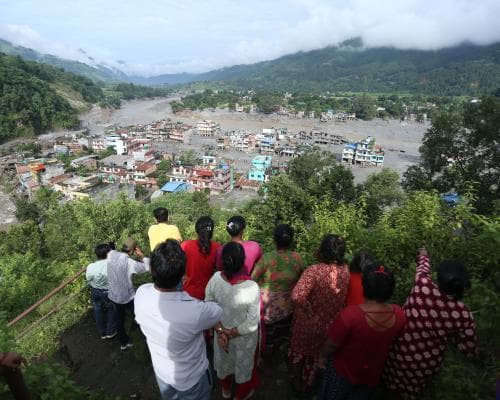
The first sign of trouble was not a rumble, but a silence. On the morning of the flood, the air in the Langtang Valley, a place of prayer flags and yak bells, felt unnaturally heavy. Then, the mountain itself seemed to exhale. A wall of ice, a cathedral of ancient blue, calved from the north face of Langtang Lirung and crashed into the valley below. The impact, later measured as a magnitude 5.2 seismic event, sent a torrent of mud, rock, and water surging down the Bhotekoshi River, scouring away roads, bridges, and entire communities in a matter of minutes. The official death toll hovers near 360, but more than a thousand souls remain unaccounted for, swallowed by a landscape that was once considered eternal.
For the ultra-wealthy traveler who has stood on the viewing decks of Everest Base Camp or flown by helicopter into the Mustang region's ancient caves, this is not a distant tragedy. It is a seismic shift in the very definition of adventure. The Himalayas, the world's most exalted mountain range, have long been the ultimate trophy—a place of physical extremity and spiritual clarity. But the science emerging from this disaster is unambiguous: the glaciers and permafrost that have held these peaks together for millennia are being unstitched by global heating. The US Geological Survey's analysis of long-period seismic waves points not to an earthquake, but to a glacial collapse as the primary trigger—a chilling confirmation that the mountains themselves are now moving in ways our maps cannot predict.
What does this mean for the discerning traveler? It means the journey to the high Himalaya is no longer a static pilgrimage. The luxury lodges of the region, from the boutique havens in Kathmandu's hills to the tented camps that appear each season on the moraines of the Khumbu, are now operating in a theater of profound dynamism. The landscape that once offered a sense of timeless reprieve is now a living, breathing entity in crisis. The very rocks beneath the trekking poles are less stable, the ice bridges more ephemeral. For those who can afford to travel with a private guide, a helicopter on standby, and a geologist in tow, the experience has transformed. It is no longer enough to merely see Everest; one must understand the fragile hydrology of the region, the way a single warm spell can melt the 'glue' that binds the bedrock, as Dr. Hamish Pritchard of the British Antarctic Survey notes.
This is where the new luxury lies: in access, not just altitude. The most sought-after expedition operators are no longer selling a simple trek to a base camp. They are curating journeys of witness—flights over the Langtang Valley to observe the scarred landscape, private briefings with glaciologists from the International Centre for Integrated Mountain Development, and stays in remote lodges that have been retrofitted with structural reinforcements and emergency evacuation plans. The price for such bespoke experiences has soared, with a single helicopter charter into the high valleys now commanding five figures, and a fully guided expedition into the newly unstable zones running into the hundreds of thousands of dollars. But the true currency is no longer the summit photograph; it is the understanding of a world in transition.
The tragedy also signals a broader recalibration in the luxury travel zeitgeist. The ultra-wealthy have always been drawn to extremes—the coldest, the highest, the most remote. But the Himalayan disaster, coupled with the melting of polar ice caps, is forcing a reckoning with the fact that these extremes are themselves becoming fragile. The new status symbol is not just having been to a place, but having been there at a moment of historical significance. To stand in the shadow of Langtang Lirung now is to witness the vanishing of a world, a sensation that is both deeply humbling and increasingly rare. The affluent traveler is no longer a passive observer but a documented witness to the Anthropocene, and the most sophisticated itineraries now include not just a summit view, but a conversation about the mountain's future.
Where do the wealthy go next? Not away from the mountains, but deeper into their meaning. The next frontier is not a new peak, but a new perspective. Expect to see a surge in 'scientific tourism'—expeditions that pair luxury amenities with research missions, where guests can contribute to the monitoring of glacial lakes or the cataloging of species displaced by warming. The lodges of the future will be designed not just for comfort, but for resilience, with modular structures that can adapt to shifting terrain. The Himalayas, in all their perilous beauty, are becoming the world's most exclusive classroom, and the lesson is one of impermanence. For those who can afford the journey, the greatest luxury is not the absence of risk, but the presence of meaning—a chance to stand at the edge of what is changing and to understand, with profound clarity, that the mountains are not eternal after all. They are, like us, in motion.