The Sacred and the Sublime: When the Himalayas Turn Violent
A devastating glacial flood at the Nepal-Tibet border has swept away pilgrims on a sacred journey to Mount Kailash, reminding even the most intrepid travelers that the world's most revered landscapes demand profound respect. This is a story of faith, fragility, and the raw power of nature in the high Himalaya.
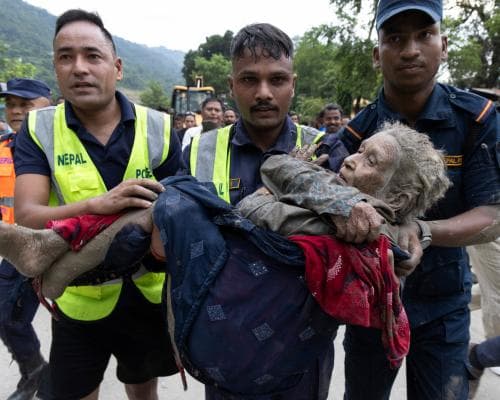
The road to Mount Kailash is not for the faint of heart. It is a pilgrimage that strips away the superfluous, leaving only the essential: faith, endurance, and a willingness to stand before one of the most sacred peaks on Earth. But on a grey Wednesday morning, that road became a wall of mud and debris, and the journey turned from spiritual quest to desperate survival. More than a thousand people are missing after a glacial collapse sent a torrent of water and rock crashing through the border region between Nepal and Tibet, taking with it a group of 80 Hindu pilgrims who had paused at the immigration office on the Chinese side of the frontier.
Isha Foundation founder Sadhguru, the charismatic Indian guru whose voice reaches millions, was himself on the other side of the border when the flood hit. In a raw, emotional video posted to his social channels, he described the terrifying scene: a surveillance clip from the Chinese side showing a monstrous wave of brown slurry swallowing the border building whole. 'Literally, the entire group was there in the building,' he said, his voice cracking. 'This is a terrible and extraordinary event. All phones are off, telecommunications are down, roads are blocked, we are unable to go there.' The pilgrims, part of several groups organized by his foundation, were on the final leg of a journey to Kailash and the turquoise waters of Lake Mansarovar, a site that Hindus believe is the abode of Shiva and the source of the Ganges.
For the ultra-wealthy traveler, Mount Kailash has long been the ultimate bucket-list destination — a place where money buys access to a landscape that feels more myth than matter. The pilgrimage, organized annually by India's foreign ministry in coordination with Chinese authorities, restarted in 2025 for Indians for the first time since the 2020 border clash. It is a journey that typically costs tens of thousands of dollars, involving chartered helicopters, oxygen canisters, and a retinue of porters and guides. But this tragedy underscores a truth that no amount of luxury can insulate against: the Himalaya are not a theme park. They are a living, breathing, collapsing mountain range, and their power is absolute.
The victims hail from across the globe — 22 from the United States, 12 from Canada, 11 from Australia, nine from the United Kingdom, and smaller numbers from Germany, France, the Netherlands, New Zealand, Spain, Singapore, Finland, Hungary, Israel, Lithuania, the Philippines, Portugal, Russia, and South Africa. They were not adrenaline junkies or Instagram influencers; they were mostly women, 46 of them, seeking something deeper than a vacation. They had flown across oceans, hiked through thin air, and endured days of rough roads to stand in the shadow of a mountain that has been a site of veneration for millennia. Now, their phones are silent, and the search-and-rescue teams are working against a clock that is ticking faster than the mountain's melting glaciers.
This is not the first time the Kailash region has shown its teeth. In 2023, a glacial lake outburst flood in nearby Sikkim killed dozens and washed away roads and bridges. Scientists have long warned that the Hindu Kush-Himalaya region is warming faster than the global average, and that its glaciers are retreating at an alarming rate. The flood that hit the border building is a stark reminder that the 'third pole' is melting, and that the consequences are not just environmental but deeply human. For the luxury travel industry, this is a moment of reckoning: how do we sell a journey to a place that is actively becoming more dangerous, and how do we honor the sanctity of a site that is now a site of tragedy?
For those who were planning to make the Kailash pilgrimage in the coming months, the message is clear: this is not the year to go. The Chinese and Nepali authorities have closed the border crossing, and the pilgrimage route is impassable. But the allure of Kailash will not fade. The mountain will remain, stark and white, and the faithful will return — perhaps with more humility, and certainly with more caution. The ultra-wealthy will find new ways to experience the sacred, perhaps through virtual reality tours or curated visits to the foothills, but the essence of the journey — the sense of standing before something greater than oneself — will always demand a physical presence. And that presence, as this week has shown, comes at a price that no credit card can cover.
In the coming months, the luxury travel world will pivot. The new frontier will be the 'soft adventure' — experiences that offer a taste of the sublime without the mortal risk. Think high-altitude lodges in the Annapurna foothills, where you can sip single-origin coffee while watching the sunrise over the peaks, or curated helicopter tours that circle Kailash from a safe distance, never landing. But for those who truly understand the mountain's power, there is no substitute for the ground beneath your feet. And as the search continues, the rest of us are left with a haunting question: in our pursuit of the extraordinary, how much are we willing to risk to touch the divine?