The Quiet Billionaire's Europe: Five Cities Where Old Money Goes to Unwind
There is a moment, usually somewhere between a private viewing at a marquee auction house and a third consecutive night of tasting menus in a Michelin-starred room, when the world’s most seasoned travelers realize they’ve been collecting the wrong things. The right address in Paris? Done. The yacht in Monaco? Moored and forgotten. The real prize, it turns out, isn’t another gilded landmark—it’s the rare, almost illicit feeling of having an entire Renaissance masterpiece to yourself, or cycling past terracotta walls without a single selfie stick in sight. For the ultra-wealthy, the new status symbol isn’t a louder statement; it’s the volume turned down. And nowhere does that quiet opulence better than Europe’s smaller cities, where history isn’t a performance but a daily companion.
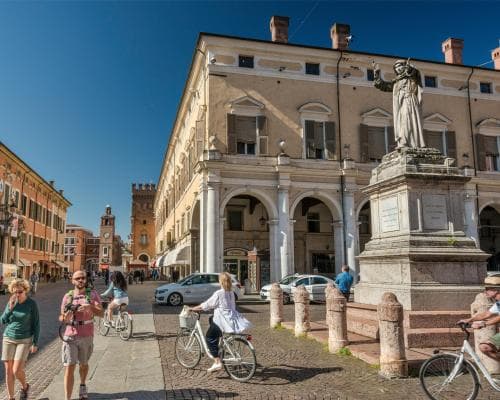
Take Ferrara, in Italy’s Emilia-Romagna. This is not the Italy of tour buses and gelato queues. This is a city that rewards the deliberate. Picture this: you wake in a small family-run hotel tucked near Via delle Volte, where the morning soundtrack is the soft scuff of your own footsteps on cobblestones and the scent of fresh pastries drifting from a corner bakery. The Palazzo dei Diamanti—a palace whose facade is studded with 8,500 diamond-pointed stones—stands nearly empty as you wander its galleries, absorbing Renaissance art without the jostle of a thousand camera phones. Evenings here are not about reservations; they’re about instinct. You cycle past ancient walls to a tiny trattoria where the specialty is pumpkin cappellacci, a pasta so delicate it feels like a secret shared only with you. This is Italy with the volume turned down, and for those who measure wealth in moments of unbothered beauty, it is priceless.
But Ferrara is just one verse in a larger hymn to the understated. Consider Hanover, in northern Germany—a city that has long suffered the snobbery of being called “boring” next to Munich’s glamour or Berlin’s edge. What a gift that reputation is. It keeps the crowds away from the Sprengel Museum, a world-class modern art gallery, and from the Great Garden at Herrenhausen, one of Europe’s best-preserved baroque gardens, where symmetry and grandeur unfold without a single queue. Then there’s the Eilenriede—640 hectares of urban forest, nearly double the size of Central Park—and an artificial lake where you can glide across the water using nothing more than a bus ticket. More than 600 miles of cycle paths lace the city, leading you to the art nouveau district of List, with its independent shops, or the multicultural buzz of Linden. And when fatigue sets in, you sink into a deck chair on Ballhofplatz, sipping tea and cake at the Teestübchen, feeling like you’ve discovered a Germany the guidebooks forgot to mention.
For those who prefer their luxury with a craft narrative, Loulé, ten miles inland from Faro in Portugal’s Algarve, offers something increasingly rare: authenticity you can touch. This small city has made an art of preservation through Loulé Criativo, a network of community-driven artisans who keep alive traditions that would otherwise fade into history. Step into the House of Weaving, where hands still coax patterns from palm leaves, or the Watchmakers’ workshop, where time is repaired with the patience of an age before smartwatches. These are not sterile museum exhibits; they are vibrant spaces where you can interact with the makers, watch them work, and perhaps commission a piece that carries the soul of the Algarve. In a world of mass-produced everything, this is bespoke heritage—and for the discerning collector, that is the ultimate luxury.
Then there is Arras, in northern France, a mere 35 minutes by train from Lille, yet a world away. Here you find not one but two UNESCO World Heritage sites: the belfry of the Hôtel de Ville and the Vauban Citadel. Below the city lies the Boves, a 10th-century network of tunnels that sheltered soldiers in two world wars—an underground experience that feels like stepping into a living history book. Above ground, two magnificent Flemish squares are lined with alfresco cafes and indie boutiques, and if you time it right, you can wander one of the largest Christmas markets north of Paris, where international gourmet foods tempt even the most jaded palate. Arras doesn’t shout; it seduces with layers of time and taste.
Finally, cross the bridge from Copenhagen to Malmö, Sweden’s southern gem. This walkable city offers the free Malmö Konsthall, a contemporary arts space that rivals any capital’s, and outside, skateboarders turn the square into a performance of raw creativity. The Western Harbour is a showcase of architectural daring, including the twisted skyscraper Turning Torso, but the real luxury is the ease of it all—no reservations, no velvet ropes, just the pleasure of discovery at your own pace.
What do these cities signal about wealth in 2025? That the truly rich have stopped chasing the obvious. They’ve traded the private jet to St. Tropez for a quiet rail journey to a city where the concierge knows your name because you’re the only guest. They’ve realized that exclusivity isn’t a VIP section; it’s an empty gallery, a silent forest, a handcrafted watch from a workshop in Loulé. The luxury market is shifting from ostentation to osmosis—soaking in place, culture, and time. And for those who can afford anything, the greatest indulgence is a weekday afternoon in Ferrara, with nothing to do but breathe.
The future belongs to the slow traveler. Not because they can’t go faster, but because they’ve learned that the fastest way to feel rich is to make time stand still. So skip the usual capitals. Take the smaller road. The volume is down, but the signal is clearer than ever.
The Experience
To live this story, book a bespoke itinerary through a luxury travel curator like Abercrombie & Kent or Virtuoso, and request a private guide in Ferrara or a cycling tour of Hanover’s royal gardens.