The Nuns of Spotorno: A Holy War Over Italy’s Most Sacred Sand
In the Ligurian town of Spotorno, a group of nuns who have run a beloved beach club since 1946 are fighting the local council’s plan to strip them of their concession—a clash that reveals the soul of Italy’s coastline and the new rules reshaping it. For the wealthy traveler, this is a story about the fragility of the places we love and the unexpected guardians of their charm.
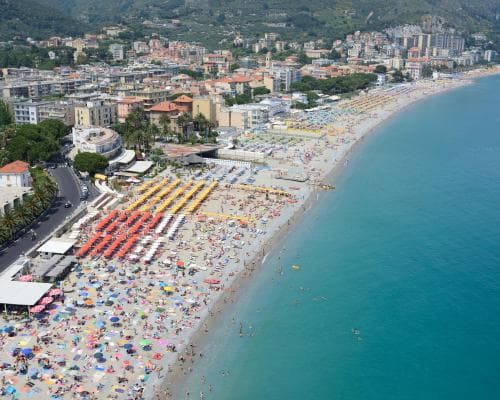
The first thing you notice about Bagni Gino Garrone is the quiet. Not the silence of a library, but the hush of a place where time has slowed to the rhythm of the waves. Here, on a 50-metre stretch of sand in Spotorno, a Ligurian village perched between the sea and the olive terraces, the loungers are arranged with a care that suggests devotion. And that is no accident. For nearly eight decades, this beach has been run by the Suore di Carità di Santa Maria—a small order of nuns who have turned sunbathing into an act of charity. But now, the local council wants it back, and the sisters are not going gently into that good night.
The dispute, which local papers have cheekily dubbed “a holy war,” began when Spotorno’s mayor, Mattia Fiorini, informed the nuns that their concession would be reclassified as a “free equipped beach” and put out to public tender. The reason? A tangle of EU directives and regional laws designed to break the monopoly of private beach clubs along Italy’s coastline—a battle that has seen billionaires, hoteliers, and now nuns, caught in the crosshairs. The sisters, who have operated the club since 1946, were once exempt from commercial rules because their profits funded an infant school and a summer camp for children. But that exemption, the mayor argued, no longer exists. The beach must go to the highest bidder.
Sister Miranda, an octogenarian with the gentle steel of someone who has prayed through worse, confronted the mayor at a public debate. “It’s ours,” she said, as quoted in Corriere della Sera. “Why does the municipality want to take away our beach? If they do, we won’t even be able to keep the school running.” Her words landed like a stone in still water. In a country where beach clubs are often run by families who treat their patch of sand like a fiefdom, the nuns are an anomaly: they charge for loungers and umbrellas, yes, but every euro goes to feed a child or keep a classroom open. For the traveler who has lounged on their deckchairs, the experience is not just about the bronzed skin and the gelato; it’s about the feeling that you are part of something larger—a community, a tradition, a promise.
The stakes here are not merely legal. They are existential. Italy’s coastline is a stage for a slow-motion drama about who owns beauty. The EU’s Bolkestein Directive, designed to open up services to competition, has forced a reckoning with the 30,000 or so private concessions that occupy much of the country’s best sand. For years, these clubs have operated in a legal gray zone, renewing permits automatically and often paying token fees. The nuns, who have never been in it for profit, are collateral damage in a war they never chose to fight. And yet, their fight is a mirror of a larger truth: the things we treasure most—a quiet cove, a familiar face, a sense of belonging—cannot be put out to tender.
For the affluent traveler, Spotorno is not a name that rolls off the tongue like Portofino or the Cinque Terre. It is a quieter, more authentic corner of the Ligurian Riviera, where the locals still argue about the weather and the nuns run the beach. The irony is that this very authenticity is what makes it so valuable. As the super-rich flock to ever-more-private islands and hyper-curated resorts, the nuns of Spotorno offer something rarer: a place that feels real. The sand is not imported from the Caribbean; the umbrellas are not designer; the water is the same Ligurian blue that has inspired poets for centuries. What the nuns sell is not luxury, but something more precious—the sense that you are a guest, not a customer.
If the council wins, the beach will likely be leased to a commercial operator who will charge more, offer more, and care less. The school will close, the summer camp will vanish, and the nuns will be left to pray for a different kind of miracle. But this is not just a local tragedy. It is a warning to anyone who loves Italy’s coast: the forces of homogenization are coming, and they do not discriminate between a nun and a tycoon. The next time you sip an Aperol Spritz on a sun-warmed terrace, remember that the woman handing you the towel might be fighting for more than her livelihood—she might be fighting for the soul of the place itself.
Where do the wealthy go next? Not to the obvious places, but to the ones that still have a story to tell. Spotorno, with its nuns and its stubbornness, is exactly that. For now, the beach is still open, the loungers are still out, and Sister Miranda is still watching the horizon. If you go, bring a book, leave a donation, and perhaps say a small prayer that the holy war ends with the sisters still in charge. Because once the nuns are gone, the sand will still be there, but the magic will have quietly slipped away.