The New Highland Ritual: Paying Homage to Scotland’s Wildest Peaks
A two-day volunteering stint with the Outdoor Access Trust for Scotland turns a summer escape to Wester Ross into an intimate act of stewardship—where the ultra-wealthy trade their usual indulgences for the quiet currency of giving back to the land. On the flanks of Stac Pollaidh, the luxury is not in what you take, but in what you leave behind.
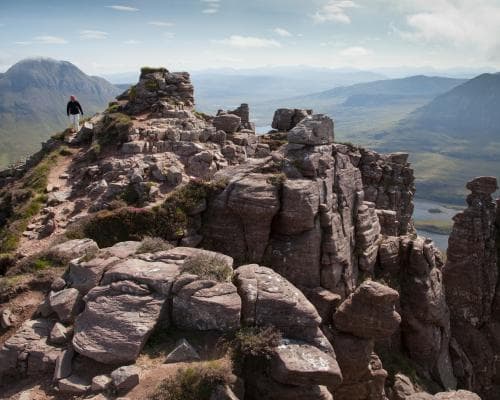
The light was doing that thing it only does in the far north-west of Scotland—slanting gold and honeyed across the lochans, catching the quartzite teeth of Stac Pollaidh as if the mountain were a cathedral lit for evensong. I was ankle-deep in blanket bog, my back bent, a heavy-duty mattock in my gloved hands, and I had never felt more alive. This was not the Highlands of castle tours and whisky flights, nor the carefully curated wilderness of a five-star bothy with a private chef. This was the Highlands as a working relationship—a place you tend, not just visit.
I had come to Wester Ross with a bucket and spade, not for the postcard beaches of Achmelvich or Clachtoll, but with the notion of giving something back to the hills. The Outdoor Access Trust for Scotland (OATS) is the quiet steward of many of the country’s most iconic mountains—building, repairing, and reviving the paths that carry thousands of feet each year. I joined a small group of volunteers for two days on the north-west Highlands’ most visited peak, swapping the usual summer itinerary of sea kayaking and bothy nights for something more elemental: the slow, meditative work of lifting stone, unblocking drains, and repacking paths so the next walker’s journey is a little easier, and the land a little less scarred.
There is a particular intimacy in this kind of labour. As I cleared a cross drain and repacked it with fresh stonework, a trickle of water began to run—clear and bright across the sparkling bedrock—and I felt a strange, almost reverent satisfaction. It was like appreciating a masterwork in a museum, but one I had helped restore. Farther up the hillside, another volunteer was cutting a deep brown scar into the moor grass, rerouting a path to prevent erosion. We worked in companionable silence, the only sounds the squelch of peat and the distant call of a curlew. This is the new luxury of the Highlands: not a private estate or a heli-ski drop, but the rare privilege of leaving a place better than you found it.
OATS has long been the guardian of Scotland’s most famous mountains—An Teallach, Lochnagar, Braeriach—and this summer, the trust has turned to voluntourism as its primary engine of restoration. For the traveller who has already skied the Alps, sailed the Galápagos, and trekked to Everest Base Camp, there is a growing appetite for something more meaningful: a holiday that gives back. The stay is simple—a free bed at Ullapool youth hostel, a home-cooked communal meal, and the promise of a midge-free forecast—but the experience is priceless. It is a masterclass in slow travel, where the reward is not a stamp in a passport but the deep, bone-tired satisfaction of a day’s honest work.
This is not the luxury of excess; it is the luxury of purpose. For the ultra-wealthy, the Highlands have long been a playground—for grouse shooting, salmon fishing, and the quiet acquisition of vast estates. But a new generation of travellers is seeking a different kind of ownership: not of the land, but of its care. They are swapping the private chef for a shared pot of stew, the five-star suite for a bunk bed, the concierge for a ranger. And in doing so, they are discovering a deeper connection to place—one that cannot be bought, only earned.
As the sun dipped below the horizon, painting the sky in shades of rose and amber, I stood back and looked at my handiwork. The path was clearer, the drain flowing, the bog a little less sodden. I felt a quiet pride, the kind that comes from knowing you have contributed to something larger than yourself. The Highlands have always rewarded those who respect them; now, they are rewarding those who restore them. For the traveller in search of the next frontier, this is it—not a new destination, but a new way of being there. And as I drove south the next morning, the hills glowing in my rearview mirror, I knew I would be back, mattock in hand, ready to give again.