The Kailash Pilgrimage Risk: How Adventure Travel's Hidden Liabilities Are Reshaping Wealth Planning
A flash flood on the Nepal-Tibet border has swept away 15 Australian pilgrims, exposing the uninsured tail risks of high-altitude spiritual tourism and forcing wealthy families to rethink how they underwrite their most personal journeys.
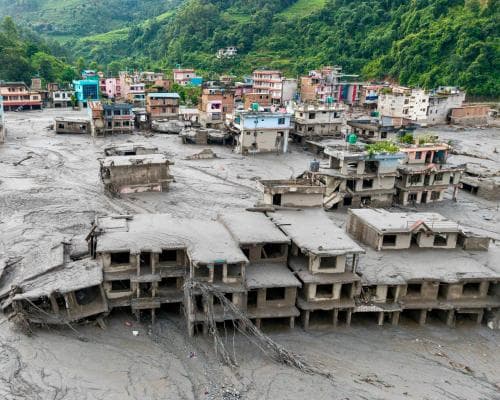
The phone call every wealthy family dreads came on a Wednesday morning in New South Wales, not from a broker or a banker, but from a Himalayan river that had turned murderous overnight. Venkatraman Balakrishnan, 52, and his wife, Chitra Venkatraman, 46, were meant to be leaving their riverside lodge in Syabrubesi for the final leg of a Mount Kailash pilgrimage. Instead, the floodwaters arrived first. Their son, Akash, lost contact with them yesterday. He is now one of dozens of family members across Sydney's Indian-Australian community refreshing satellite feeds, calling consulates, and praying for a miracle that may never come.
This is not a story about a stock market crash or a bond yield spike. It is about a far more primitive form of capital destruction: the sudden, violent erasure of human wealth that no portfolio diversification can hedge. The missing group — 15 Australians, aged 11 to 64, all connected through the Australia Bharatha Brahman Samajam religious organisation — were on a spiritual tour operated by Himalayan Glacier Trekking, a Kathmandu-based firm whose founder, Sagar Pandey, has lost all contact with his 47-person group. The flood hit Syabrubesi, a gateway town on the Nepal-Tibet border, with no warning. One minute, the pilgrims were packing for a sacred mountain. The next, they were part of a disaster statistic.
For the wealth desk, the numbers here are not in billions but in the far more telling currency of unquantifiable loss. The missing include a 52-year-old IT professional and his 46-year-old wife, both pillars of a Sydney community that has rallied around Akash with a ferocity that speaks to the social capital these families hold. Vasan Srinivasan, CEO of the Mental Health Foundation Australia and a leader of the same religious group, is using every government contact he has to track the missing. “They are great contributors to our community,” he told Guardian Australia, “and have assisted me with lots of my fundraising activities.” These are not tourists. They are donors, mentors, and volunteers. Their disappearance is a direct hit to the philanthropic balance sheets of at least two Australian foundations.
The financial mechanics of this tragedy are brutally instructive. Adventure travel to places like Mount Kailash — a peak considered sacred by Hindus, Buddhists, and Jains — has grown into a niche but lucrative market, with operators charging premium rates for logistics that include river crossings, mountain passes, and border permits. But the insurance and liability structures for such trips are notoriously opaque. Most standard travel policies exclude high-altitude trekking above 5,000 meters, and even dedicated adventure policies often carry exclusions for “acts of nature” like flash floods. The result is a gap between what wealthy families think they are covered for and what they actually are. In this case, the tour operator, Himalayan Glacier Trekking, is a respected firm, but its liability is likely capped at a fraction of the human and financial cost now unfolding.
For the families of the missing, the immediate concern is not money — it is finding bodies, or survivors, in a landscape where the river has already swept away roads, bridges, and any trace of a 47-person group. But for the broader community of high-net-worth individuals who fund such pilgrimages, this is a wake-up call. The same families who meticulously structure trusts, hedge currency risk, and diversify across asset classes are often cavalier about the risks they take with their own bodies in pursuit of spiritual meaning. A pilgrimage to Kailash is not a beach vacation. It is a multi-day journey through some of the most geologically unstable terrain on Earth, where monsoon rains can turn a gentle stream into a 20-foot wall of water in minutes.
What does this signal for markets? Not in the traditional sense — no ticker will move on this story. But for the wealth management industry, it signals a growing demand for “life logistics” services: emergency evacuation plans, satellite communication rentals, and bespoke insurance policies that cover acts of God in high-risk zones. UHNW families are increasingly hiring risk consultants to vet every leg of their travel, from the helicopter ride to Lukla to the riverside lodge in Syabrubesi. This tragedy will accelerate that trend. Expect to see more family offices building “travel risk” clauses into their operating agreements, and more insurers offering parametric policies that pay out automatically when a flood or earthquake hits a specific coordinate.
For now, the community waits. Akash Venkatraman has made a decision that is both stoic and heartbreaking: “I’m focused on continuing as normal as worrying will get me nowhere.” That is the mentality of a man who understands that panic is a wasted asset. But for the rest of us, the lesson is darker and more immediate. The wealth you build can be lost in a second, not to a market correction, but to a river you chose to sleep beside. The smartest capital in the world is not the kind that grows — it is the kind that survives. And survival, as these 15 families are learning, begins long before you board the plane.