The Golden Gilt: Trump's $1 Coin and the Art of Legal Ambiguity
A numismatic provocation wrapped in gold-tone alloy, the new $1 coin bearing Donald Trump's scowling visage turns constitutional taboo into collectible kitsch. For the connoisseur of power, it is less currency than a bronze-age monument to the transactional presidency.
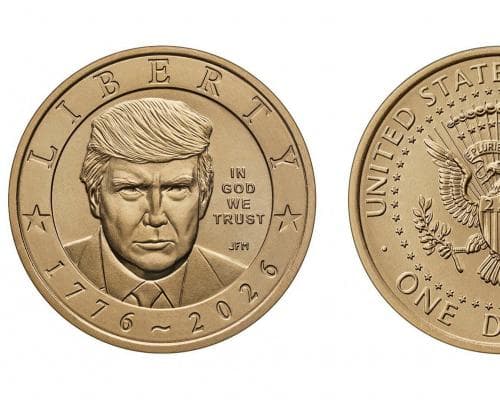
There is a moment, in every great collector's life, when the object of desire arrives with a whiff of the forbidden. The new $1 coin from the United States Mint, released to mark the nation's 250th anniversary, offers exactly that frisson. Its face bears the unmistakable scowl of the 45th and 47th president, a living man on legal tender—a breach of a tradition so old that George Washington himself, when offered a coin bearing his image in the late 1700s, demurred with the modesty of a patrician who knew that monarchy's trappings were the one thing the republic could not abide. Trump, of course, is no Washington. And so we have a coin that is legal, unless it is not, which is precisely what makes it irresistible.
The coin itself is a study in deliberate contradiction. It looks gold, but it is not. Beneath its gilded sheen lies a base of zinc, manganese, nickel, and copper—a recipe that would make a Florentine goldsmith weep and a modern marketing director grin. The Mint will strike some nine million of these coins, each one a miniature billboard for the brand that now occupies the Oval Office. At $61 for a roll of 25, the premium over face value is a wink to the collector: this is not money in any practical sense, but a token of an era, a relic of a presidency that has made the word 'unprecedented' feel almost quaint.
The legal gymnastics are part of the allure. The 1866 statute forbidding the portrait of a living person on currency is clear enough, but clarity has never been the coin of this realm. Treasury Secretary Scott Bessent has argued, with the straight face of a man who knows the court of public opinion matters more than the court of law, that since Calvin Coolidge's face graced a coin during the 150th anniversary celebrations, Trump's can grace the 250th. The precedent is shaky—Coolidge's coin was a commemorative medal, not legal tender—but in the age of alternative facts, who is to say? The Mint's own website describes the coin as 'honoring 250 years of great American heritage,' a phrase so broad it could cover a toaster if the toaster were made by the right people.
For the serious collector, the coin raises questions that go beyond mere legality. What does it mean to own a piece of currency that is simultaneously official and, in the view of many constitutional scholars, unlawful? The answer, as with so much in the Trump era, is that the object's value lies precisely in its ambiguity. A coin that is legal tender but not quite legal, that is gold but not gold, that honors heritage by flouting it—this is a perfect synecdoche for the second term. The market, as ever, will decide. Early listings on auction sites suggest a brisk trade, with rolls changing hands at multiples of the face value, driven not by numismatic rarity but by political appetite. For the MAGA collector, this is a relic of the movement. For the connoisseur of irony, it is a darkly comic artifact. For the historian, it is a warning.
The tradition of keeping living faces off money was never about aesthetics. It was about the principle that no man, however powerful, should be confused with the state itself. Washington understood this. Coolidge, to his credit, accepted only a commemorative medal, not a coin. Trump, in a single stroke, has collapsed that distinction, minting his own image into the pocket change of 330 million people. The signal to the luxury market is unmistakable: in this era, the ultimate status symbol is not a watch or a yacht, but the state itself, rendered in base metal and sold back to the public at a premium.
What comes next? If the coin sets a precedent, we may see living presidents on bills, on stamps, on the side of Air Force One. The 1866 law may be amended, or ignored, or reinterpreted by a compliant court. For now, the $1 Trump coin sits in a strange limbo, a numismatic unicorn that is both legal tender and legal fiction. For the collector who owns it, the pleasure is not in the metal, but in the message. This is a coin that says, without a word, that the rules are what the powerful say they are. And that, in the end, is the most luxurious thing of all.