The Glass Cathedral’s Last Stand: Kew’s Palm House Prepares for a Daring Resurrection
As Kew Gardens races to save its iconic Victorian Palm House, some of its most beloved trees must fall — a poignant prelude to one of the most ambitious botanical restorations of our time. For the discerning traveler, this is a rare chance to witness history, loss, and renewal unfold behind the scenes of the world’s greatest living plant collection.
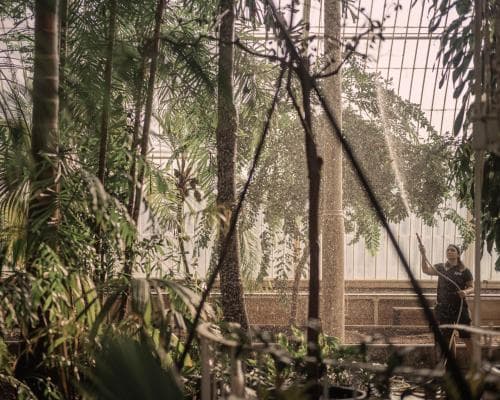
There is a particular hush inside the Palm House at Kew Gardens, a silence that feels almost sacred beneath the soaring arches of wrought iron and glass. For 180 years, this cathedral of botany has held its breath, sheltering palms that brush the sky, cycads older than the building itself, and orchids so rare they exist nowhere else on Earth. But now, that hush is breaking. By 2027, the great glasshouse will undergo a renovation so profound that some of its most magnificent inhabitants will have to be sacrificed — felled, not by storm or disease, but by the very urgency of saving the home they share.
Will Spoelstra, the Palm House manager, knows every frond and fissure of this place. When he speaks of the coming months, his voice carries the weight of a man about to lose old friends. “There are some sad moments ahead,” he admits, standing beneath the very trees that will soon be cut down. The giant palms, whose crowns have pressed against the roof for generations, are not portable. Their roots are too deep, their trunks too fragile to survive a move. And so, they will be removed, their absence leaving voids of light where their shadows once pooled. It is a gut-wrenching reality, but one that Spoelstra faces with a gardener’s pragmatism and a curator’s reverence.
The urgency is real. The ornate ironwork that gives the Palm House its lace-like silhouette has rusted from within, and the 16,000 panes of glass — each one warped by decades of London weather — can no longer hold the steamy, tropical climate that its plants depend on. For Kew, which holds the world’s most comprehensive living plant collection, this is not merely an aesthetic crisis. Some of the species inside are critically endangered, and for a handful, Kew possesses the only known specimens on the planet. Losing them would be an irreplaceable blow to global biodiversity. The renovation, scheduled to begin in 2027 if funds are raised in time, is a race against decay — and against extinction.
While the work is underway, the Palm House will remain open, a ghost of its former self with empty beds and bare soil. Spoelstra confesses that he sometimes walks to where a favorite plant once stood, only to find a blank space. “It’s a shame to see the empty beds,” he says quietly. The displaced plants have been moved to a behind-the-scenes tropical nursery, a secret greenhouse that now resembles the Palm House in miniature. There, they will acclimate to new conditions before making the journey back — a process that Spoelstra describes with a knowing smile: “Most plants will sulk for a bit when they’re moved.” Meanwhile, Kew’s scientists are collecting seeds and cuttings, banking genetic futures in a quiet act of hope.
For the luxury traveler, this moment offers something far richer than a standard garden tour. It is a backstage pass to conservation in action — a chance to see the meticulous, often heartbreaking work that goes into preserving our planet’s botanical treasures. Private viewings can be arranged through Kew’s Patrons’ Circle, offering access to the tropical nursery and conversations with the horticulturalists who know each plant by name. It is an experience that money alone cannot buy, though membership starts at a few thousand pounds a year — a small price for the privilege of witnessing history’s delicate hinge.
This is the new frontier of luxury travel: not just seeing the world’s wonders, but understanding the fragile ecosystems that sustain them. The ultra-wealthy are no longer content with five-star resorts and private islands; they crave meaning, access, and the chance to be part of something larger than themselves. Kew’s Palm House renovation is a case in point — a destination that offers both beauty and purpose, where the rarest commodity is not gold or silk, but knowledge. And as the glasshouse is reborn, those who visit now will have a story to tell: they were there when the palms fell, and they returned when the new ones rose.
What comes next for the discerning explorer? The Palm House will rise again, its ironwork restored, its glass gleaming, and new plants — propagated from the very specimens that survived — filling the air with green. But for now, there is a poignancy in the air, a sense of witnessing an ending that is also a beginning. For those who understand that true luxury lies in rarity, a visit to Kew in these final years before the renovation is an invitation to be part of a singular, fleeting chapter. As Spoelstra puts it, with a mixture of sorrow and anticipation, “It’s an exciting project. But we are going to lose some really nice specimens.” And in that loss, there is a profound beauty — one that only those who look closely will ever see.