The Art of the Long Ride: Tadej Pogacar’s Private Pyrenees Exhibition
In the high passes of the Pyrenees, Tadej Pogacar turned a brutal Vuelta a España stage into a masterclass in controlled dominance, a spectacle for the few who understand the poetry of pain. This is luxury travel as witnessed from the roadside — where the only currency is watts and the view is a moving masterpiece.
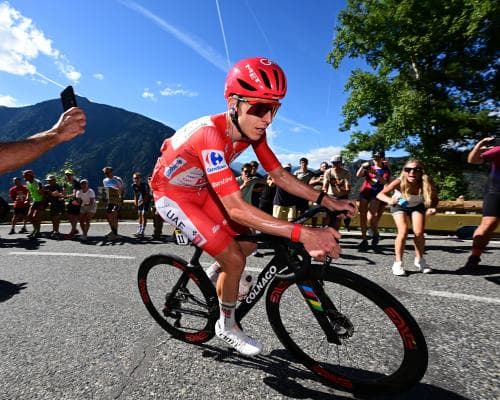
There is a moment in every grand tour when the race stops being a race and becomes a work of art. On Tuesday, on the road to Andorra la Vella, Tadej Pogacar painted that picture in the high Pyrenees, attacking with 50 kilometres still to climb and reducing the peloton to a distant, gasping chorus. For the discerning traveller who has traded the Riviera for the ramparts of the mountains, this is the real theatre of the ultra-wealthy: not a box at the opera, but a perch on a hairpin bend, waiting for the flutter of a Slovenian jersey to signal the beginning of the end.
Pogacar’s victory was not merely a win; it was a declaration of intent, a private exhibition of the body’s limits and the mind’s resolve. He had arrived in red, the leader’s jersey, but he wore it like a crown, not a burden. The stage began with the usual cat-and-mouse over the Port d’Envalira, where the breakaway’s hopes were as thin as the alpine air. Then, with the nonchalance of a man choosing a wine from a cellar, he surged clear on the Collada de Beixalis. By the summit, his lead was 1 minute 30 seconds over a chasing group that included the likes of Primož Roglič and Enric Mas. The final ascent was a procession, a three-minute gap that felt like an eternity, a solo ride into the capital of the Pyrenees that ended with a time of 2 hours 40 minutes and 35 seconds.
For the traveller who follows the grand tours not as a spectator but as a connoisseur, the appeal is in the access. Imagine hiring a private helicopter to land on a quiet stretch of the descent, or a chauffeured 4x4 that weaves through the team buses to deposit you at the summit just as the race’s true action unfolds. The hotels in Andorra la Vella, from the sleek, glass-fronted Sport Hotel to the rustic charm of a mountain refuge, become temporary palaces for those who understand that the real luxury is proximity to greatness. The air is thin, the coffee strong, and the conversation is all about watts and gradients — a language that transcends borders.
The rarity of this moment is not lost on those who know their cycling history. Pogacar’s only previous Vuelta appearance was seven years ago, a mere cameo in a career that has since been defined by Tour de France dominance. To see him return, at the height of his powers, is to witness a once-in-a-generation talent at the peak of his craft. The price of admission is not a ticket, but a willingness to embrace the grind — to stand on a mountain pass for hours, shivering in the wind, just to see a flash of red and white for 30 seconds. For the ultra-wealthy, that is the ultimate indulgence: time, patience, and the thrill of being there when history is made.
This is what luxury travel has become for the new guard of high-net-worth adventurers. It is no longer about passive beach lounging or five-star buffets; it is about curated experiences that offer a visceral connection to the extraordinary. The Vuelta, with its brutal climbs and unpredictable weather, is the antithesis of comfort, yet it draws a crowd that could afford anything else. They come for the drama, the human endurance, and the sheer spectacle of a man like Pogacar turning a mountain into his own private stage. It is a reminder that the most opulent journeys are often the ones that challenge us, that leave us breathless, that make us feel alive.
As the race moves on, the question is where the wealthy will go next. The answer, perhaps, is to the Alps in July, or to the gravel roads of Tuscany for the Strade Bianche, or even to the cobbles of Paris-Roubaix. But for now, the Pyrenees have had their moment, and Pogacar has given the world a lesson in the art of the long ride. For those who were there, it was not just a stage win; it was a memory to be savoured over a long dinner, a story to be told with the kind of reverence usually reserved for old masters. And for those who missed it, there is always next year — but it will not be the same. Nothing ever is.