The $2M Band-Aid: What Nepal's Flood Disaster Says About the Cost of Climate Risk
As catastrophic floods kill 359 and leave 1,300 missing in Nepal and Tibet, the UN's initial $2M aid allocation underscores a harsh truth for wealth builders: climate disasters are becoming more frequent, more destructive, and far more expensive to insure, rebuild, and hedge against. For global capital, the region's tragedy is a stark reminder that infrastructure risk is now a portfolio risk.
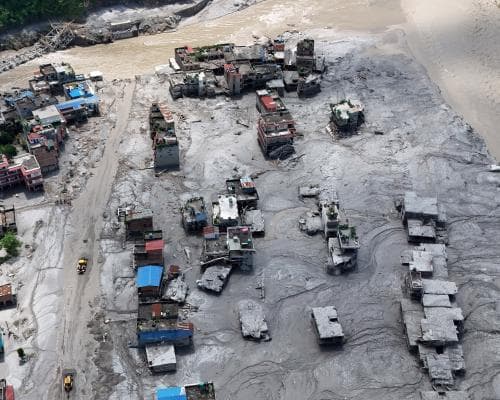
When a wall of water — thick with mud, boulders, and the debris of entire villages — thundered down the Himalayan valleys on Wednesday, it didn't just wipe out bridges and roads. It wiped out the illusion that remote, mountainous regions are somehow insulated from the financial shockwaves of climate change. The death toll is at 359 and climbing, with 1,300 people missing, including tourists from India, the US, Britain, Australia, and Canada. But for the world's wealth managers, the real story isn't just the human catastrophe — it's the brutal math of disaster response in an era when the climate is rewriting the rules of risk.
The numbers are staggering, and not in a good way. The UN's humanitarian chief, Tom Fletcher, called the flood "horrifying" and mobilized emergency teams. But the initial allocation — $2 million — is a rounding error in the world of global capital. It's less than the cost of a modest Manhattan co-op. It's a fraction of a single high-net-worth individual's annual insurance premium. And yet, that's what the international community is offering to cover emergency medical care, shelter, and water for hundreds of thousands of affected people. The gap between the scale of the disaster and the scale of the response is a stark reminder that our financial infrastructure is just as unprepared as the physical infrastructure it's meant to protect.
Consider the mechanics of this particular disaster. A lake formed at the site of the flood is now swelling and at risk of bursting — a glacial lake outburst flood (GLOF), in the technical jargon. These are not rare events anymore. As glaciers melt at unprecedented rates, they leave behind unstable lakes that can breach without warning, sending billions of gallons of water cascading down valleys at speeds that make evacuation impossible. The power and speed of Wednesday's flood gave people no time to escape. Trucks were overturned like toys. Houses, roads, and power plants were swept away. In Tibet, officials fear "major casualties" after a mudslide hit a border crossing. And with 25 miles of roads and dozens of bridges destroyed, rescue teams are finding bodies hundreds of miles downstream, in Nepal's Chitwan district, near the Tibetan border.
For the wealthy, this is not a distant humanitarian tragedy — it's a preview of coming risk. The same forces that make these floods deadly are making infrastructure investments, supply chains, and even real estate in mountain regions increasingly volatile. The tourists missing in the disaster zone are not just backpackers; they're a reminder that adventure travel — a luxury market worth billions — is now operating in a zone of heightened physical risk. Insurance premiums for such regions are already climbing, and after this event, they'll climb faster. The cost of rebuilding roads, bridges, and power plants in Nepal will run into the hundreds of millions, if not billions. And who pays? Not the UN with its $2 million check. Not the tourists' travel insurance. The bill lands on the local economy, on global aid budgets, and ultimately on the portfolios of investors in emerging-market infrastructure funds.
There's a deeper capital angle here, too. The disaster is happening in a region that has become a flashpoint for Chinese and Indian infrastructure investment. Tibet is part of China, and Nepal sits between the two Asian giants. The destruction of border crossings and power plants isn't just a local tragedy — it's a disruption to regional trade and energy flows. For investors, this is a real-time stress test of how climate shocks can undermine geopolitical investments. The $2 million from the UN is a drop in the bucket compared to the billions already sunk into Himalayan infrastructure projects. And if the lake at the flood site bursts, as authorities warn it could, the damage will be even worse. The cost of inaction is not just measured in lives, but in the stability of regional markets.
So what does this mean for the world's smartest capital? It means that climate risk is no longer a niche ESG concern. It's a hard, quantifiable threat to assets, from Alpine ski resorts to Andean mining operations to Himalayan trekking routes. The wealthy are already moving — not out of concern, but out of self-interest. They're diversifying into climate-resilient infrastructure, hedging with catastrophe bonds, and re-evaluating any exposure to regions where glacial lakes are growing. The tragedy in Nepal is a wake-up call, but it's also a market signal. The next time you see a headline about a flood or a wildfire, ask yourself: how much capital is being destroyed, and how much is being repositioned? The answer will tell you where the smart money is heading — and it's not toward the next disaster zone.
The forward-looking play here is not just about philanthropy. It's about recognizing that the world's most beautiful and remote places are now its most volatile. For the ultra-wealthy, that means the cost of adventure, the cost of infrastructure, and the cost of insurance will all rise. The $2 million from the UN is a symbol of how underfunded our global response is. But for those who can read the tea leaves, it's also a signal: invest in resilience, not just recovery. The lake is still rising. The question is whether global capital will rise with it — or be swept away.