The 1,000-Metre-Deep Salad: Inside the World's Most Unlikely Fine-Dining Source
Deep beneath the Yorkshire moors, scientists are cultivating pristine pak choi and lettuce in a disused mine, reimagining the future of ultra-fresh, hyper-local produce. For the luxury traveller, this subterranean farm is the next culinary pilgrimage — a place where the rarest ingredient isn't truffle or caviar, but soil itself.
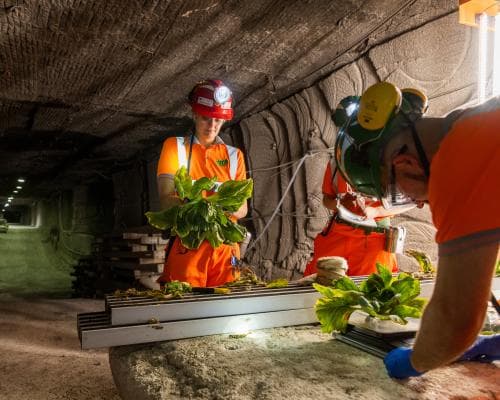
Imagine descending a thousand metres into the earth, the lift humming like a spaceship, the air growing cool and still. You emerge into a cavern lit by the violet glow of LED panels, where neat rows of emerald pak choi and delicate lettuce leaves unfurl in perfect, climate-controlled silence. It feels less like a farm and more like the set of a Bond film — minus the death laser. This is the world's deepest underground farm, hidden inside the working Boulby mine in North Yorkshire, and it is quietly rewriting the rules of where our food comes from — and, for the discerning traveller, where the next great culinary destination might be.
The project, led by University of Sheffield research fellow Jacob Nickles, is not a gimmick. It is a serious answer to a pressing question: how do we feed a planet of 10 billion by 2050 when the surface is burning, flooding, and failing? As Nickles puts it, "We need to double food production by 2050. That is the long and the short of it. Is it possible? Maybe if we start using mines." The urgency is no longer theoretical. This year's brutal European summer has already withered crops and forced livestock onto winter feed. The crisis, he says, "is less looming — it's here, now." But for the luxury traveller, this subterranean experiment offers something more immediate: a chance to witness the future of gastronomy before it reaches the menus of Michelin-starred restaurants.
Boulby is not your average mine. It is the world's only commercial source of polyhalite, a mineral used in fertiliser, and it houses a government-funded science facility where physicists hunt for dark matter. Driving through the ICL-UK site, past towering machinery and workers in hi-vis, you reach the unassuming entrance to this underground Eden. The farm itself is a prototype — a series of stacked trays under purple LEDs, where temperature, humidity, and light are tuned to perfection. The team is testing whether the mine's stable environment and existing infrastructure can slash the crippling energy costs of conventional vertical farming, which typically relies on vast amounts of electricity to simulate sunlight. Here, deep underground, the earth itself provides insulation, and the result is a crop that grows faster, cleaner, and with a fraction of the carbon footprint.
For the ultra-wealthy, rarity is the ultimate currency, and this farm is the rarest of all. It is not open to the public — access is strictly limited to researchers and, occasionally, curious journalists. The produce is not yet for sale, but when it is, imagine the allure: a salad grown a kilometre beneath the Yorkshire moors, harvested by hand in a cavern that once held ancient minerals. It is the culinary equivalent of a limited-edition timepiece — not because it tastes different, but because of the story it tells. The team is racing against the clock, gathering evidence to prove the concept can scale. "We need to show it works," Nickles says, and the pressure is palpable.
This is not just about food security; it is a signal of where luxury travel is heading. The affluent no longer want just a private chef or a vineyard tour — they want provenance with a plot twist. They want to eat where no one else has eaten, to touch the source, to feel the chill of a mine shaft on their skin before tasting a leaf that has never seen sunlight. Subterranean dining is already a niche — from the salt mines of Austria to the cheese caves of Missouri — but this project elevates it to a new level. It is agriculture as adventure, science as spectacle, and sustainability as the ultimate status symbol.
So where do the wealthy go next? Not to a rooftop in Dubai or a private island in the Maldives, but down. Down into the earth, where the air is thin and the possibilities are vast. The Boulby farm may be a prototype, but it points to a future where the most exclusive reservation is not at a three-star restaurant in Paris, but a thousand metres below the North Sea coast, where the salad is crisp, the story is extraordinary, and the only light is the glow of a future being born.