From the No. 7 Train to Center Court: Michael Zheng’s Full-Circle Triumph at the U.S. Open
Columbia University’s two-time NCAA champion Michael Zheng turns a childhood commute into a triumphant U.S. Open debut, dispatching world No. 63 Fabian Marozsan on the very courts where he once trained. A story of grit, homecoming, and the quiet power of belonging.
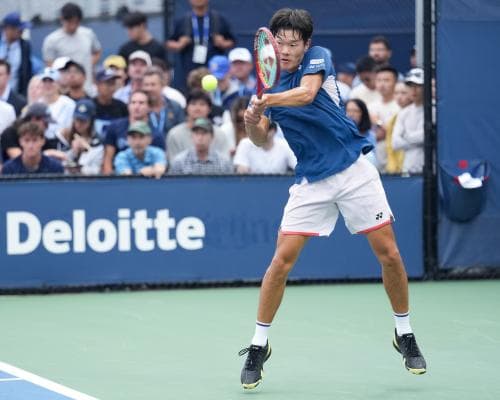
There is a particular kind of romance in returning to the place where you first dreamed, only to find the dream has already begun to outgrow you. For Michael Zheng, that place is the USTA Billie Jean King National Tennis Center in Queens — a sprawling cathedral of hard courts and corporate hospitality that, for most of his young life, was simply home. On a rainswept Wednesday afternoon, the 22-year-old wildcard from Montville, New Jersey, walked onto Court 10 and, in just under two hours, dismantled Hungary’s Fabian Marozsan, 6-4, 6-4, 6-2, to claim his first main-draw victory at the U.S. Open. The scoreline was emphatic, but the true story was written in the journey — a decade of bus rides and subway transfers that turned a far-flung tennis dream into a lived reality.
Zheng’s path to this moment was never the one laid out in glossy academies or private jets. As a 10-year-old, he would leave school early, his mother collecting him for the two-hour commute from northern New Jersey — first a bus across the Hudson to the Port Authority, then the full length of the No. 7 line, that rattling artery of Queens that spits out tennis pilgrims at the gates of the National Tennis Center. It was a ritual repeated several times a week, a grind that might have broken lesser spirits. But for Zheng, the destination was never a chore; it was a sanctuary. “This is a place I grew up training,” he said afterward, his voice carrying the weight of memory. “It was one of the first places that I kind of called home base.”
Wednesday’s match was a masterclass in controlled aggression — a quality that has become Zheng’s signature since he claimed back-to-back NCAA titles at Columbia, a program he helped elevate to national prominence. Against Marozsan, a player 40 places his senior in the world rankings, Zheng broke serve five times, dropped his own just once, and fired 33 winners against a mere 17 unforced errors. His first serve was nearly untouchable: 92.3 percent of points won behind it, a statistic that speaks less to power and more to precision — the kind of ruthless efficiency that comes from years of hitting the same lines until they feel like old friends. The crowd, a boisterous pocket of Columbia blue and white, chanted his name with the fervor of a college pep rally, and Zheng fed off it. “It just felt like a college tennis match, really,” he said, grinning. “I’m not sure my opponent was ready for it.”
For the uninitiated, Zheng’s story is a refreshing counterpoint to the factory-line production of modern tennis talent. He is not the product of a tennis brothel in Barcelona or a Florida academy with a waiting list of oligarchs. He is the product of public courts, collegiate discipline, and a mother’s willingness to sit in traffic so her son could chase a ball. His rise through the ranks — from junior standout to Ivy League champion to U.S. Open wildcard — has been marked by a quiet tenacity that feels almost anachronistic in an era of early specialization and sports psychology consultants. His game, a blend of court craft and first-strike aggression, is a testament to the virtues of patience and adaptability, qualities that have made him a darling of the American tennis press and, increasingly, of the sport’s tastemakers.
In the broader context of this year’s U.S. Open, Zheng’s victory was one of several bright spots for the American contingent on a day when the home side flexed its depth. But his win carried a particular resonance, not just for the personal narrative, but for what it signals about the changing geography of American tennis. The sport’s traditional power bases — California, Florida, Texas — are being challenged by a new generation of players forged in colder climates and unconventional routes. Zheng, with his Ivy League pedigree and his affinity for the No. 7 train, embodies this shift. He is a player who has chosen the long road, the one that runs through college campuses and public parks, and in doing so, he has reminded us that excellence is not always born in the most obvious places.
As the rain clouds gathered over Flushing Meadows and the lights flickered on Court 10, Zheng’s victory felt less like a debut and more like a homecoming. He had returned to the courts where he once hit balls against a wall as a boy, now a man with a ranking, a reputation, and a place in the second round. The journey from Montville to this moment was not a straight line — it was a series of buses and trains, of early mornings and late nights, of sacrifices made by a family who believed in a dream. And as Zheng walked off the court, waving to the crowd that had adopted him as one of their own, it was impossible not to feel that this was only the beginning. The No. 7 train still runs, but for Michael Zheng, the destination has changed. He is no longer coming to learn. He is coming to win.