The Algorithmic Tipping Point: Gig Workers Are Fighting Back Against the AI That Pays Them
Food delivery riders in Edinburgh are demanding transparency from Deliveroo, Uber Eats, and Just Eat, saying AI-driven algorithms have quietly cut their pay and worsened conditions. Their grassroots campaign to open the 'black box' could redefine the power balance between platform capital and the gig workforce.
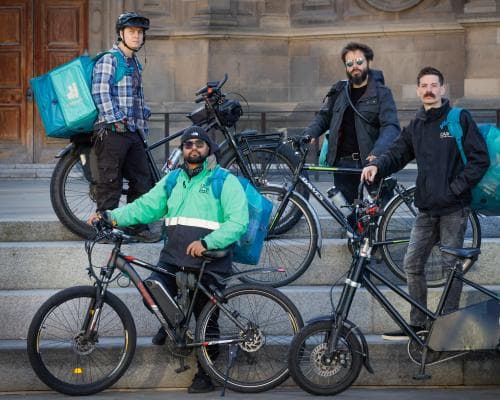
In Bristo Square, Edinburgh, a group of riders lean against their bikes, insulated bags still warm from the dinner rush. They are not here to swap routes or complain about the weather. They are here to dissect a ghost: the algorithm that decides who gets an order, how much it pays, and whether they eat tonight. David, a seven-year veteran of the city's food delivery scene, puts it bluntly: "I am making half the money I was making four years ago, for the same amount of hours. It makes no sense." He is not alone. Across the square, riders nod in agreement — their pay has quietly eroded even as they pedal the same miles, deliver the same meals, and log the same hours. The culprit, they suspect, is the invisible hand of AI, now steering the platforms that dominate the UK and Ireland's gig economy: Deliveroo, Uber Eats, and Just Eat.
This is not a Luddite uprising. It is a data-driven counteroffensive. The riders have organized under the Workers' Observatory, a charity founded with academics from St Andrews and Edinburgh universities. Their mission is to reverse-engineer the algorithms that govern their labor — to turn a black box into a glass box. Xabier Villares, an eight-year rider and the observatory's lead organizer, describes the shift as "dramatic." The same platforms that once promised flexibility and fair pay for gigs have become opaque systems where pay rates fluctuate without explanation, and riders are left to chase phantom incentives. The group is collecting their own data — screenshots, timestamps, pay stubs — to build evidence of algorithmic wage suppression. It is a quiet, methodical rebellion against the most powerful force in modern labor management.
The stakes extend far beyond a few Scottish cyclists. This is the frontline of a broader war over who controls the code that allocates work in the 21st century. The platforms argue that their algorithms optimize efficiency — matching supply and demand in real time, reducing wait times for customers, and rewarding the most productive riders. But the riders see a different logic: one that subtly pushes pay down to the minimum needed to keep them on the road. The Workers' Observatory is not just collecting anecdotes; it is building a quantitative case. By logging thousands of deliveries, they can identify patterns — for instance, how pay per mile drops during peak hours when rider supply is highest, or how the algorithm seems to favor newer riders with lower base rates. This is the kind of evidence that could fuel legal challenges, regulatory scrutiny, and public pressure campaigns.
This battle is part of a larger, global reckoning. From Uber drivers in California to food couriers in London, gig workers are awakening to the fact that AI is not a neutral tool — it is a managerial system that can be as ruthless as any human boss, but far less accountable. The European Union's AI Act, which classifies certain algorithmic decisions as high-risk, is already forcing platforms to disclose more. The UK's Employment Rights Bill, currently winding through Parliament, could extend similar protections. But legislation moves slowly, and algorithms evolve faster. That is why the Workers' Observatory's approach is so potent: it equips workers with the tools to monitor their own exploitation in real time, creating a countervailing force to corporate data. They are not waiting for a judge or a regulator to act; they are building a worker-owned database of algorithmic behavior.
For the platforms, the threat is existential. If riders can prove that pay has been systematically cut via algorithmic tweaks, they could face class-action lawsuits, unionization drives, and a public relations nightmare. More importantly, transparency could erode their competitive advantage. The entire gig economy model relies on an information asymmetry: the platform knows everything, the worker knows almost nothing. Open the black box, and that asymmetry collapses. Riders could negotiate better rates, choose when to log on based on actual demand data, and even optimize their own routes to maximize earnings. The platforms would lose their ability to nudge, nudge, nudge workers into ever-more-precarious positions.
What happens next will set a precedent. If the Edinburgh riders succeed in forcing even one platform to disclose its pay algorithm, it will ripple across the sector. Investors are watching too — if the cost of labor rises or regulatory fines mount, the valuations of these companies, which have never been consistently profitable, could take a hit. But there is a deeper signal here: the rise of algorithmic literacy among workers. Just as factory workers in the 19th century learned to read the machinery that employed them, gig workers in the 21st century are learning to read the code that governs them. The next generation of labor rights will not be won on picket lines alone; it will be won in databases and dashboards.
David packs his bag and prepares to head out for another shift. He does not know what tonight's algorithm will bring — a steady stream of orders or long waits in the cold. But he knows one thing: he is no longer just a rider. He is a data collector, a citizen scientist in a new kind of labor movement. And as he pedals off into the Edinburgh night, the algorithm that once seemed so all-powerful has a new adversary: the collective intelligence of the people it was designed to manage.