Brandon Flowers Goes Full Honky-Tonk: Inside the Killers Frontman’s Nashville Reckoning
In Thrasher, Brandon Flowers trades Vegas neon for Nashville’s hallowed honky-tonk halls, enlisting the city’s most revered session legends for a full-throated country pivot that feels less like a detour and more like a homecoming. A backstage pass to the making of the year’s most unapologetically joyful country record — and what it signals about the new geography of American cool.
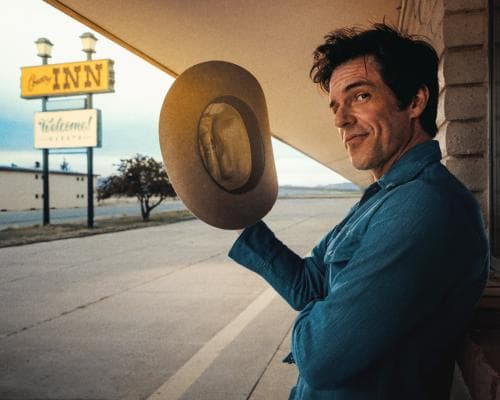
The first thing you need to know about Brandon Flowers is that he has never once in his life done anything by halves. When the Killers burst out of the Nevada desert in the early aughts, all eyeliner and synth-pop swagger, he wrote choruses that sounded like a man screaming into a canyon. When the band wanted to go bigger than the Springsteen-sized euphoria of Sam’s Town, he called in Stuart Price to lacquer Day & Age with disco glitter. So it should come as no surprise that his third solo album, Thrasher, doesn’t just dip a boot into country music — it dives in, boots first, spurs jangling, into a full-throated, Nudie-suit-wearing, honky-tonk hoedown. And here’s the kicker: it’s an absolute hoot.
Forget the muted, windswept balladry of the Killers’ 2021 Pressure Machine, a record that felt like Flowers was trying on Americana like an ill-fitting overcoat. Thrasher is the opposite: a record made with the kind of giddy, unapologetic commitment that only comes when an artist stops trying to be tasteful and starts trying to have fun. Flowers decamped to Nashville, the city that has become the new spiritual capital of American excess and authenticity in equal measure, and he didn’t just book a studio — he assembled a dream team of Music City’s most storied session players. Pedal steel legend Bruce Bouton, 85-year-old harmonica wizard Charlie McCoy, Gillian Welch’s longtime partner Dave Rawlings, and the formidable Margo Price all show up to lend their chops. The result is a record that sounds less like a rock star slumming it and more like a man who’s done his 10,000 hours and finally feels licensed to write his own rules.
The opener, “Does It Ever Cross Your Mind?”, sets the tone with a rollicking, barroom swagger that finds Flowers writing like a man who has absorbed every pop cliché of the last five decades and now feels equipped to spin them into gold. “I could’ve been born in Bangladesh / But I wasn’t, I was born here / With just enough jellybeans in my basket / To ask you to go a’wishing,” he sings, with the kind of deadpan, wink-and-nudge delivery that suggests he knows exactly how absurd and wonderful this all is. It’s the sound of a man who has stopped trying to be cool and, in doing so, has become the coolest thing in the room.
But Thrasher isn’t just a musical pivot — it’s a geographical one, and that’s where the travel story gets interesting. Las Vegas, Flowers’ birthplace, has always been a city of spectacle and reinvention, a place where the line between performance and reality is deliberately blurred. Nashville, by contrast, is a city that has built its identity on the opposite premise: that the music is the thing, and everything else is just a stage. Flowers’ move south feels less like an escape and more like a pilgrimage, a journey to the source of a certain kind of American storytelling that has always been present in his work, even when it was buried under synths and eyeliner. It’s a reminder that the most interesting luxury travel isn’t about five-star resorts — it’s about going to the place where a particular kind of magic is made, and getting to witness it up close.
And there’s the rarity angle. This isn’t a record made in a high-tech LA studio with a dozen producers and a team of songwriters. It’s a record made in Nashville’s storied studios, with players who have been the secret sauce behind countless country classics for decades. Bruce Bouton’s pedal steel alone is a masterclass in how a single instrument can evoke a whole world of longing and joy. Charlie McCoy, at 85, brings a harmonica style that is pure American history, a sound that predates rock and roll and still feels as fresh as ever. This is the kind of access that money can’t always buy — you have to have the songs, the vision, and the humility to let these legends do what they do best. And Flowers, to his credit, does exactly that.
What Thrasher signals, beyond the music itself, is a shift in the luxury traveler’s map of America. For years, the ultra-wealthy flocked to the coasts — the Hamptons, Malibu, Aspen. But Nashville has emerged as a destination that offers something rarer than a beach or a ski slope: a sense of cultural authenticity that can’t be manufactured. It’s a city where you can stay at a boutique hotel like the Noelle or the Thompson, dine on farm-to-table Southern cuisine, and then walk into a honky-tonk on Broadway and see a world-class musician playing for tips. The wealthy are no longer content to just consume culture from the cheap seats; they want to be in the room where it happens, to feel like they’re part of the story. Flowers’ Nashville sojourn is a perfect metaphor for that desire — a rock star who could have made this record anywhere, but chose to go to the source, to immerse himself in the tradition, and to come out the other side with something that feels both timeless and utterly new.
So where do the wealthy go next? If Thrasher is any indication, it’s not about the destination — it’s about the transformation. The most luxurious journeys are the ones that change you, that force you to see yourself and your work in a new light. For Flowers, that meant trading the Vegas strip for Music Row, trading the arena for the studio, trading the spotlight for the collective glow of a band of legends. For the rest of us, it’s a reminder that the best trips aren’t the ones we plan down to the minute, but the ones we take with an open heart and a willingness to be surprised. And if you happen to find yourself in Nashville, with a cold beer in hand and “Does It Ever Cross Your Mind?” playing in the background, you might just understand what Flowers was chasing all along.