When a Starship Came to Christmas Island
A 52-meter piece of Elon Musk's Starship has washed up off a remote Australian island, turning a routine space recovery into the most talked-about arrival in local memory. For the ultra-curious traveler, it's a fleeting collision of cutting-edge aerospace and untouched island life.
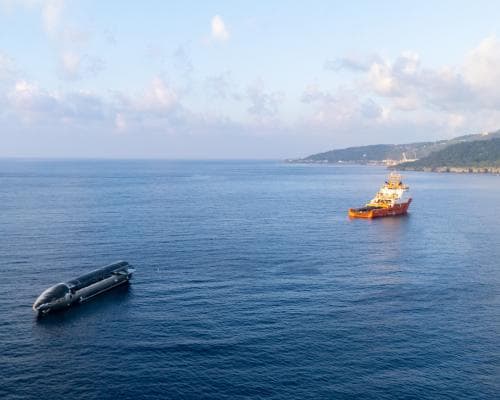
On a Tuesday morning in late July, the residents of Christmas Island woke to an unusual sight off their coast: three dark shapes on the horizon, too large for fishing boats, too still for whales. As the sun lifted, the shapes resolved into something stranger still — a black, scorched cylinder, 52 meters long, bobbing in the swell like a beached leviathan. This was no shipwreck. It was the upper stage of a SpaceX Starship, fresh from a suborbital arc across the Indian Ocean, and it had chosen this speck of Australian territory as its final resting place.
The arrival was the culmination of the 13th test flight of the Starship program, launched from Texas on July 24. After releasing 20 dummy satellites into orbit, the upper stage re-entered the atmosphere and executed a controlled splashdown, coming to rest just off the coast of Christmas Island — a dot of land 1,550 kilometers from Western Australia, known chiefly for its red crabs and its once-thriving phosphate mines. For the locals, the spectacle was pure, bewildering theater. "When you looked a bit closer, what looked like a ship was a black rocket," said David Watchorn, chair of the island's tourism association, capturing the surreal quality of the moment.
What followed was a masterclass in logistical discretion. SpaceX's recovery team, working in rough seas, managed to guide the floating hulk to calmer waters, where it now awaits the arrival of a dedicated engineering crew. The company's social media post was characteristically understated: "The SpaceX Recovery team successfully guided Starship to a location just off the coast of Christmas Island. A team of SpaceX engineers is on their way to conduct additional analysis on the vehicle in calmer waters before attempting to return it to Starbase." It reads like a routine service call, but the object in question is a piece of the most powerful rocket ever built, and its recovery is a delicate ballet of marine salvage, aerospace engineering, and intergovernmental courtesy.
For the islanders, the event is less a technical triumph than a social phenomenon. "It's been the talk of the island since," Watchorn told reporters, with the kind of understatement that only a small community can muster. The island's population of roughly 1,500 has seen its share of oddities — a detention center, a famous crab migration, a World War II-era gun emplacement — but a SpaceX rocket drifting into the lagoon is something new. The hope, naturally, is that the global attention might lure a few more visitors to experience the island's "rugged, raw" landscapes, its dense rainforests, its endemic birds, and those impossibly fluffy flying foxes that hang from the trees like living fruit.
From a collector's perspective, the Starship's visit is a reminder that the final frontier is no longer the preserve of governments and their deep-pocketed contractors. SpaceX, valued at over $200 billion, has turned rocketry into a commercial spectacle, with launches streamed live to millions and booster landings as routine as a private jet touching down at Teterboro. The retrieval of this particular stage is not just a salvage operation; it's a statement of intent. Every component is studied, every heat-scarred tile analyzed, to refine the next iteration. For the ultra-wealthy who book seats on future Starship flights — the waitlist is said to include a handful of billionaires — this is the kind of behind-the-scenes rigor that justifies the ticket price.
But there's a more poetic layer to the story. As space archaeologist Alice Gorman of Flinders University points out, the "rapid acceleration" in satellite launches means more rocket bodies and debris are raining down on the planet's most remote corners. Christmas Island, once a node in the British Empire's telegraph network, now finds itself on the frontline of a new kind of exploration — one that leaves its marks not in flags but in floating metal. The islanders, ever pragmatic, have chosen to see the beauty in it. They've named the rocket a tourist attraction, a conversation piece, a brush with the sublime.
As the engineers arrive and the recovery operation unfolds, one can't help but imagine the scene: a team in SpaceX polo shirts, squinting at the horizon, coordinating with local fishermen who've never seen anything like this. The rocket will eventually be towed back to Starbase in Texas, where it will be dissected, studied, and archived. But for a few weeks, it belonged to Christmas Island — a gift from the heavens, delivered by the sea. For those of us who collect experiences rather than objects, it's a reminder that the most extraordinary things often wash up where you least expect them. And for the island's tourism board, it's the best free advertisement money can't buy.