Theatre's 'Library of Things' Burns — and a New Model of Creative Resilience Emerges
When Sydney's Belvoir Theatre lost its storage warehouse to fire, it lost decades of sets, props, and costumes — but the company is now rebuilding with a forward-looking strategy that treats its material history as a living, adaptable asset. This story signals a broader shift in how cultural institutions can turn catastrophe into a catalyst for innovation.
When Neil Armfield heard that Belvoir, the Sydney theatre company he helmed for 17 years, had lost its storage warehouse in a fire, the first thing he thought of was his washing basket — recently borrowed by artistic director Eamon Flack for a show. It’s strange where the mind goes in moments of shock, and he laughs now at the ridiculousness of this thought. But that absurd detail is a window into something profound: the material memory of a creative institution, the odd, intimate objects that carry decades of storytelling. The fire on 22 June, which tore through Belvoir’s Marrickville production facility, destroyed tools, sets, costumes, and props — including most of the materials for the upcoming *The Jungle and the Sea*. For Armfield, who has made scores of shows there since the 1980s, it felt like “my work had been erased.” Yet from those ashes, Belvoir is doing more than rebuilding — it is reimagining how a theatre company owns, preserves, and reuses its physical legacy.
The fire is a brutal reminder that cultural infrastructure is fragile. But it is also a case study in resilience — one that resonates far beyond the Sydney stage. Belvoir’s loss is not just a pile of timber and fabric; it’s a “library of things,” as the company has called it, a repository of objects that carried meaning across productions. The chairs scavenged from Armfield’s backyard for a 1990s *The Seagull* starring a young Cate Blanchett, the costumes that defined characters for a generation — these are the physical anchors of collective memory. When they burn, they take something intangible with them. Yet Belvoir’s response has been remarkably forward-looking. Instead of mourning the past, the company is leveraging its community, its history, and its creative network to write a new chapter — one that may serve as a blueprint for other institutions facing similar catastrophes.
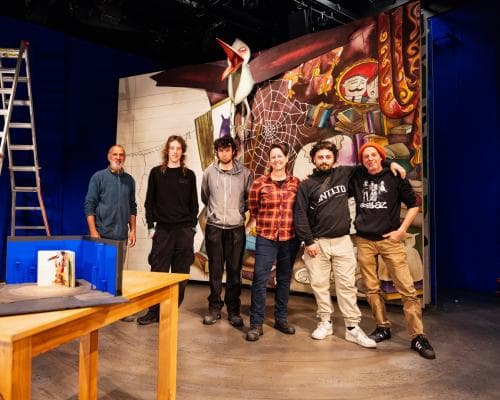
At the heart of this rebuilding is a remount of Armfield’s acclaimed 2010 production *The Book of Everything*, created with Kim Carpenter, his long-time collaborator from the pioneering visual storytelling company Theatre of Image. The show stars Belvoir stalwarts Peter Carroll, Rebecca Massey, and Julie Forsyth — actors who carry the company’s DNA. Armfield describes the production as “history woven into it,” and indeed it is. The rehearsal room has become a space where memory is not a burden but a raw material. The team is reconstructing sets and costumes from scratch, but with a new sensibility: they are designing for adaptability, for modularity, for future reuse. This is not just a tribute to the past; it’s an investment in a more resilient creative future.
The fire also exposes a deeper tension in the arts: the tension between permanence and ephemerality. Theatre has always been an art form that lives in the moment, but its physical remnants give it a second life — in archives, in revivals, in the hands of audiences who touch a prop after a show. Belvoir’s loss has sparked a conversation among cultural institutions worldwide about how to digitize and decentralize their collections. Imagine a shared digital registry of sets and costumes, where theatres can borrow and adapt rather than build from scratch. Imagine a cloud-based “library of things” that survives any physical disaster. That is the kind of innovation that could emerge from this tragedy — and Belvoir is already exploring partnerships with other companies to create a more circular economy for theatrical materials.
But there is also an emotional dimension to this rebuilding that money and technology cannot solve. Armfield’s laughter about his washing basket is a reminder that the objects we lose are never just objects. They are vessels for relationships, for moments of collaboration, for the quiet backstage rituals that make theatre magic. The fire has forced Belvoir to confront what it truly values — and the answer is not the objects themselves, but the people and the practices that create them. That is why the remount of *The Book of Everything* is so fitting. It is a story about finding wonder in the ordinary, about seeing the world through a child’s eyes. In a way, Belvoir is doing exactly that: turning catastrophe into a chance to see its own history with fresh eyes, and to build something more durable than a warehouse full of props.
What happens next will be watched closely by theatres, museums, and galleries around the world. Belvoir has already announced plans to rebuild its production facility with a focus on sustainability and flexibility — but the real innovation will be in how it manages its intellectual and physical assets going forward. The company is exploring digital twins of its sets, using 3D scanning to preserve designs that can be recreated anywhere. It is also considering a shared storage model with other Sydney arts organizations, so that no single fire can wipe out a generation of creative work. This is the new frontier of cultural resilience: not just insurance, but systems thinking. And it is a lesson that extends far beyond the arts — to any organization that relies on physical infrastructure to tell its story.
The fire at Belvoir is a loss, but it is also a signal. It signals that the institutions we love are more than the sum of their objects. It signals that creativity can turn even destruction into a catalyst for change. And it signals that the future of culture lies not in hoarding the past, but in building systems that allow it to be reborn, again and again. As Armfield and his collaborators ready *The Book of Everything* for the stage, they are not just reviving a show — they are staging a proof of concept for a more resilient, more adaptive, more generous cultural economy. The washing basket may be gone, but the hands that carried it are still here, ready to build something new.