Putin Calls Musk a 'Genius' as Russia Races to Build Its Own Starlink
Vladimir Putin praised Elon Musk's satellite constellation while revealing Russia's plans for a military-grade alternative, Rassvet. The race for orbital communications dominance is heating up, with Musk's Starlink already shaping the war in Ukraine and now drawing attention from the Kremlin.
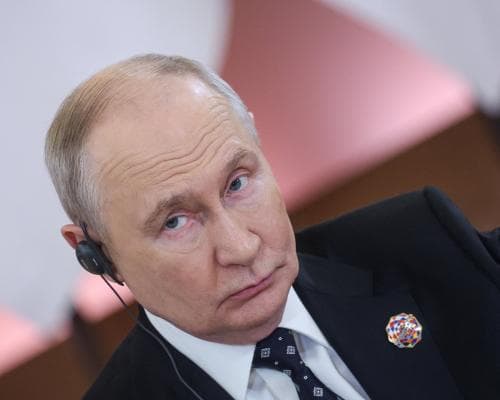
Vladimir Putin just called Elon Musk a genius. That's not a headline you see every day. But there it was, at a summit with African leaders in Moscow, the Russian president marveling at the scale of Musk's Starlink constellation: over 5,000 satellites in orbit, while Russia is only "taking the first steps" with its own version. The compliment came with a strategic edge. Putin confirmed that Moscow is in "close contact" with Musk and other American partners to avoid orbital collisions, even as Russia develops a satellite network for its military to use against Ukraine. The flattery is calculated, but the underlying message is clear: in the new space race, Musk's SpaceX is the benchmark, and everyone else is playing catch-up.
Musk, the world's richest person, built his fortune through Tesla and SpaceX, the rocket company that has upended the economics of space access. Starlink, SpaceX's broadband-from-orbit service, is now the dominant satellite internet provider, with roughly 10,000 active satellites beaming high-speed connections to remote corners of the globe. Its military counterpart, Starshield, has become a critical asset in Ukraine's defense, enabling drone strikes and secure communications. But Musk's control over that network has also made him an unexpected geopolitical player. Earlier this month, a temporary restriction on Starlink access in Ukraine sparked a diplomatic row, with Musk initially denying he had ordered a throttling before admitting he had closed a loophole allowing civilian Starlink to be used for military purposes. That episode underscored a new reality: a private billionaire now wields influence once reserved for nation-states.
Russia's answer is the Rassvet constellation, a project still in its infancy. Putin's admission that Russia is only "taking the first steps" is a rare moment of humility from the Kremlin, which has long touted its space prowess. But the gap is stark. Starlink's thousands of satellites provide resilient, low-latency internet that has proven hard to jam or destroy. Russia's network, by contrast, remains largely on the drawing board. The Kremlin's interest in Starlink isn't just about technology—it's about learning from the master. Putin's praise for Musk may be an attempt to flatter the billionaire into cooperation, or at least to ensure that Russian satellites don't collide with Starlink's swarm. "It is very important, in orbit, not to get in each other's way," Putin said, a nod to the crowded orbital environment that Starlink has come to dominate.
The strategic implications are enormous. Starlink has already reshaped modern warfare, giving Ukrainian forces a communications edge that Russia has struggled to counter. If Russia succeeds in building its own satellite constellation, it could level the playing field, enabling its military to operate with similar connectivity. But that's a big if. The Rassvet project faces daunting hurdles: Russia's space industry has been hobbled by sanctions, aging infrastructure, and a brain drain. Meanwhile, SpaceX continues to launch Starlink satellites at a blistering pace, with plans for thousands more. The company's reusable rockets have driven down launch costs, making it increasingly difficult for state-run programs to compete. Musk's dominance in orbit is not just a commercial triumph; it's a strategic asset that has made him a pivotal figure in global affairs.
For investors and policymakers, the episode signals a new phase in the space economy. The lines between commercial and military space are blurring, and the control of orbital infrastructure is becoming a source of geopolitical leverage. Musk's Starlink is the first truly global satellite internet system, and its success has prompted rivals to accelerate their own plans. Amazon's Project Kuiper, China's Guowang constellation, and Europe's IRIS² are all racing to catch up. But Starlink's head start is formidable. Putin's praise for Musk is a recognition of that reality—and a warning that the battle for orbital dominance is only just beginning.
What happens next? Watch for Russia to pour resources into Rassvet, even as it seeks to avoid antagonizing Musk. The Kremlin's courtship of the billionaire is a delicate dance: it needs his technology, but it also fears his power. Musk, for his part, has shown a willingness to engage with world leaders, but his primary loyalty appears to be to his companies and his vision of a multiplanetary future. As the space economy matures, the question is whether private actors like Musk will continue to shape global security, or whether governments will reassert control. For now, the stars are aligned in Musk's favor—and even his adversaries are taking notes.