The Widow, the Toy Soldiers, and the Shadow State: Inside Hezbollah's Welfare Machine
Fatima al-Ashkar, a 26-year-old widow in south Lebanon, lost her husband to war—but found a lifeline in Hezbollah's vast social welfare system, which provides housing, stipends, schooling, and therapy. Her story reveals how a non-state actor has outpaced the Lebanese state in caring for its people, deepening the country's divide.
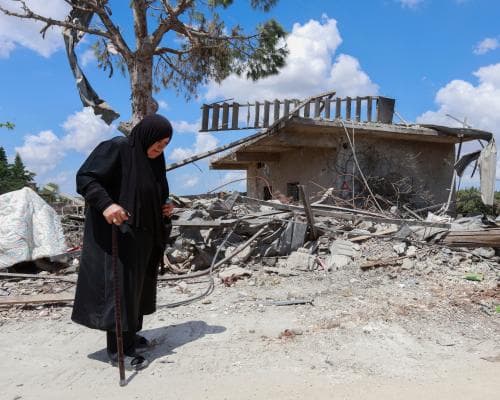
Fatima al-Ashkar lined up the toy soldiers on the living room floor, one by one, as her children watched. She picked up a plastic airplane and mimed a bombing run over the tiny green men. “Israel came and bombed here,” she told them. “Daddy was here. Daddy was martyred. Daddy was protecting us.” She was 26, a widow in Markaba, a village in south Lebanon, and her husband—a Hezbollah fighter—had been killed in April. She had to explain death to children who were too young to understand it, so she turned to the language of play. It was the most human of gestures, and it was also, in a way, a beginning.
What happened next is not a story about grief alone. It is a story about the machinery of care that surrounds that grief—a machinery run not by the Lebanese state, but by Hezbollah. Within weeks of Mohammed Ali’s death, the group’s martyr foundation had found al-Ashkar and her children an apartment in the southern suburbs of Beirut. They furnished it, covered the rent in full, and set up monthly stipends for each child. They paid school fees. They covered every healthcare cost. And every so often, a representative would come by, sit with the family, and offer psychological support sessions. “Hezbollah is standing by us,” al-Ashkar said. “They do everything for us.” She did not turn to the state. She did not even think to.
This is the quiet power of Hezbollah’s social welfare system—a network of foundations, clinics, schools, and aid programs that has been running for decades, often better than the state itself. It is not a charity in the Western sense, but a political project with a human face. It wins loyalty not through ideology alone, but through the tangible, daily relief of suffering. For a widow in Markaba, it means a roof and a check. For a wounded fighter, it means a hospital bed. For a displaced family, it means a place to sleep. The state, meanwhile, is absent, broke, and paralyzed by sectarian division.
The mechanics are sophisticated. The martyr foundation is just one arm of a broader network that includes the Jihad al-Bina development association, which rebuilds homes and infrastructure after Israeli strikes, and a network of schools and clinics that serve both Shiite and non-Shiite communities. The funding comes from Iran, from diaspora donations, and from Hezbollah’s own commercial enterprises. The result is a shadow state that provides everything from bread to blood transfusions—and does so with a consistency that the Lebanese government cannot match. It is not just welfare; it is a social contract, written in the currency of care.
The broader impact is profound. Hezbollah’s welfare system is not merely a safety net; it is a political weapon, albeit a velvet-gloved one. It binds supporters to the movement with bonds of gratitude and obligation, making it nearly impossible for the state to disarm Hezbollah or challenge its authority without also dismantling the very services that keep people alive. The Lebanese state, by contrast, has failed to provide basic electricity, water, or security. In the south, where the war has displaced thousands, the state is a rumor. Hezbollah is a fact.
For the culture of giving, this is a cautionary tale. Philanthropy is never neutral. It can build bridges or entrench divisions. Hezbollah’s model is the latter—it is charity as governance, and governance as resistance. It is also a reminder that when states fail, other actors will fill the void, often with strings attached. The world may call Hezbollah a terrorist organization, but to Fatima al-Ashkar, it is the hand that holds her children. As the Lebanese state tries to reassert itself, it must do more than disarm Hezbollah; it must learn to love its people as fiercely as its rival does. That is the real battle—not for territory, but for trust.