The Zero-Bills Home: How Santander's Retrofit Gift Is Quietly Rewriting the Rules of Energy Giving
Santander has retrofitted a Milton Keynes family's home with a heat pump, 17 solar panels, and a battery, guaranteeing no energy bills for five years. It's a corporate gift that treats a house like a mini power station — and offers a blueprint for funding the transition to net zero.
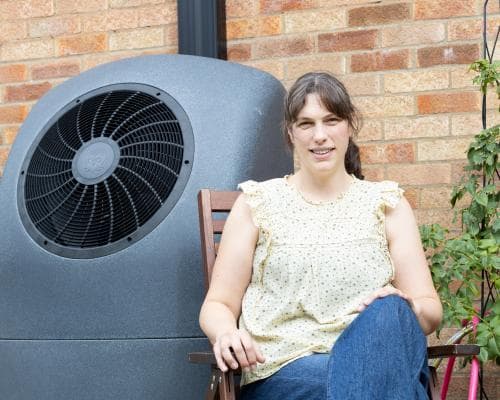
Clare Naylor used to run her home like a military operation. Last winter, with energy prices climbing and three children under ten racing around, she filled hot-water bottles, handed out extra jumpers, and kept the thermostat locked at 18C. "Slippers, hot-water bottle, jumpers — that's how you get through the winter," she says. This year, she's planning to heat the house before the kids get home from school. Not because she's splurging, but because she can. Her four-bedroom detached home in Milton Keynes now comes with a guarantee: no energy bills for five years.
While millions of British households absorb yet another price-cap rise — the highest in three years, with predictions of a 16% jump in January — the Naylor family has stepped off the treadmill entirely. Their 1980s house was recently fitted with a heat pump, 17 solar panels, four new radiators, and a large battery in the garage to store excess power. The result is a home that behaves like a mini power station, feeding surplus energy back to the grid. Under a "fair usage" agreement with Octopus Energy, as long as the family stays within reasonable limits, they won't see a bill for heating, lighting, or the countless devices a family of five relies on.
The gift came from Santander. The bank retrofitted the property for free as part of a broader project examining how to finance the decarbonisation of Britain's ageing housing stock. It's a corporate philanthropy play, but not the ribbon-cutting, logo-covered kind. Santander isn't just writing a cheque; it's testing a model. The question the bank is trying to answer is simple and urgent: how do you pay for the kind of deep retrofit that most homeowners can't afford, and that the planet can't afford to skip?
The mechanics matter. A heat pump replaces a gas boiler, running on electricity instead of fossil fuel. Solar panels generate power on sunny days. The battery stores what isn't used immediately, so the family can draw on it at night or sell it back to the grid. Octopus Energy's tariff — a guaranteed-zero-bills arrangement — is the final piece. It turns the home into a small, distributed energy asset. The family isn't just saving money; they're participating in the energy system. And Santander gets something too: real-world data on how retrofits perform, what they cost, and how they might be financed at scale.
For Clare Naylor, the change is deeply personal. Her old bills were relatively modest — about £130 a month — but the anxiety was constant. Now that money is earmarked for holidays. More importantly, the daily calculus of warmth has vanished. "We were always fairly careful," she says. Careful is a polite word for cold. Careful means blankets instead of heating, hot-water bottles instead of a warm bath. Careful is what millions of families do every winter, and what this project quietly erases for one household.
The broader impact is harder to quantify but impossible to ignore. Britain's housing stock is among the oldest and leakiest in Europe. Retrofitting it is one of the biggest barriers to meeting climate targets. Government schemes have come and gone; take-up has been patchy. Santander's experiment suggests a different route: corporate-funded pilots that prove the technology works, that the savings are real, and that the model can be replicated. If a 1980s detached house in Milton Keynes can run on sunshine and a battery, so can thousands of others.
There's a culture-of-giving story here too. Corporate philanthropy often means sponsorships, scholarships, or disaster relief. Santander is doing something more interesting: treating a family home as a laboratory for a public good. It's not charity in the traditional sense. It's investment in a proof point. And proof points are what move markets, policies, and minds. The Naylor family gets warmth and holidays. The rest of us get a glimpse of what's possible when a bank decides to put its balance sheet behind a heat pump and a battery.
The zero-bills home is not a fairy tale. It's a retrofit, a tariff, and a guarantee. But it points to something bigger: a future where energy isn't a source of dread, where homes give back to the grid, and where the transition to net zero is financed not just by governments but by the institutions that have the most to gain from a stable, sustainable economy. Clare Naylor will heat the house before the children come home this winter. That small luxury is a quiet revolution.