The Oberek, Reimagined: How Poland's Whirling Folk Dance Became the Underground's Newest Obsession
In Katowice's industrial heart, a new generation of musicians is splicing the rapid, triple-meter rhythms of Poland's oberek with footwork, acid, and hip-hop—creating a sound that feels both ancient and utterly now. This is folk tradition not as museum piece, but as living, pulsing conversation.
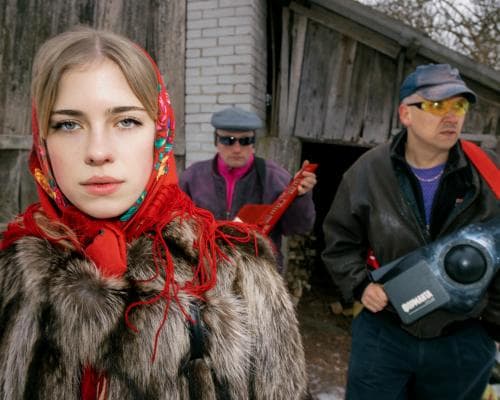
The first thing you notice is the beat. It's not the four-on-the-floor thump you expect from a festival stage, nor the lazy swing of a hip-hop loop. It's a stuttering, off-kilter pulse that seems to ricochet between your ears—rapid, irregular, almost like a stutter in the rhythm itself. The crowd at OFF Festival in Katowice, a sea of nylon jackets and faded band tees, is jerking to it, limbs moving in sharp, angular bursts. Most have no idea that the sound they're dancing to is distinctly Polish—the oberek, a traditional dance in triple meter whose very name derives from the verb 'to spin,' because it's meant to whirl couples across a dancefloor in dizzying circles.
Tercet Imperial, the band commanding this scene, looks like they've stepped out of a late-80s Chicago basement gym: disco tracksuits, Chicago Bulls caps, and a keyboardist, Piotr Zabrodzki, coaxing resonant acid melodies from his synth. Drummer Jan Emil Młynarski lays down a scattergun rhythm that owes as much to footwork—that ghetto-house subgenre born on the South Side—as it does to the folk fiddlers of his homeland. Lead singer Joanna Sztucka, in a voice that's equal parts velvet and steel, explains the project simply: 'We play traditional music, but on different instruments.' Their debut album, Prymat, is a masterclass in this alchemy. Violins and snare drums are swapped for synthesisers and drum pads, while the melodies and lyrics of centuries-old songs are woven into something that feels startlingly contemporary. It's what Młynarski calls 'an attempt to create an alternative history,' made, he adds, 'primarily for people who know nothing about traditional music and don't need to know anything at all.'
The oberek, for those unfamiliar, is a dance of dizzying speed and subtle complexity. Its triple meter—think of a waltz, but turned up to a sprint—is built on a rhythmic tension that has long fascinated ethnomusicologists. But for a new generation of Polish musicians, it's not an academic curiosity; it's a playground. The connection to footwork, with its own frantic, asymmetrical pulse, is not as far-fetched as it sounds. Both are dances of the body, of the street, of communal joy. Both demand a kind of physical surrender that's rare in modern electronic music.
This isn't a solitary experiment. Across the Atlantic, in Chicago—the very birthplace of footwork—drummer Gary Gwadera (born Piotr Gwadera) has taken the oberek even further. His concept album, Footberk Suite, imagines a meeting between the Polish dance and Chicago's footwork scene. Its genesis, he says, was the influential 2010 compilation Bangs & Works Vol. 1, released on Planet Mu. 'I suddenly realised that the grooves and this pulse of footwork were typical of the oberek,' Gwadera recalls. 'I wanted to combine them.' The result is a record that sounds like a conversation between two worlds that never knew they were related—a Polish wedding band jamming with a Chicago drill crew, and somehow, it works.
What's happening here is more than just a clever mash-up. It's a signal of how the ultra-wealthy and the culturally curious are now approaching heritage. There's a growing appetite for authenticity, but not the kind that's preserved in amber. The new luxury is in the remix—in taking something deeply rooted, with centuries of craft and meaning, and making it feel urgent and new. It's the same impulse that drives a collector to commission a bespoke one-off from a master craftsman, or a chef to reinvent a grandmother's recipe with modernist techniques. The value isn't in the object itself, but in the story it tells and the way it's retold.
For the tastemakers of the world, the oberek's revival is a quiet revelation. It offers a way to own something that can't be bought—a sense of cultural fluency that goes beyond the obvious. The music of Tercet Imperial and Gwadera isn't just for the dancefloor; it's for the salon, the private listening room, the curated playlist that signals you understand something deeper than the latest trend. It's the sound of a tradition that refused to die, and instead, chose to evolve.
As the night deepens in Katowice, the crowd doesn't disperse. They stay, swaying to the impossible rhythms, their bodies speaking a language that predates them. The oberek, once a dance for spinning couples, is now a dance for the mind—and for anyone willing to listen with fresh ears. The spinning has only just begun.