The New Uncanny: When AI Makes Us Strangers to Ourselves
A meditation on how artificial intelligence and digital perfection are reshaping our sense of self, turning the familiar into the unsettling. This piece explores the psychological toll of a world where our own faces can be rendered unrecognizable by algorithms.
The other night, I found myself scrolling through Instagram in a dimly lit room, the glow of the screen casting a pale blue light on my hands. I stopped at a photo of John Travolta at Cannes, his jawline a little too smooth, his eyes a little too bright. Then, a few posts later, Carla Bruni on a date night with her husband, Nicolas Sarkozy, her features porcelain-smooth, her smile a study in controlled elegance. Both looked like themselves, and yet—somehow—not. It was as if I were looking at approximations of people, not the people themselves. I felt a flicker of unease, a sensation I couldn't quite name. But there is a name for it, and it was coined in 1970 by a Japanese robotics professor named Masahiro Mori: the uncanny valley.
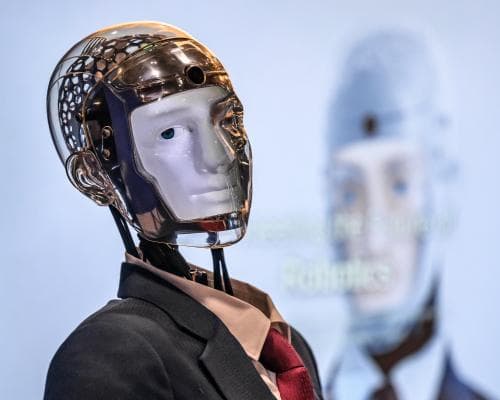
Mori's theory was simple and unsettling. He observed that robots designed to look almost human—but not quite—provoke a deep discomfort in us, far more than those that are obviously mechanical. A robot with a metal face and articulated joints is fine; it's clearly a machine. But a robot with skin that's too smooth, eyes that don't blink, a mouth that moves without warmth—that triggers something primal, a sense of danger, a fear of the undead. We sense something wrong, something that defies categorization. It's the same feeling you get when you see a mannequin that's a little too lifelike, or a doll that seems to be watching you. The uncanny valley is a failure for humanoid robots, but what does it mean when a human being—a real, breathing, living person—falls into it?
The answer, I think, lies in the work of Günther Anders, a German-Austrian philosopher who, in 1956, published a collection of essays called *The Obsolescence of the Human*. Anders, who was Hannah Arendt's first husband, argued something radical: that technology would breed a new kind of self-contempt in us. As mass-produced goods become more perfect, more precise, more flawless, we humans—with our wrinkles, our asymmetries, our clumsiness—would come to see ourselves as inferior. We would regret our bodily imperfections, our corporeal imprecision. And now, with AI, that imprecision extends beyond our bodies to our very minds. It's not just that our faces can be smoothed and our waists cinched; it's that our thoughts, our emotions, our identities are being rendered as data, as patterns that can be optimized, corrected, and perfected. The uncanny valley is no longer just a place for robots; it's where we live, caught between our human messiness and the digital ideal.
This is the new luxury, and it's not one we can buy. The ultra-wealthy have long used cosmetic surgery, personal trainers, and dermatologists to chase a certain kind of perfection. But now, with AI, the game has changed. It's not just about looking younger or fitter; it's about looking *right*—the way an algorithm would render you, the way a filter would smooth you. I think of the faces I saw on my feed, and I wonder: did they choose to look that way, or did they simply surrender to the tools available? The craftsmanship of the human face, once a matter of genetics and time, is now a collaborative project with machines. And the rarity—the true rarity—is not a perfectly symmetrical face, but one that shows the marks of a life lived. The market for authenticity, for the unpolished, for the genuine, is just beginning to emerge.
For collectors and connoisseurs, this shift is profound. We've spent decades accumulating objects—cars, watches, art—that are prized for their perfection. But the human face is not a hypercar. It's not meant to be flawless. The most compelling faces in history—think of Audrey Hepburn's gentle asymmetry, or the deep lines on a seasoned sailor's brow—are compelling precisely because they are imperfect. They tell a story. And in an age of AI, that story is being erased, replaced by a digital mask that says nothing. The collectors who understand this will be the ones who value the patina of experience, the wear of time, the quirks that make a person unmistakably themselves. They will seek out faces that are not engineered, but lived.
What does this signal about luxury taste? It signals a return to the real, a rebellion against the sterile perfection of the digital. There is a growing appetite for the handcrafted, the artisanal, the bespoke—in fashion, in interiors, in travel. And now, perhaps, in ourselves. The luxury of the future is not in erasing our imperfections, but in embracing them. It's in the laugh lines, the crooked smiles, the moments of awkwardness that make us human. As AI continues to infiltrate every aspect of our lives, the ultimate luxury will be authenticity. The ability to look in the mirror and see yourself—not a filtered version, not an approximation, but the real, imperfect, beautiful you—will be the rarest commodity of all.
Looking forward, I suspect we'll see a cultural shift, a quiet rebellion against the uncanny. We'll start to value the human, the flawed, the genuine. We'll seek out experiences that remind us of what it means to be alive—not just to look like a perfect image, but to feel the sun on our skin, to laugh until we cry, to age with grace. The uncanny valley will always be there, a reminder of what we might become if we lose ourselves to the machine. But we don't have to cross it. We can choose to stay on the other side, where the faces are real, the minds are messy, and the beauty is authentically ours.