The Mayor-Builders: How Andy Burnham's Planning Power Grab Could Redraw Britain's Housing Future
Andy Burnham is set to hand metro mayors the power to override local councils and fast-track large-scale developments, a move that could unblock England's stalled housing pipeline and redefine urban governance. This shift signals a bold experiment in top-down, execution-focused statecraft, with implications for construction technology, infrastructure investment, and the speed of national renewal.
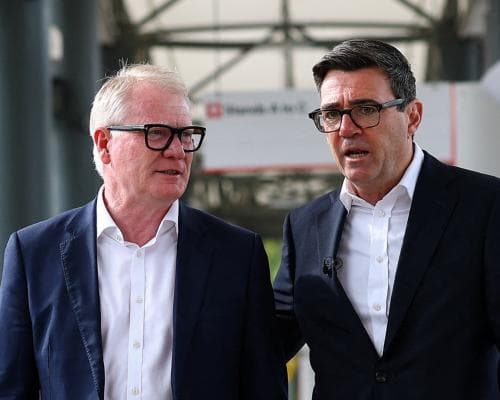
The most radical thing about Andy Burnham's latest proposal isn't the extra cranes it might put on Manchester's skyline. It's the quiet transfer of political gravity. Next week, the Greater Manchester mayor is expected to unveil plans that would let him and his fellow metro mayors 'call in' planning decisions, override local councils, and grant upfront permission for developments of more than 150 homes, commercial spaces over 15,000 square metres, or any building taller than 30 metres. That's roughly ten storeys. In one stroke, the slow, friction-heavy machinery of local democracy—where a single objection can stall a project for years—could be bypassed by a single elected executive. This isn't just planning reform. It's a bet that the future of British housing will be built by strongmen with spreadsheets, not committees with parish councils.
Burnham, the Labour mayor who has become the de facto voice of England's devolution movement, isn't pretending this is a painless shift. He told the Sunday Times that he understands the argument that empowering mayors could disempower councillors, MPs, and constituents. But he frames it as a two-way street: sometimes local authorities push through something unacceptable to their communities, and sometimes they block what's needed. 'It's not all about nimbyism,' he said. 'Sometimes it's the other way round.' The nuance is refreshing, but the direction is clear. Ten of England's fourteen devolved mayors, spanning different parties, have already backed the move. This isn't a fringe idea. It's a coalition of convenience, united by frustration with a system that has delivered just over a quarter of the government's 1.5 million homes target in five years.
The technical mechanics matter as much as the politics. Under the proposed powers, a mayor could direct a council to approve a scheme—or refuse it—and, crucially, grant upfront permission so developers can start digging without the usual multi-year application dance. That's a game-changer for construction economics. For a sector that spends billions on land banking, legal fees, and holding costs while waiting for approvals, the ability to de-risk a project at the front end could unlock capital that's currently sitting on the sidelines. It also creates a powerful incentive for developers to align with mayoral priorities—affordable housing quotas, green building standards, or infrastructure contributions—because the alternative is a council that might say no. The mayor becomes the ultimate client, the one who decides what gets built and who gets to build it.
This is where the story gets interesting for anyone tracking the deep-tech and infrastructure economy. The housing crisis isn't just a planning problem; it's an execution problem. Modular construction, 3D-printed homes, and AI-driven design tools have been touted as silver bullets, but they've struggled to scale because the regulatory pathway is so unpredictable. A mayor with call-in powers could, in theory, create a pipeline of approved sites that makes it viable for a factory to mass-produce housing components. Imagine a mayor saying: 'Here are 20 sites, pre-approved, with standardised specifications. Build them all.' That's not just a planning reform. It's a procurement strategy that could finally give construction technology the volume it needs to drive down costs. Burnham's move, if it survives the inevitable legal challenges and parliamentary scrutiny, could be the catalyst that turns Britain's housing crisis from a political headache into a technological opportunity.
The competitive context is equally sharp. London's Sadiq Khan was given similar powers earlier this year as an emergency measure to unblock stalled sites, and the results have been telling. The capital has seen a flurry of approvals that would have taken years under the old system. Now, the rest of England wants a piece of that. But this isn't just about catching up with London. It's about a new model of urban governance, where mayors act less like administrators and more like chief executives of cities. They're taking on the role of a planner-in-chief, willing to absorb political heat for the sake of delivery. That's a profound shift in the British political culture, which has traditionally valued localism and consultation over speed and decisiveness. The risk, of course, is that this concentrates power in ways that could be abused—a mayor with a grudge could kill a project that a community actually wants, or fast-track one that enriches their donors. The safeguards will be crucial.
For the rest of the world, this is a laboratory. The UK's housing crisis is not unique—cities from San Francisco to Sydney are wrestling with the same NIMBY-versus-growth tension. Burnham's experiment offers a template for how to break the logjam: give an elected executive the power to override local objections, but make them accountable at the ballot box. If it works, it could inspire similar moves in other countries. If it fails, it will be a cautionary tale about the perils of top-down development. Either way, it's a story about power, technology, and the built environment—and it's only just beginning.