The Longest Voyage: Inside the Quiet Crisis on America's Floating Cities
As the USS George Washington arrives to relieve the USS Abraham Lincoln after a record 250-day deployment, a closer look reveals the human cost of maritime endurance—sparse meals, frayed morale, and the unseen toll on the families waiting ashore. This is the story of life at sea when the horizon never changes and home remains a distant rumor.
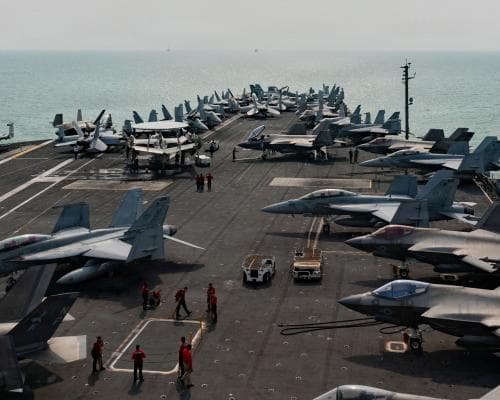
There is a particular kind of silence that settles over a naval base at 3 a.m. when a ship is overdue. It is not the silence of absence, but of waiting—the kind that wives and mothers know in their bones. On a recent Thursday, that silence broke with the announcement that the USS George Washington had finally arrived in the Arabian Sea, ready to relieve the USS Abraham Lincoln after a deployment that has stretched past 250 days without a significant port visit. The image released by Central Command shows sailors on the flight deck, wind-whipped and purposeful, but the story beneath the steel is far more fragile.
For the families left behind, the deployment has become a study in micro-signals. One wife, speaking anonymously for fear of retribution, described parsing her husband's text messages like a code. The exclamation points disappeared weeks ago. The little jokes stopped. What remains is a flat, exhausted cadence that she has learned to translate: “There's less hope in the way he talks,” she said. “He's just exhausted. It's a long, long deployment and it takes a toll.” She has seen photographs of his meals—a tray with a few pieces of bacon and three or four chicken wings—and wondered, quietly, whether the Navy's promise of hot chow has quietly given way to something more meager.
The Lincoln's endurance has become a kind of accidental record, a test of human limits that no one designed. At 250 days, the ship has surpassed the typical six-to-seven-month deployment cycle by a wide margin, and the strain is visible in ways that official statements rarely capture. The ship's stores, designed for a finite mission, have been stretched like a rubber band. Fresh produce runs low first, then the comfort foods that sailors cling to as anchors of normalcy. The photographs the wife receives are not of heroics or sunsets, but of small, sad trays—the visual grammar of a crew running on fumes and discipline.
This is not a story about hardware, though the hardware is magnificent. The George Washington is a Nimitz-class carrier, a floating city of nearly 6,000 souls, with a flight deck that can launch 90 sorties in a day. But the real engineering challenge is human. Morale, as any admiral will tell you, is a consumable resource, and it does not resupply at sea. The Navy's own studies have long warned that extended deployments without port visits corrode retention, mental health, and operational readiness. The Lincoln's crew has been asked to hold the line against Iran with no end date in sight—a mission that began as a show of force and has quietly metastasized into a test of endurance.
The arrival of the George Washington is, on paper, a relief. But the handover is a slow ballet, not a quick swap. No date has been announced for the Lincoln's return, and the crew knows it. In the world of naval logistics, a relief carrier's arrival is the first act of a three-act play: transit, integration, and finally, the long voyage home. For the families, that final act cannot come soon enough. The wife who spoke to the Guardian put it plainly: “To put it plainly, I just don't think they're getting enough calories.” It is a sentence that should never be true on a modern warship, and yet here it is.
What does this moment signal about the way we value endurance? In the luxury world, we celebrate the long game—the vintage watch that outlives its owner, the hand-stitched saddle that improves with decades of use. But there is a difference between endurance that is chosen and endurance that is imposed. The Lincoln's crew did not sign up for a 250-day test of deprivation; they signed up to serve. The Navy's promise is that hardship has a horizon, and when that horizon keeps receding, the promise itself begins to corrode. The George Washington's arrival is a reminder that even the most powerful machines require human maintenance, and that maintenance begins with a hot meal and a date to come home.
As the sun rises over the Arabian Sea, the George Washington's sailors are already at work, their own deployment just beginning. The Lincoln's crew will watch them from across the water—a mirror of what they once were, fresh and eager and unbroken. The handover will take weeks, and the Lincoln's return will take longer still. But for one wife, the math is simple: every day closer to home is a day she can stop reading between the lines. The Navy will call it a rotation of forces. She will call it the beginning of the end. And in the quiet of her kitchen, with the coffee going cold and the phone in her hand, she will wait for the message that finally says, without any code, “I'm coming home.”