The King Who Walked Through Ashes: Belgium’s Philippe Meets the Heroes of a Historic Wildfire
As the largest wildfire in Belgian history scorches the Hautes Fagnes nature reserve, King Philippe steps into the smoke to honor the firefighters and volunteers fighting to save a national treasure. Their courage, not royal pomp, is the real story of a nation rallying against climate-fueled disaster.
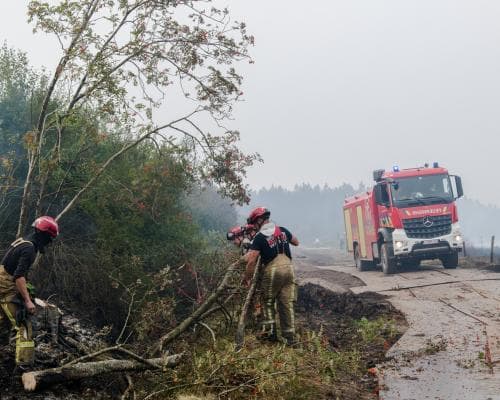
The smoke had barely cleared from the Hautes Fagnes plateau when King Philippe’s boots sank into the ash. It was Monday morning, August 17, 2026, and the monarch had traded his palace shoes for the soot-stained ground of what officials now believe is the largest wildfire in Belgian history. More than 3,000 hectares of peat bogs, heathland, and ancient forest—an area roughly the size of 4,200 football pitches—had burned since Friday afternoon. Philippe wasn’t there to give a speech. He was there to listen, to shake hands, to see the blistered faces of the men and women who had spent 72 hours fighting a beast that seemed to have no end.
This is not a story about a king, though he makes a compelling entry point. It’s a story about a quiet revolution in how we respond to disaster. The Hautes Fagnes, a nature reserve straddling Belgium’s eastern border with Germany, is a landscape of rare, almost otherworldly beauty—a high moorland of peat bogs that act as giant sponges, storing carbon and sheltering species found nowhere else in the country. But this summer’s heatwave turned that sponge into tinder. By Friday, a fire that began near the town of Robertville had exploded into a blaze that crept toward the German town of Monschau, forcing the precautionary evacuation of parts of the town. Local newspaper Le Soir captured the mood with a stark headline: “This is no longer just a warning.”
The firefighting effort was nothing short of extraordinary. Hundreds of firefighters from across Belgium, many of them volunteers, converged on the reserve, joined by colleagues from Germany and the Netherlands. They worked in shifts that stretched into 18-hour days, their hoses drawing water from the region’s famous streams and ponds, while helicopters dropped loads of water from above. But the peat itself was the enemy. Unlike a forest fire that flares and moves, peat fires smolder underground, creeping along root systems and bursting into flame days after they seem extinguished. The firefighters had to dig trenches, douse the soil, and even use controlled back-burns to starve the fire of fuel. By Monday morning, light rain offered a fragile reprieve, slowing the eastern advance toward Germany, but the blaze continued to grow in a north-eastern direction, local media reported.
King Philippe’s visit was a gesture, yes, but it was also a signal. In a country where the monarchy is largely ceremonial, his presence at the front lines—meeting exhausted firefighters, thanking volunteers who had brought food and water, and speaking with evacuees from Monschau—carried a weight that went beyond protocol. It said: this matters, and so do you. It also highlighted a growing truth: climate change is no longer a distant threat for Belgium. The summer of 2026 has already seen record temperatures, and this fire is the most dramatic evidence yet that the country’s natural heritage is at risk. As the king walked the charred landscape, he was not just surveying damage; he was witnessing the birth of a new era of environmental crisis—and the resilience of those who answer its call.
But the real philanthropy here is not royal. It’s the thousands of ordinary citizens who mobilized without being asked. Local farmers opened their land to firefighters, providing water tankers and heavy machinery. Residents of nearby towns like Eupen and Malmedy organized donation drives, delivering sandwiches, water, and sunscreen to exhausted crews. A group of off-duty nurses set up a first-aid station at a community center. And the volunteers of the Red Cross and Civil Protection worked alongside the professionals, their vans serving as mobile canteens. This is the quiet, unglamorous giving that rarely makes headlines—the kind that shows up with a shovel and a thermos, not a check. It is, in many ways, the most powerful philanthropy of all: neighbor helping neighbor, stranger helping stranger, in the face of a shared threat.
As the fire continues to burn, the long work of recovery is just beginning. The Hautes Fagnes will take decades to fully regenerate, and the carbon released from the peat—a storehouse of ancient plant matter—is a bitter blow to Belgium’s climate goals. But the fire has also sparked a new conversation about how to protect such landscapes. Experts are calling for more investment in firebreaks, better early-warning systems, and a national strategy for wildfire response, which is no longer a Mediterranean problem. King Philippe’s visit may have been symbolic, but it has focused the nation’s attention. In the coming weeks, there will be calls for funding, for policy change, and for a deeper public commitment to the environment. The question is whether Belgium will answer with the same urgency that its firefighters showed on that burning plateau. If they do, the ashes of this fire may yet give rise to something stronger than what was lost.