The King of Speed: Magnus Carlsen’s Undefeated Reign at the Esports World Cup
In a four-day spectacle at Paris Expo Porte de Versailles, Magnus Carlsen clinched the Esports World Cup without a single loss, proving that even in the frantic world of 10-minute chess, cold calculation and nerve still reign supreme. The $250,000 prize and a flawless run underscore a new era where classical mastery meets digital dexterity.
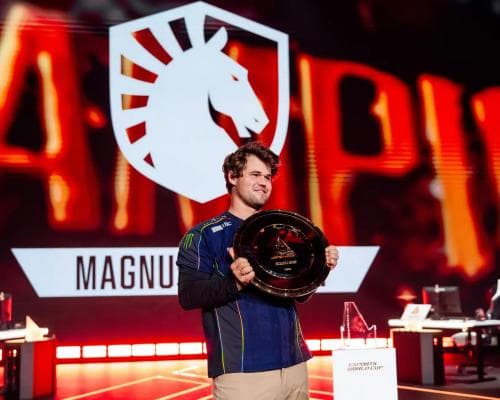
There is a moment in every great performance when the crowd stops breathing. At the Esports World Cup in Paris, that moment came not with a checkmate, but with a queen sacrifice so quiet, so perfectly timed, that even the grandmasters in the audience leaned forward. Magnus Carlsen, the world’s number one, had already sealed his victory—but he wanted more. He wanted art.
The venue, the Paris Expo Porte de Versailles, is more accustomed to haute couture and auto salons than to chess clocks, but for four days it became the epicenter of a new kind of luxury: speed chess as spectator sport. Carlsen, the Norwegian prodigy who has redefined what it means to dominate a game, walked away with the 2026 Esports World Cup title, a $250,000 first prize, and a record that will be whispered about in clubs from Oslo to Mumbai: undefeated, untroubled, untouchable.
The format is a brutal one—10 minutes per player, no increment per move, a pace that turns even the most serene grandmaster into a gambler. It is chess stripped of its velvet gloves, where a single slip can cost you everything, and where the clock is as much an opponent as the man across the board. Carlsen, however, treats chaos like a familiar guest. He dispatched Russia’s Andrey Esipenko and America’s Hans Niemann in the group stage, then swept past India’s Nihal Sarin, France’s Alireza Firouzja, and finally Belarus’s Denis Lazavik in a final that felt less like a contest and more like a coronation.
But it was the last game that will be remembered. With the title already in hand, Carlsen unveiled a prepared line—a positional queen sacrifice that he had noticed Lazavik had defended in a previous game. It was a move of pure audacity, a calculated risk that most players would never dare, let alone attempt with the world watching. There was an easier path, a perpetual check that would have secured a draw, but Carlsen waved it away. He wanted the full story, and he got it.
Lazavik, the 19-year-old from Minsk, was the event’s revelation. Ranked only 110th in classical chess, he has carved a niche in the hyper-competitive world of online speed events, where his solid, positional style frustrates even the most aggressive opponents. Carlsen’s praise was measured but genuine: “He just doesn’t beat himself. He plays very solid positional chess and doesn’t put his pieces on bad squares.” For his efforts, Lazavik took home $190,000—a consolation prize that, in the rarefied air of elite chess, feels almost like a down payment on future greatness.
This is the new frontier of the game, and it is a lucrative one. The Esports World Cup, which began in Riyadh in 2025, has quickly become a fixture on the calendar, drawing capacity crowds and six-figure payouts. It signals a shift in how the ultra-wealthy consume chess: no longer a quiet pastime for drawing rooms, but a high-stakes spectacle that blends mental endurance with the dexterity of a concert pianist. The “dirty flagging” that Carlsen himself has criticized—a desperate race to flag your opponent’s clock in a dead drawn position—was on display, but so was the artistry that makes chess a lifelong obsession.
For collectors and connoisseurs, Carlsen’s victory is a reminder that true mastery is the ultimate luxury. It cannot be bought, only earned. And in a world where attention is the scarcest commodity, his undefeated run is a masterclass in focus. As he said afterward, “To go undefeated was part of my strategy.” Not a boast, just a fact—delivered with the same calm that has made him the greatest of his generation.
Looking ahead, the Esports World Cup is poised to grow, with whispers of new venues and even larger purses. But for now, the image that lingers is of Carlsen in Paris, his hand hovering over the mouse, his eyes fixed on a board that most of us would find incomprehensible. He is not just winning; he is redefining what winning looks like. And in the process, he has turned a 1,500-year-old game into the most exciting ticket in town.