The Eternal Dream: Why the Bridge to Sicily Remains the World's Most Elusive Luxury
For over two millennia, the vision of bridging the Strait of Messina has tantalized emperors, dictators, and billionaires alike—yet it remains a phantom of ambition. This is the story of the world's most coveted unbuilt infrastructure, where engineering meets mythology, and where the ultra-wealthy watch from their superyachts as history refuses to be paved.
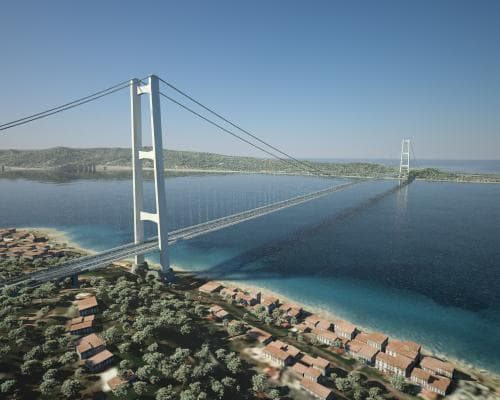
There is a certain poetry in a dream that outlives empires. The Strait of Messina, that glittering ribbon of cobalt between Sicily and the Italian mainland, has been the subject of human longing since 251 BC, when Pliny the Elder marveled at a bridge of boats and barrels carrying 140 war elephants across its waters. Two thousand years later, the fantasy persists—not as a relic of ancient ambition, but as the world's most exquisite architectural mirage.
For the ultra-wealthy, who glide through these straits aboard their 80-meter superyachts, the bridge is more than concrete and steel. It is a monument to hubris, a testament to the fact that even the most formidable fortunes cannot command the sea. The Romans tried. Mussolini tried. Berlusconi tried. And now Matteo Salvini, Italy's infrastructure minister, has revived the myth with characteristic bravado, promising that the €13.5 billion project will break ground this summer. Yet in Torre Faro, the Sicilian village where construction is meant to begin, the only sound is the lapping of waves and the gentle skepticism of locals.
Take Mariolina De Francesco, a 76-year-old retired university lecturer whose villa sits on a cliff overlooking the strait—one of over 400 properties slated for expropriation. When asked if she worries about losing her home, she laughs. "You're surprised I'm so unfazed. Why should I worry? If they didn't build the bridge before, why would they now? It's all talk. They'll never build it." Her nonchalance is not naivety; it is the wisdom of a woman who has watched five decades of politicians promise the impossible. For the collector of rare experiences, there is something deeply alluring about a place that refuses to be tamed.
The bridge itself, if ever realized, would be the longest suspension bridge on Earth, with a central span stretching over 3.3 kilometers—a figure that makes the Golden Gate look like a garden footpath. The engineering challenges are staggering: seismic fault lines, winds that whip through the strait at 120 kilometers per hour, and the deep-water currents that have made this passage a graveyard for ancient ships. The proposed design, with its twin towers rising 399 meters, would dwarf the Eiffel Tower and redefine the skyline of southern Italy. Yet for all its grandeur, the project remains a paper ghost, a stack of feasibility studies and artist renderings that have become collector's items in the boardrooms of Milan and Monaco.
The market context is equally fascinating. The €13.5 billion price tag—roughly the cost of a small fleet of Feadship superyachts—has been a political football for decades. Berlusconi's government signed contracts in 2011, only for the project to be scrapped by a subsequent administration. Salvini's revival in 2022 was met with a mix of hope and derision, and the promised groundbreaking has slipped from 2024 to 2025 to now, allegedly, this summer. The delays are not merely bureaucratic; they are existential. In a world where the ultra-rich can buy private islands and space tourism, the Messina bridge remains the one acquisition that money cannot expedite. It is the ultimate status symbol precisely because it is unobtainable.
For the yachting class, the strait is a daily theater of the absurd. From the decks of their vessels, they watch ferries shuffle between Sicily and Calabria, carrying commuters who would rather see a bridge than another promise. The yacht owners, meanwhile, have no stake in the crossing—they simply enjoy the irony of watching a nation struggle to build what they could fund with a fraction of their portfolios, yet choose not to, because the dream is more beautiful than the reality.
As the summer deadline approaches, the horizon remains empty. No cranes. No concrete mixers. No surveyors. Just the eternal blue, and the eternal dream. Perhaps the bridge will never be built, and perhaps that is its true luxury. In an age of instant gratification, where the wealthy can 3D-print villas and charter submersibles to the Titanic, the Messina bridge stands as a defiant monument to the unattainable. It is the last great 'what if'—a conversation piece for the salons of Portofino and the decks of Sanlorenzo yachts. And for those who collect the world's most elusive treasures, that may be worth more than any toll ever could be.