The Emirates, Dressed in Midnight: A Night When Football’s New Aristocracy Meets Coventry’s Revival
Inside the Emirates Stadium, where Arsenal’s relentless pursuit of perfection meets Coventry City’s 25-year odyssey back to the top flight, a single match becomes a masterclass in ambition, heritage, and the quiet art of reinvention. For the discerning few who travel to football’s cathedrals, this was not merely a game—it was a study in how the beautiful game’s elite and its romantics share the same sacred turf.
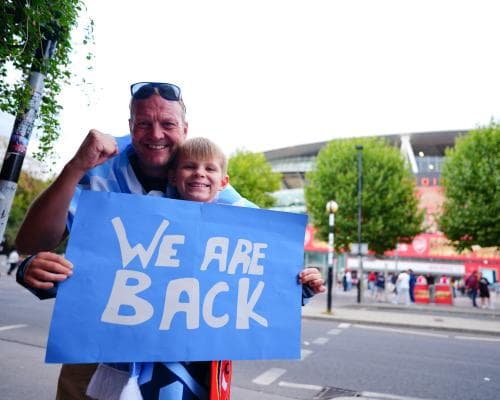
There is a particular hush that falls over the Emirates Stadium just before kick-off, a collective intake of breath from 60,000 souls who know they are about to witness something rare. Tonight, the air is thick with anticipation of a different sort—not just the usual Premier League theatre, but a collision of two worlds that could not be more different, yet share an identical hunger. Arsenal, the polished silverware of north London, face Coventry City, the Midlands romantics who have spent a quarter of a century clawing their way back to the promised land. As the floodlights hum and the pristine pitch glows like a billiard table, you realize this is not merely sport; it is a living diorama of aspiration, heritage, and the relentless pursuit of excellence that defines the modern luxury experience.
Mikel Arteta, the architect of Arsenal’s renaissance, stands pitchside with the calm of a man who has seen every possible future and chosen only the one he wants. His words, delivered in that measured, almost hypnotic cadence, are a manifesto for the high-performance life: “We have to be the best version of ourselves… deliver our game for 96 minutes every three days.” It is a philosophy that could apply equally to a Swiss watchmaker or a Bordeaux château owner—the obsessive attention to detail, the refusal to accept mediocrity, the understanding that greatness is not a moment but a discipline. Arteta’s Arsenal are the embodiment of this credo, a team rebuilt not with reckless spending but with surgical precision, each signing a deliberate brushstroke on a canvas that now gleams with the sheen of a collector’s piece.
Across the tunnel, Frank Lampard—a name that evokes Chelsea’s own golden era—speaks with a warmth that betrays his deep connection to Coventry’s journey. “The story of 25 years… what the fans were desperate for… we’ve managed to bring that back to the club.” His words are not the polished PR of a corporate behemoth but the heartfelt testimony of a man who understands that football, at its core, is about belonging. Coventry’s return to the Premier League is not a transaction; it is a homecoming. And as they step onto the Emirates turf, they bring with them a roster of debutants—Swiss defender Aurèle Amenda, Ghanaian midfielder Caleb Yirenkyi, French winger Loum Tchaouna—each one a story waiting to be written, a gem uncut, a future heirloom in the making. This is the beauty of the sport’s lower tiers: they are the ateliers where tomorrow’s masters are forged, away from the gilded glare of the elite.
For the traveling supporter—the one who flies in from Monaco or takes the helicopter from a Hampshire estate—the Emirates is more than a stadium; it is a destination, a pilgrimage site for those who appreciate the finer mechanics of the game. The executive boxes are not merely seats but private salons, where champagne is poured with the same reverence as a vintage Burgundy, and the match unfolds like a live performance of a Shakespearean drama. Tonight, the drama is heightened by the absence of Bruno Guimarães, Arsenal’s midfield maestro, felled by a groin strain that Arteta describes with the clinical detachment of a surgeon: “He did not have a pre-season… we need to take him bit by bit.” In the world of high-stakes sport, even the most refined machines require careful calibration, and Guimarães’s absence is a reminder that perfection is a process, not a product.
The market for such experiences—the premium matchday, the exclusive access, the chance to witness history—has never been more robust. For the ultra-wealthy, football is no longer just a game; it is a cultural currency, a way to signal taste and discernment. A box at the Emirates is not a purchase but an investment in narrative, a seat at the table of a story that will be retold for generations. And as Arsenal’s young debutant Christos Tzolis takes the pitch, you see the future in his eyes—the same fire that once burned in a teenage Thierry Henry, the same hunger that drives a collector to chase a rare Patek Philippe. The transfer window, with its whispers of new arrivals, adds another layer of intrigue, a reminder that even the most polished collections are never complete.
As the final whistle approaches, the scoreline matters less than the spectacle—the choreography of passing, the elegance of movement, the raw emotion of a Coventry fan who has waited 25 years to see their club on this stage. In that moment, the Emirates becomes a microcosm of the luxury life: it is not about the price tag but the experience, not the possession but the passion. For those who travel to football’s cathedrals, the real luxury is not in the box seats or the hospitality suites but in the shared belief that, on any given night, the beautiful game can still surprise us, still move us, still remind us why we fell in love with it in the first place. And as the lights dim and the crowd disperses, you carry that feeling with you—a souvenir more precious than any trophy, a memory that will outlast the season.