The Comeback of a Lifetime: How Qinwen Zheng Turned Certain Defeat into a Masterclass in Grit
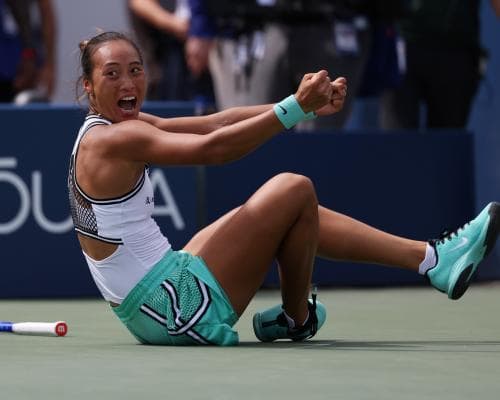
There are moments in sport that defy logic, and then there are moments that redefine the very essence of will. On a sweltering afternoon at the US Open, the tennis world witnessed the latter. Qinwen Zheng, a former world No. 4 who has slipped to No. 121 after a brutal injury layoff, was on the verge of elimination. Madison Keys, the American powerhouse, had served for the match at 5-1 in the final set. The crowd was already shifting in their seats, the commentators were writing their summaries, and the cameras were preparing for the handshake. But Zheng, with the quiet fury of a woman who has stared into the abyss of her own career and refused to blink, had other plans.
To understand the magnitude of this comeback, you must first understand the stakes. Zheng was not merely fighting for a place in the fourth round; she was fighting for relevance. A year ago, she was on the cusp of tennis royalty, a top-five player with a game that could dismantle anyone on any surface. Then came the injuries—'the worst few months of my career,' as she later described them. The ranking plummeted. The whispers began. She had to qualify for this tournament, a humbling experience for someone who once graced the sport's grandest stages. And here she was, down 5-0 to Keys, a player who had been serving with the precision of a Swiss watchmaker. The match point came and went, saved by a volley that was less a shot than a declaration of survival. Three consecutive breaks of serve followed, six games in a row, and suddenly Zheng was the one serving for the match. The pendulum of pressure, which had been so firmly in Keys' favor, had swung with such violence that the American could only throw her arms up in frustration.
What makes this victory so compelling is not the statistics—though they are staggering—but the craftsmanship of the comeback itself. This was not a collapse by Keys, but a resurrection by Zheng. She changed her tactics, turning rallies into prolonged chess matches, forcing the American into errors with a relentless mix of spin and depth. Her first serve, which had been timid, became a weapon. Her movement, which had been labored, became fluid. It was a masterclass in adaptation, a reminder that the greatest athletes are not those who never falter, but those who can recalibrate under the most extreme duress. In the luxury world, we speak of bespoke tailoring and hand-finished details. Zheng's performance was the athletic equivalent: a custom-made response to a crisis, executed with precision and flair.
For those who collect excellence—whether in art, automobiles, or achievements—this match offers a profound insight into the nature of value. We are drawn to the rarest items, the ones that have survived the most arduous journeys. A vintage wine from a difficult vintage, a one-of-one timepiece with a storied provenance, a comeback from the brink of defeat. Zheng's victory is the sporting equivalent of a rare gem, forged under immense pressure. It signals that true worth is not found in perfection, but in the ability to overcome imperfection. The luxury market has long understood this: the most coveted pieces are often those with a history of struggle, a narrative of resilience. Zheng's ranking may be low, but her marketability has never been higher. She has shown that she possesses the one commodity that cannot be bought or faked: character.
As the tournament progresses, and Zheng prepares to face either Iga Swiatek or Maria Bouzkova, the question is not whether she can win—she already has, in the most profound sense. The question is whether the rest of us, in our boardrooms and our private clubs, can learn from her example. We like to think that our success is a product of our environment, our resources, our connections. But Zheng, with her unseeded status and her battered body, reminds us that the ultimate luxury is the ability to rise when everything is against you. That is the new status symbol. Not the yacht, not the penthouse, but the unyielding belief that the match is not over until the last point is played. And as she walked off the court, elated and exhausted, she offered a simple truth: 'I always believed I could win. I just kept fighting.' That, in the end, is the only investment that truly matters.
The Experience
To witness such moments of resilience live, book a premium hospitality package at the next Grand Slam, where you can watch history unfold from the comfort of a private suite.