The Beautiful Chaos of the Beautiful Game: A Night at St. James’ Park
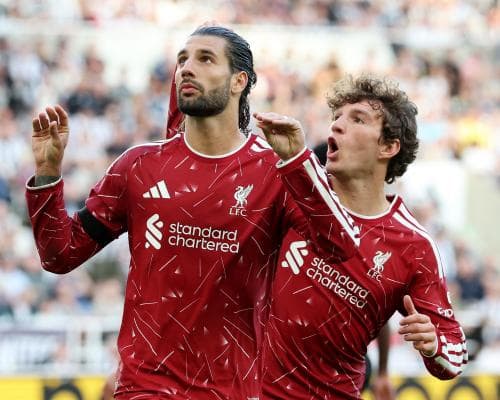
A late, late penalty from Dominik Szoboszlai rescued a point for Liverpool in a match that was less a football contest and more a masterclass in controlled pandemonium. For the discerning spectator, it was a reminder that the sport’s true luxury lies not in polished perfection, but in the raw, unpredictable theatre of human ambition.
There is a certain romance in the untamed. The Gallowgate End, draped in a banner quoting the late Kevin Keegan, set the tone before a single ball was kicked: “I want people to dream about their football. We should all be dreamers at heart.” And dream they did. For ninety-odd minutes, St. James’ Park became a stage for organised chaos, a symphony of misplaced passes and lightning-fast transitions that left both benches gripping the edge of their seats. This was not the pristine, possession-based football of the modern era; it was a throwback to a time when the game was a wild, beautiful beast, and the only rule was to survive it.
At the heart of this maelstrom were two managers, Matthias Jaissle and Andoni Iraola, each a conductor of disorder. Jaissle, in his nascent tenure at Newcastle, has clearly instilled a philosophy that prizes verticality over patience. His side, led by the irrepressible William Osula, attacked with the ferocity of a summer storm. Osula, a young Dane with the pace of a sprinter and the unpredictability of a jazz solo, tormented Liverpool’s central defence from the opening whistle. It was his burst of acceleration, following a sloppy giveaway by Ryan Gravenberch, that set up Anthony Elanga’s clinical finish after just five minutes. The goal was a statement: this was not a team content to merely compete; it was one intent on imposing its will through sheer athleticism and audacity.
But Liverpool, under Iraola, are no strangers to chaos. The Basque manager, known for his high-pressing, vertical style, seemed almost to relish the anarchy. His side’s response was not to calm the waters but to stir them further. Florian Wirtz, the visitors’ playmaker, attempted to impose a semblance of order, dropping deep to collect the ball and spray passes wide. Yet even his elegant touches were often swallowed by the frantic pace. The game became a blur of turnovers, last-ditch tackles, and counter-attacks that left defenders scrambling like commuters caught in a downpour. It was, as one seasoned observer noted, the kind of match that makes you forget your own name, so consumed are you by the spectacle.
For the collectors of footballing moments, this was a fixture rich in subtext. Alexander Isak, the returning hero, was supposed to be the story. The Swedish striker, who left Newcastle for Liverpool in a deal that made headlines, was expected to haunt his former club. Instead, he was a ghost, a peripheral figure in a game that belonged to the young and the reckless. Osula, his replacement, stole the spotlight with a performance that will be replayed in highlight reels for weeks. It is a reminder that in the world of elite sport, as in the world of fine art, the value of a piece is often determined not by its provenance but by its impact in the moment.
The market for such moments is, of course, insatiable. For the ultra-wealthy, football is not merely a game but a form of cultural currency. A ticket to a match like this, in the rarefied atmosphere of a Premier League stadium, is a commodity as coveted as a first-edition Patek Philippe or a case of Romanée-Conti. The experience, however, is far less predictable. That is its allure. In a world of curated lives and controlled environments, the beautiful game offers a rare dose of authentic, unscripted drama. It is the thrill of the unknown, the possibility of a late, late twist that no amount of money can guarantee.
What does this match signal about the state of luxury taste? Perhaps it is a shift away from the sterilised, data-driven approach that has dominated football for a decade. The success of Jaissle and Iraola, both of whom favour a more visceral, instinctive style, suggests a growing appetite for the unpredictable. The connoisseur, it seems, is tired of the same old Bordeaux; they crave the wild, untamed wines of a new vintage. This is football as it was meant to be played: with heart, with passion, and with a glorious disregard for the consequences.
As the final whistle blew, the scoreline read 1-1, a result that felt both anticlimactic and perfectly apt. Szoboszlai’s stoppage-time penalty, won after a VAR check that had the entire stadium holding its breath, was a fitting end to a night of high drama. It was a moment of individual brilliance, but also of collective relief. For the neutral, it was a reminder that football, at its best, is not about perfection but about possibility. And for those who collect experiences, who seek out the moments that money can’t buy, this was a masterclass in the art of the unexpected. As Keegan would have said, it was a dream worth having.