The Balkans' Billionaire-Backed Chess Move: How the Youth Sport Games Became a Geopolitical Playground
The Plazma Youth Sport Games, celebrating 30 years in Split, has evolved from a regional amateur sports event into a soft-power magnet attracting tech billionaires and sports icons. Its blend of grassroots competition and elite networking signals a new model for youth engagement amid geopolitical shifts in Southeast Europe.
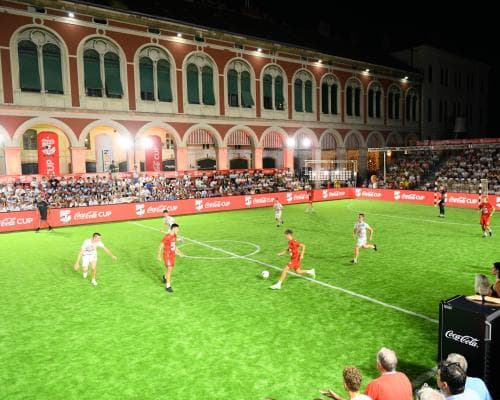
On a sunlit dais above the Adriatic, a circle of children isn't just playing chess—they're playing a game within a game. Each move against grandmaster Nigel Short comes with a whisper from a rotating cast of celebrity coaches: former tennis star Ana Ivanovic, ex-Burnley manager Sean Dyche, and, in a twist that would make any tech conference blush, the rightwing billionaire Peter Thiel. This isn't a Silicon Valley retreat. It's the 30th anniversary of the Plazma Youth Sport Games (YSG) in Split, Croatia, where nearly half a million children from the Balkans competed in qualifiers for a week of finals in 10 sports, from 3v3 basketball to chess.
What began as a regional sports day has morphed into what some visitors call 'the Davos of sport'—a curious hybrid of amateur athleticism and elite networking. The presence of Thiel, a man more associated with Palantir's data warfare and seasteading fantasies than with youth chess, is not accidental. For a region still navigating the post-Yugoslav identity, YSG offers a stage where power brokers and kids share the same sandbox. The organizers bill it as a 'social project' first, a sporting event second, and the pitch is working: Zlatan Ibrahimovic and Alastair Campbell have signed on as ambassadors, and Dyche left evangelized, calling the Games 'a brilliant initiative.'
The technology here isn't silicon—it's scale and sentiment. YSG's real innovation lies in its ability to convert fleeting celebrity attention into durable regional pride. The chess event, with its AI-assisted coaching tips (yes, there's an app), is a microcosm of a larger trend: using sport as a delivery mechanism for lessons in teamwork, collaboration, and even digital detox. 'Put your phones away' is a literal rule, yet the event's digital backend—ticketing, live scoring, and social amplification—runs on the same tools that power global tech summits. This duality is the signal: youth events are no longer just about medals; they're about building networks that outlast the tournament.
Competitively, YSG sits in a crowded field of youth sports initiatives, from the Olympics' Youth Games to FIFA's grassroots programs. But its Balkan focus gives it a unique geopolitical edge. With Croatia now in the eurozone and Schengen, and Serbia eyeing EU membership, the Games serve as a low-stakes dress rehearsal for regional cooperation. The presence of figures like Thiel—who has funded Balkan startups and holds a dim view of European bureaucracy—adds a layer of ideological tension. Is this a benevolent playground or a soft-power proxy? The answer is both, and that ambiguity is precisely why it attracts capital and curiosity.
For the deep-tech and elite-capital crowd, YSG is a case study in 'attention arbitrage.' Billionaires and celebrities get a feel-good halo; children get once-in-a-lifetime mentorship; and the region gets a global spotlight that no tourism campaign could buy. The economics are compelling: the event's low overhead and high emotional ROI make it a repeatable model for other emerging markets. As Western tech hubs face burnout and regulatory fatigue, the Balkans offer a fresh canvas—young, digital-native, and hungry for legitimacy.
Looking ahead, the next decade will test whether YSG can scale beyond its 30-year legacy. The organizers are already eyeing esports and AI-driven talent scouting, which could merge the chess circle with algorithmic analysis. If they pull it off, the Games could become a prototype for how youth sports, tech, and diplomacy intertwine. The children on that dais won't just be playing chess; they'll be moving pieces on a board where the next move belongs to them—and to the billionaires who choose to sit beside them.
For now, the Adriatic breeze carries a simple lesson: the future of regional influence isn't written in boardrooms or policy papers. It's played out one move at a time, in the laughter of kids who don't yet know they're part of something bigger. And that, perhaps, is the most brilliant initiative of all.