The Art of Discretion: When Even a President Needs a Yacht-Like Escape
A secret midnight transfer from Air Force One to a military jet—a logistical ballet worthy of a superyacht owner's covert rendezvous—reveals the ultimate luxury of our era: invisibility. For the ultra-wealthy, this is not paranoia but prudence, a lesson in moving through the world unseen.
There is a moment in every great escape—whether from a crowded marina in Saint-Tropez or a NATO summit in Turkey—when the world believes you are one place, and you are, in fact, another. The recent revelation that a certain world leader slipped off his gleaming jumbo jet via a catering truck, only to board a shadowy military aircraft bound for Britain, is not merely a tale of geopolitical intrigue. It is, for those of us who curate lives of quiet magnitude, a masterclass in the art of the unseen. The glossy magazine covers show the yacht, the villa, the vintage Ferrari. But the true connoisseur knows that the real prize is the ability to disappear—to be, quite literally, elsewhere when the world expects you to be here.
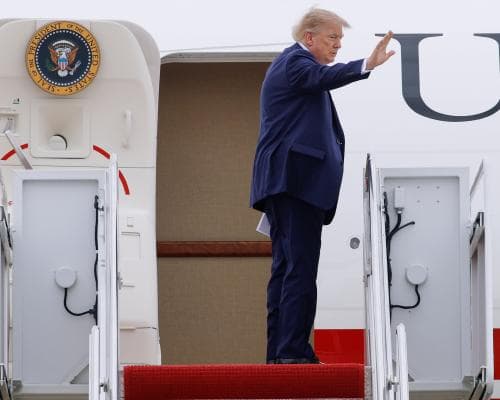
The scene unfolded with the kind of choreography normally reserved for a Monaco heist film. President Trump, having just attended a NATO summit, boarded Air Force One in full view of the press corps, waving with practiced confidence. Cameras clicked, the gangway retracted, and the world assumed the most powerful man on earth was settling into his leather throne for a transatlantic hop. But then, the subtle magic. A catering truck—that humble workhorse of airport logistics—pulled up alongside the presidential aircraft. The Secret Service, in a move that would make any superyacht captain proud, executed a silent exchange. The president was hustled out of the jumbo jet, through the service door, and into the unmarked truck, which then delivered him to a waiting military aircraft. Journalists and even several White House staffers remained aboard Air Force One, blissfully unaware that their commander-in-chief was no longer among them.
For the ultra-wealthy, this is not paranoia; it is prudence. The same logic that compels a billionaire to install a panic room in a Belgravia townhouse or to keep a second, unlisted superyacht in a discreet Indonesian anchorage is at play here. The threat was real, or at least perceived as such: an alleged Iranian assassination plot, reported by the Washington Post and the New York Times, had put the president's security detail on high alert. The elaborate ruse—the catering truck, the decoy aircraft, the silent transfer—was not an overreaction but a calculated response to a specific, credible threat. In the world of high-net-worth individuals, such measures are not anomalies but standard operating procedure. The difference is that most of us never read about them in the morning papers.
This is the new luxury, and it is not for sale in any boutique. It is the luxury of operational security, of having a team that can move you across continents without a single footprint left on the digital or physical map. For years, the status symbol was the biggest yacht, the fastest car, the most private island. Now, it is the ability to vanish. The catering truck is the new Maybach; the unmarked military jet, the new Gulfstream. The craftsmanship here is not in leather stitching or carbon fiber but in logistics—the meticulous planning, the redundant systems, the quiet professionalism of those who ensure that the principal is never where the threat expects him to be.
The market for such discreet services is booming, even if it operates entirely in the shadows. Security consultancies that once catered to heads of state now serve a clientele of tech founders, hedge fund managers, and entertainment royalty. They offer 'executive protection' that includes route planning, counter-surveillance, and, yes, the occasional covert transfer via an airport service vehicle. The cost is significant—a dedicated security detail for a year can easily run into the millions—but for those who have everything, this is the ultimate insurance policy. It is not about fear; it is about freedom. The freedom to move without explanation, to attend a summit or a family wedding without the world's commentary, to live a life where the only headline is the one you choose to write.
What does this tell us about the current state of luxury taste? It signals a shift from ostentation to opacity. The era of the 'look at me' superyacht, with its helipad and glass-bottomed pool, is giving way to a quieter, more considered form of wealth. The truly powerful no longer want to be seen; they want to be understood—on their own terms. This is why the most sought-after residences are not the penthouses with panoramic views but the townhouses with underground garages and private lifts. It is why the most exclusive clubs are not in St. Moritz or Gstaad but in unmarked buildings in London and New York. The president's secret flight is merely the most public example of a private truth: visibility is vulnerability, and the only true luxury is control.
Looking forward, we can expect this trend to deepen. As geopolitical tensions rise and digital surveillance becomes more invasive, the ultra-wealthy will invest even more heavily in what I call 'invisible infrastructure.' Expect to see more private terminals, more secure communication networks, and more 'decoy' yachts—vessels that sail to one destination while the owner is flown to another. The catering truck, once a symbol of airport banality, may well become the most coveted asset in the private aviation fleet. And while the rest of the world debates the politics of it all, the connoisseur will simply nod, pour a rare vintage, and appreciate the flawless execution of a very difficult maneuver. After all, in the curated life, the greatest statement is often the one you never have to make.