The actuary who modelled a city out of the ocean: inside Eko Atlantic's financial blueprint
Eko Atlantic's financial model was built by Olawale Opayinka, an actuary brought in 2011. He reveals how Lagos's luxury city took shape.
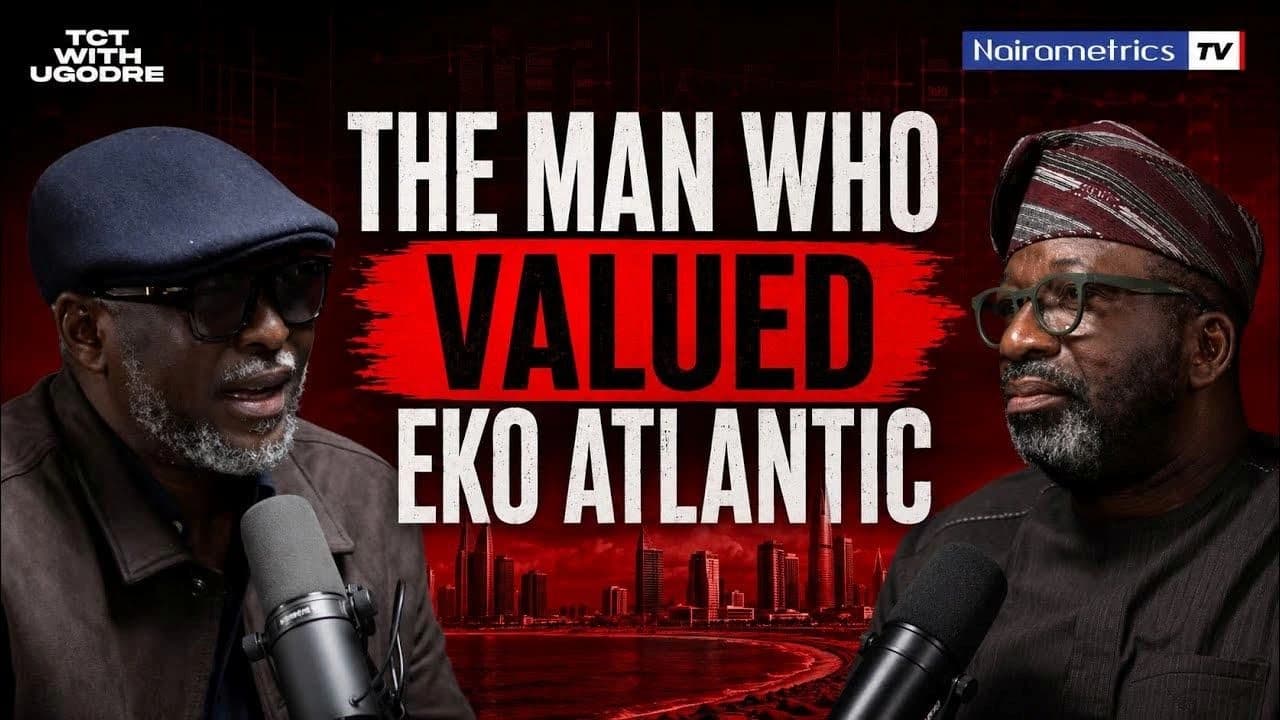
For anyone tracking where Africa's serious money is being placed, the most revealing story out of Lagos this week isn't about a refinery or a telecom merger. It's about a spreadsheet — or rather, the man who built the financial architecture for a city that didn't exist yet. Olawale Opayinka, founder of Makaya Consult FZE, has gone public with a detail that had stayed buried for over a decade: he was brought into the Eko Atlantic project in 2011, when the site was still ocean swallowing the mainland, to create the financial model that would turn a patch of Atlantic into prime real estate.
Opayinka's disclosure, made on The Coffee Table podcast with Ugodre Obi-Chukwu, pulls back the curtain on one of Africa's most audacious urban experiments. Eko Atlantic is a planned city built on 10 million square meters of reclaimed land off Victoria Island. It now leads Lagos's luxury residential market with 59.5% sales growth over five years, and a two-bedroom shortlet there runs N325,000 a night. But before the towers and the 24/7 security, before the expatriates and the high-net-worth tenants, there was a modelling problem: how do you price a city that hasn't been built, on land that was underwater, in a country where demographic data is patchy at best?
Opayinka's answer came from actuarial science — a discipline built on quantifying uncertainty. He trained with the Institute of Actuaries, and around 2000 became the first Black consultant to set up an actuarial firm in the UK, working with the Financial Services Authority. That background matters because it shaped how he saw Nigeria's trajectory. He points out the population has nearly quadrupled in 50 years, from about 65 million in 1976 to roughly 240 million today. Lagos, already estimated at 20 million, could double within 15 years. For an actuary, that's not a crisis; it's a calculation. And for Eko Atlantic, it's the bull case — a city built for a future where Lagos's elite need somewhere to live that isn't gridlocked or flooded.
The deeper story here is about who gets to build Africa's future. Eko Atlantic isn't a government project; it's a private development riding on reclaimed land, master-planned infrastructure, and a bet that Nigeria's wealthy will pay for certainty. Opayinka argues Nigeria is uniquely permissive — a place where street trading and billion-dollar refineries can coexist, where a hairdresser can out-earn a salaried professional. That freedom, he says, means Nigerians have little excuse to blame external forces for their economic condition. It's a contrarian view in a country where many feel the system is rigged, but it's also the logic that underpins Eko Atlantic: build your own island, literally, if the mainland doesn't work for you.
Opayinka also offers a framework for national unity, slicing Nigeria's population into four life-stage cohorts — education, industry, experience, and what he calls the Gray Panthers. He contrasts Nigeria's ethnic fragmentation with Singapore's shared values under Lee Kuan Yew. It's an idealistic pitch, but it lands differently coming from a man who has spent 15 years modelling a city for a demographic tsunami. He sees the doubling of Lagos as both a bigger crisis and a big opportunity — and he's positioned himself at the intersection of both.
What Eko Atlantic signals, for anyone watching African capital flows, is that the continent's wealth is increasingly self-segregating. As Ikoyi and Banana Island also post double-digit growth, the pattern is clear: the ultra-rich are clustering in fortified, professionally managed enclaves where drainage works and power doesn't fail. The question is whether this model — building new cities on water rather than fixing the ones on land — is a blueprint or a warning. For now, Opayinka's actuarial mind is betting on the former. And with Lagos's population set to surge, he may not be wrong — but the rest of the city will be watching from the shore.