The $900 Billion Wake-Up Call: How America’s Naval Might Is Being Quietly Cannibalized
A Guardian investigation reveals that the U.S. Navy is raiding payroll accounts to fund combat operations against Iran, leaving strategic budgets in tatters. For those who collect and command the world’s most formidable vessels, this is the ultimate cautionary tale about the cost of power at sea.
There is a certain romance to the American aircraft carrier — a floating city of steel and swagger, the ultimate expression of maritime dominance. But beneath the polished decks and the bravado, a quieter, more troubling story is unfolding. Documents obtained by the Guardian, alongside interviews with navy officials, contractors, and defense analysts, paint a portrait of a force quietly cannibalizing itself. Not through enemy fire, but through the mundane, grinding arithmetic of war. The U.S. Navy, it turns out, is robbing Peter to pay for bombs — and Peter is starting to notice.
The conflict in question, launched on February 28, has become a fiscal black hole. The navy, which spearheaded the initial strikes and now maintains a sprawling blockade, has seen its operational costs spiral beyond any projection. A Pentagon memo warns of “shortfalls in payroll” after the department “raided” those accounts to cover combat expenditures. One retired naval officer, Harlan Ullman, put it with the bluntness of a man who has seen too many budget cycles: “The piggy bank is broken.” This is not a metaphor. It is a ledger sheet, and it is bleeding red.
For the uninitiated, consider what this means in practical terms. Payroll is the lifeblood of any military — the steady, unglamorous stream that keeps sailors fed, housed, and paid. When that stream is diverted, the consequences ripple outward. Non-emergency maintenance on shore-based facilities has been deferred, according to one official and one contractor. That means a pier here, a hangar there, left to rust while the war machine churns. It is the maritime equivalent of skipping oil changes on a vintage Ferrari to afford the fuel for a cross-country race. You might win the sprint, but the engine will seize long before the finish line.
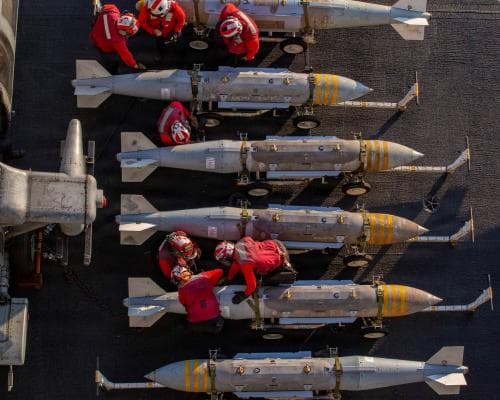
The craftsmanship of naval power is, at its core, a study in patience. A destroyer like the Arleigh Burke-class is a masterpiece of engineering — 9,000 tons of precision, built over years, crewed by hundreds. Its Aegis combat system can track a hundred targets simultaneously, a ballet of radar and missiles that would make a Swiss watchmaker weep. But none of that matters if the budget for spare parts is stripped to fund a Tomahawk launch. The navy’s munitions stockpiles, already depleted by months of strikes, are now a national security talking point. The White House has asked Congress for emergency funding, but in a political climate where the war’s popularity has cratered, that request is about as welcome as a skunk at a garden party.
This is where the collector’s eye turns sharp. The ultra-wealthy who commission custom superyachts understand that a vessel is only as good as its upkeep. You can buy the hull, the engines, the Italian leather — but the real investment is the crew, the maintenance, the endless cycle of refits and overhauls. The U.S. Navy is learning this lesson on a scale that would bankrupt a dozen sovereign wealth funds. One navy official, briefed on the service’s contingency plans, described the creative accounting with a shrug: “The money for payroll was robbed to pay for overseas contingencies and is being backfilled by money that ha…” The sentence trails off, because there is no honest ending. There is only the next raid, the next transfer, the next shell game.
For those who track the defense-industrial complex as a hobby — and there are many, often the same men who bid on decommissioned patrol boats at auction — this story is a warning flare. The navy’s budget is not infinite. Its carriers, its submarines, its silent underwater drones are all part of a delicate ecosystem. When you starve the payroll, you don’t just lose sailors. You lose the institutional knowledge they carry, the tacit expertise that no manual can replace. And once that’s gone, it takes decades to rebuild. The private sector knows this. A shipyard like Fincantieri or Lürssen would never dream of deferring wages to fund a new build. But the Pentagon, under the gun of an unpopular war, has no such luxury.
Looking forward, the question is not whether the navy will recover — it will, eventually, because it must. The question is what it will look like when it does. Will it be a leaner, meaner force, stripped of fat but sharp of tooth? Or will it be a hollowed-out shell, its decks polished but its coffers empty, a monument to the cost of hubris? For the collectors of the world, the ones who watch these things from the decks of their own 100-meter vessels, the answer matters. Because the sea, as any sailor will tell you, is unforgiving. And it has a long memory for those who fail to pay their bills.