The 10,000-Ton Yacht That Wasn't: Inside the USS Benfold's Silent Drift
When a billion-dollar guided-missile destroyer loses power in the South China Sea, the ultra-wealthy might call it a breakdown—but for those who understand naval engineering, it's a rare glimpse into the fragility of even the most formidable machines. The USS Benfold's four-day adrift offers a lesson in resilience, maintenance, and the quiet luxury of redundancy.
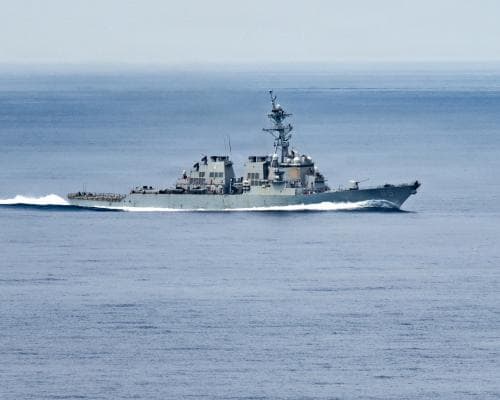
Imagine a 10,000-ton vessel, a steel leviathan bristling with advanced radar and vertical launch cells, suddenly going dark. No hum of generators, no chill of air conditioning, no glow of navigation screens. For four days in late July, the USS Benfold—an Arleigh Burke-class guided-missile destroyer that would make any superyacht look like a dinghy—drifted powerless in the South China Sea, a silent ghost in one of the world's most contested waterways. It's the kind of mechanical failure that would send shivers through any captain, civilian or military, and it offers a rare, unfiltered look at what happens when the ultimate expression of maritime engineering meets its match.
The Benfold, which had been sailing with the George Washington Carrier Strike Group, suffered what the US Seventh Fleet called "an engineering casualty involving its generators." For the uninitiated, that means the ship's electrical heart stopped beating. No power meant no galley services, no toilets, no air conditioning—a brutal reality for the 300-plus crew aboard, who suddenly found themselves in a floating sauna with no escape. The cruiser USS Robert Smalls had to step in to feed the crew, a logistical ballet that speaks to the interdependence of naval formations. For those of us who collect vessels—whether a 40-meter motor yacht or a vintage sailing sloop—the lesson is universal: even the most sophisticated systems are only as good as their redundancy.
What makes this story so compelling for the luxury-minded is the craftsmanship and heritage embedded in the Benfold herself. An Arleigh Burke-class destroyer is a masterpiece of American naval architecture, designed in the 1980s and continuously upgraded to remain at the cutting edge of naval warfare. At 10,000 tons, she's a floating city of advanced technology, from Aegis combat systems to gas turbine engines that can push her past 30 knots. The fact that she lost power is not a mark of poor design but a reminder that even the finest machines—be they a Patek Philippe movement or a Bugatti W16—require meticulous care and occasional downtime. The crew's response, as described by Commander Matthew Comer, was one of "resilience, grit, professionalism and unwavering steadiness." That's the kind of composure you'd expect from a seasoned captain in a Force 10 gale, not a 24-year-old sailor in a dark, sweltering passageway.
For collectors and connoisseurs, the Benfold incident is a stark reminder of the human element behind every grand machine. The ship was towed to Subic Bay in the Philippines—a name that evokes colonial-era naval bases and Cold War intrigue—and power was restored two days later. No injuries, no casualties, just a temporary loss of function. But the episode comes at a time of heightened scrutiny on the US Navy's operational tempo. The George Washington strike group was en route to the Middle East to relieve the USS Abraham Lincoln, a carrier that has seen reports of multiple sailor suicide attempts after more than 200 days without a port call. Democratic lawmakers and military families have demanded answers about low morale and mental health challenges, asking whether the strain on deployed service members is too great. This is not a story about a yacht's faulty stabilizer; it's about the cost of pushing any machine—and its crew—to the edge of endurance.
In the world of ultra-luxury, we often romanticize the idea of the perfect object: the hand-stitched leather, the hand-polished chrome, the hand-tuned engine. But the Benfold reminds us that perfection is an aspiration, not a state. Even the most advanced warship, a symbol of American might and technological prowess, can be humbled by a faulty generator. The true luxury, then, lies not in the object itself but in the preparation for failure—the backup systems, the spare parts, the training that turns a crisis into a manageable inconvenience. For the ultra-wealthy, this is a lesson in resilience: whether it's a private island's desalination plant or a classic car's electrical system, the art of maintenance is the ultimate status symbol.
As the Benfold sails on, her generators humming once more, the incident will likely be filed away as a footnote in naval history. But for those who understand the delicate dance between human and machine, it's a story worth savoring. It's a reminder that the sea is indifferent to our ambitions, and that even the mightiest vessels are, at their core, just floating metal—until the people aboard make them something more. In an age of AI-driven everything and autonomous superyachts, there's a certain comfort in knowing that sometimes, the most advanced technology in the world just needs a tow and a good crew. That's the kind of authenticity money can't buy—but it can certainly appreciate.