Saving the Sacred Dark: How Australia’s Karlu Karlu Became a Sanctuary for the Stars
A remote Northern Territory reserve, home to ancient granite boulders and sacred to four Indigenous groups, has been named an International Dark Sky Sanctuary—only the third in Australia. The designation is a triumph of collaboration between traditional owners, local councils, and conservationists to protect a night sky of profound cultural and scientific value.
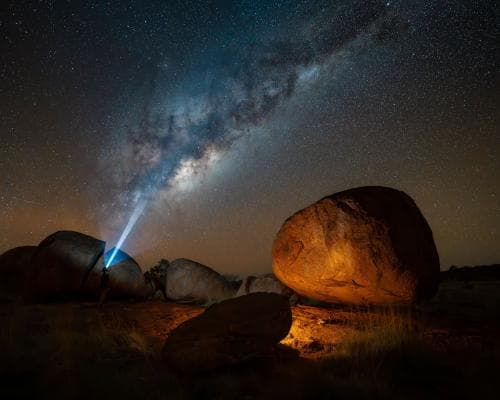
There is a place in Australia’s red center where the stars don’t just twinkle—they blaze. Where the Milky Way spills across the sky like a river of diamonds, and the darkness is so deep you can feel it on your skin. That place is Karlu Karlu, also known as the Devils Marbles, a sweeping 1,800-hectare conservation reserve about 100 kilometers south of Tennant Creek in the Northern Territory. And as of this month, it holds a rare and luminous distinction: it is now an International Dark Sky Sanctuary, one of only 24 such sites on Earth, and the first in the Territory.
This is not a story about a billionaire with a telescope. It’s a story about a community of traditional owners—the Kaytetye, Warumungu, Warlpiri, and Alyawarra peoples—who have known for millennia what the rest of us are only beginning to appreciate: that the night sky is not just a spectacle, but a sacred archive. For them, Karlu Karlu is not merely a geological wonder of balancing granite boulders; it is a living cultural landscape, where every shadow and stone carries ancestral meaning. Almost the entire reserve is a sacred site. And now, that sanctity extends upward, into the heavens.
The journey to this designation was neither quick nor easy. It began with a submission led by the Northern Territory’s Department of Tourism and Hospitality, but the real engine was a year-long, ground-level effort by NT Parks and Wildlife, working hand-in-hand with traditional owners and local councils. The process demanded six months of continuous night-sky readings to measure darkness levels, a meticulous audit of artificial lighting across the reserve, and a forward-looking assessment of future risks—from mining glow to tourist headlights—that could threaten the pristine darkness. This wasn’t a box-ticking exercise; it was a scientific and cultural vetting of the highest order.
The mechanics of the achievement are as inspiring as the outcome. To earn the International Dark Sky Sanctuary status, a site must demonstrate exceptional quality of starry nights and a protected environment that is increasingly rare in our light-flooded world. The team had to quantify what the traditional owners have always known intuitively: that Karlu Karlu’s skies are not just clear, but pristine—so dark that the faintest celestial phenomena, like the zodiacal light and the Magellanic Clouds, are visible to the naked eye. They also had to craft a management plan that balances future visitation with cultural protocols, ensuring that any growth in stargazing tourism doesn’t trample the very sanctity the designation is meant to protect.
The broader impact is profound, both for conservation and for cultural pride. This designation puts Karlu Karlu on a global map of dark-sky havens, alongside the only other two Australian sites: Arkaroola Wilderness Sanctuary in South Australia and the Australian Age of Dinosaurs Museum in Queensland. But unlike those, Karlu Karlu is the first to be co-managed with traditional owners as a sacred site, setting a precedent for how Indigenous knowledge and modern conservation science can converge. It also offers a powerful economic lifeline for a remote region—astrotourism is a growing niche, and visitors who come to marvel at the stars will leave with a deeper respect for the land and its first custodians.
For the culture of giving, this is a reminder that philanthropy isn’t always about writing checks. Sometimes, the most generous act is to protect something intangible—like darkness—for future generations. Philip Cowan, senior director of NT Parks and Wildlife Operations, put it simply: the designation represents “a commitment to protect and promote the night sky.” But it’s more than that. It’s a gift from a community that has watched over this land for tens of thousands of years, now inviting the world to look up and see what they’ve always seen. In an era of relentless light pollution, Karlu Karlu stands as a beacon of humility—a place where we don’t conquer nature, but surrender to its wonder.