Nigeria’s Market Isn’t Cheap—It’s Shallow, and the Dangote Refinery IPO Won’t Fix That
Why Nigeria's stock market looks undervalued but is really a shallow proxy for a vast, largely unlisted economy—and how the Dangote refinery IPO deepens the problem.
For anyone tracking African capital, Nigeria’s equity market has long been the continent’s most tantalizing paradox: a GDP of over $300 billion, yet a stock exchange that feels more like a boutique than a bourse. The traditional Buffett Indicator—market cap divided by GDP—suggests the country is structurally cheap, a bargain waiting for the right investor. But as a new analysis from BusinessDay makes clear, that’s a statistical mirage. Nigeria isn’t cheap; it’s shallow. The market is a narrow window onto a vast, mostly unlisted economy, and the upcoming Dangote Petroleum Refinery IPO—the most anticipated listing in years—will only make that window narrower.
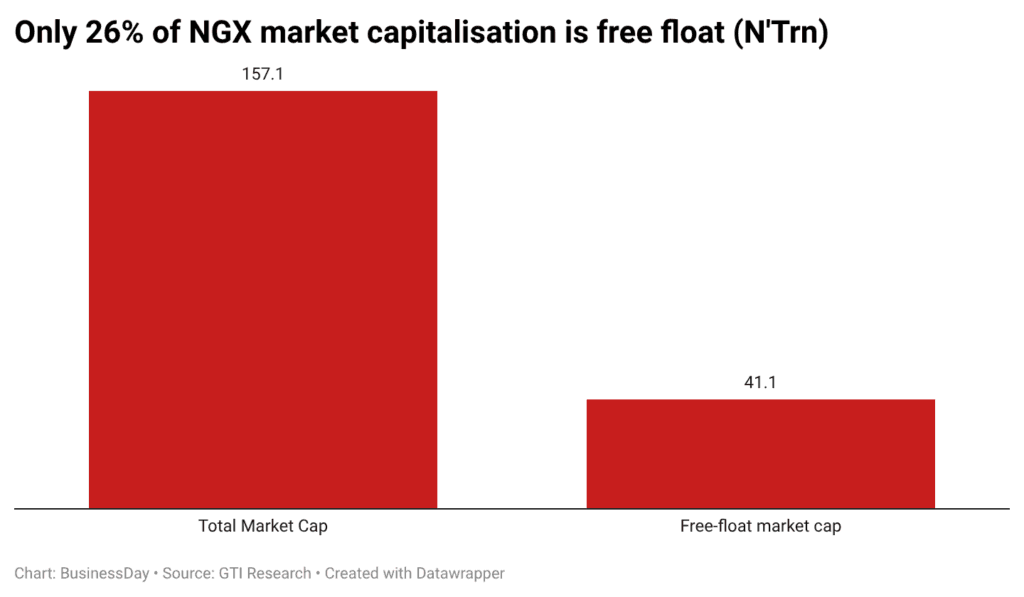
The numbers tell the story. As of August 2026, the Nigerian Exchange’s total market capitalization is around N157 trillion, but when you strip out the shares that aren’t actually available to trade—the free-float—you’re left with just N41.1 trillion. That’s a free-float ratio of about 26 percent, far below what you’d see in more mature markets. When you adjust the Buffett Indicator for that reality, Nigeria’s so-called cheapness evaporates. The real ratio of investable equity to GDP is around 10 percent, compared to 30–55 percent in emerging markets and over 100 percent in developed ones. In plain terms: Nigeria’s economy is deep, but its stock market is a puddle. The gap isn’t a discount—it’s a structural feature.
Why the disconnect? Three distortions stand out. First, listing density is brutally low. The NGX has just 147 listed companies, versus over 430 in South Africa and 5,500 in India. In 2025, the exchange recorded zero IPOs. The Technology Board, launched in 2022, hasn’t seen a single listing. Meanwhile, an estimated 50–70 percent of Nigeria’s GDP comes from unlisted conglomerates, SMEs, and the informal sector—businesses that generate wealth but never issue shares. Second, ownership is hyper-concentrated. Ten stocks—Airtel, Dangote Cement, MTN Nigeria, BUA Foods, BUA Cement, Seplat, First HoldCo, Aradel, HBM, and Zenith Bank—account for 72 percent of total market cap. The top 30 make up 94 percent. These are often family-controlled or state-linked firms with thin free floats, so their market caps are more about control than liquidity. Third, even the earnings boom in banking hasn’t translated into broad participation. Foreign investors, who briefly accounted for 19 percent of trading in August 2025, have since retreated to single digits, and monthly turnover of N1.5–2 trillion against a N157 trillion market cap is a sign of chronic illiquidity, not health.
Enter the Dangote Petroleum Refinery IPO—the listing that’s supposed to break the drought. At an implied valuation of $40–50 billion, the refinery’s full equity value would equal 34–42 percent of the NGX’s entire current market cap. But only about 10 percent is being floated, which means the newly listed shares would be worth roughly N7 trillion ($5 billion). That would make the refinery the single largest free-float-weighted stock on the exchange from day one. Far from diversifying the market, the listing would deepen its concentration. It’s a perfect illustration of the Investable Economy Ratio (IER) framework: Nigeria’s market isn’t cheap because it’s undervalued; it’s cheap because there’s so little to buy.
For the international investor, this is a crucial lesson. The Dangote refinery IPO will be a landmark moment—a symbol of Nigeria’s industrial ambition and a rare opportunity to own a piece of the country’s most strategic asset. But it won’t transform the NGX into a broad-based capital market. The real challenge lies in the structure: too few listings, too much family control, and an economy where the most dynamic sectors—tech, logistics, even parts of manufacturing—remain stubbornly private. Until Nigeria addresses that, its equity market will remain a niche play for the bold, not a benchmark for the continent’s growth. The refinery IPO is a big deal, but it’s a bigger reminder of what’s still missing.