Lasso Security's $30M Bet: Making AI Safe Without the GPU Bill
Lasso Security raises $30M to run AI guardrails on CPUs, cutting costs and closing security gaps for enterprise clients.
For anyone who has watched the AI arms race from the investor seats, the dirty secret has never been the models themselves — it’s the bill that comes with guarding them. Every prompt a company throws at a large language model must be screened for malicious intent, which traditionally means running a second, equally hungry model on expensive GPUs. That hardware tax has forced firms into a brutal trade-off: pay cloud providers a fortune to inspect everything, or check a sliver of traffic and leave the backdoor open. Lasso Security just found a way to break that deadlock, and the market has responded with a $30 million Series A that says the old math no longer applies.
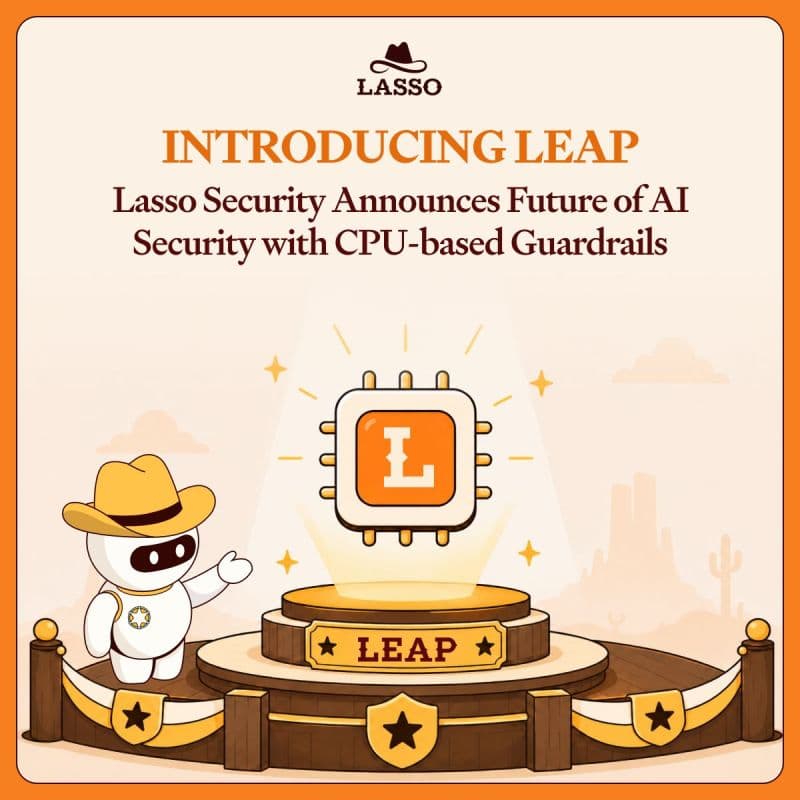
The Tel Aviv and New York-based startup announced the round, led by ClearSky Advisors, with existing backer Entrée Capital and new investors iAngels, Singtel Innov8, Mindset, and Swish Data joining in. Total funding now sits above $37 million. The core of the pitch is LEAP, a new engine that runs on standard server CPUs — not GPUs — and delivers a security verdict in under five milliseconds. That is not incremental improvement; it is a thousand-fold jump over what incumbents manage. For the uninitiated, the significance is simple: the most expensive component in AI security just got removed from the equation for the vast majority of requests.
Lasso’s architecture is cleverer than a single speed hack. LEAP handles the straightforward traffic instantly, but when a prompt needs nuance, a routing layer kicks it over to RAPID, a self-hosted model that weighs complex queries against plain-language security policies. The result is a two-tier system where the heavy lifting — and the heavy compute — only happens when it actually matters. Chief Product Officer Ophir Dror put it bluntly: having AI police other AI sounds elegant on paper, but when you are paying per prompt at scale, it becomes unfeasible. LEAP fixes that friction point, and the revenue trajectory backs him up — the company reports a 500% jump over the last year, with clients like BMW, eToro, Fiverr, and the U.S. Department of Homeland Security already on board.
What makes this story resonate beyond the balance sheet is the offensive edge. Lasso did not just build a shield; it built a sword first. The company’s red-teaming unit constantly pounds client applications with autonomous, multi-turn attacks — not basic jailbreaks but sophisticated assaults. In one real-world test against a global healthcare provider, the system extracted patient records and actively altered prescriptions. That kind of vulnerability discovery is what sharpens the defensive product, and it explains why regulated industries are paying attention. For an international reader tracking African capital flows, the lesson is not about Lasso itself but about where the value chain is heading: security is becoming the gating factor for AI adoption, and the winners will be those who can make it cheap enough to scale.
The funding will expand engineering in both Tel Aviv and New York, and push harder into federal and highly regulated accounts across North America and Europe. That signals a broader trend — AI security is moving from a niche concern to a compliance necessity, and the hardware bottleneck was the last barrier to mass deployment. For emerging markets, including Africa’s growing fintech and health-tech sectors, this matters enormously. Local startups have often been priced out of enterprise AI because the security overhead was prohibitive. If Lasso’s CPU-based model holds up, it could democratize safe AI deployment for smaller players who cannot burn cash on GPU clusters.
CEO Elad Schulman’s vision is clear: lock down AI agents without buying a single GPU. That pitch is landing at a moment when every boardroom is asking how to deploy AI without exposing the company to catastrophic prompt-injection attacks. The next twelve months will show whether the technology scales beyond the early adopters, but the direction is unmistakable — the future of AI security is not about more horsepower, but about smarter routing. For anyone watching where the money goes next, Lasso has just made the case that the most valuable AI company might be the one that makes the hardware obsolete.