Crusoe’s $3B Series F and $13B Jane Street Deal Signal a New Era for AI Power
Crusoe raises $3B at $30B valuation, inking a $13B AI cloud deal with Jane Street to build off-grid data centers.
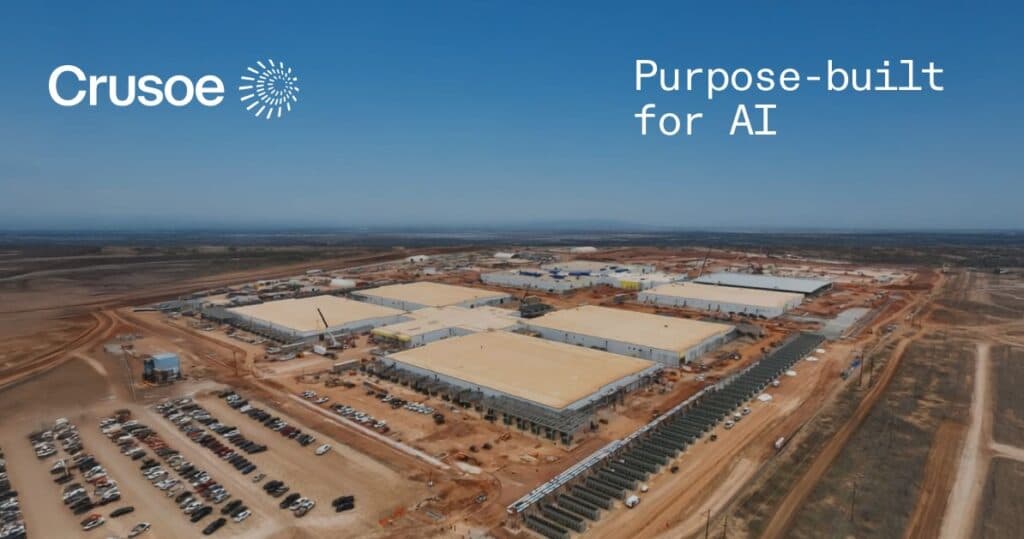
For anyone tracking the global race to build artificial intelligence, the real bottleneck has never been chips — it’s electricity. AI models devour power at a rate that grids from Virginia to Frankfurt simply cannot supply, and the wait for new transmission lines can stretch a decade. Enter Crusoe, a company that has turned this crisis into a business model, and one that just convinced Wall Street to back its bet with $3 billion in fresh funding, valuing the firm at $30 billion. That valuation — a leap from its previous rounds — is not just a number; it’s a signal that the market now sees energy infrastructure as the most critical layer of the AI stack.
Crusoe’s pitch is elegantly simple: instead of waiting for the grid to catch up, build data centers right next to stranded energy sources — like natural gas flares that would otherwise be burned off and wasted — and pipe that power directly into high-performance computing. The company has raised $3 billion in a Series F round, money that will go toward deploying massive, purpose-built AI data centers across the globe. These aren’t your typical server warehouses; they are hyper-dense facilities with liquid cooling and racks designed specifically for the thermal and electrical demands of advanced AI GPUs. And to underline its commercial traction, Crusoe has also locked down a $13 billion AI cloud infrastructure agreement with Jane Street, the notoriously secretive quantitative trading giant that needs immense computational muscle to run its millisecond-sensitive models.
For outsiders, the significance of the Jane Street deal may not be immediately obvious. Jane Street is not a household name like Google or Microsoft, but in the world of high-frequency trading, it is a colossus — a firm that thrives on speed and capacity, and one that does not hand out $13 billion lightly. This contract is a vote of confidence from a buyer that demands near-perfect uptime and performance, and it effectively guarantees Crusoe a revenue runway for years. More than that, it shows that Crusoe’s off-grid model is not just a greener alternative; it is a competitive advantage. By bringing the data center to the energy source, Crusoe bypasses the years-long grid approval process that has stalled countless other projects, giving Jane Street the dedicated, clean-ish power it needs without the usual infrastructure headaches.
The funding round is a watershed moment for the broader African and emerging-market story, even if Crusoe’s current operations are concentrated elsewhere. The lesson for African capital is clear: the next wave of wealth creation will not come from owning the apps, but from owning the pipes — the energy and compute infrastructure that makes AI possible. Across the continent, stranded energy is abundant, from gas flares in the Niger Delta to untapped geothermal in the Rift Valley, and the Crusoe model offers a template for turning that waste into digital gold. For African investors and governments, the question is whether they will seize this opportunity or watch foreign players build the infrastructure that powers their own future.
Crusoe’s aggressive expansion plan is a bet that the AI boom is not a bubble, but a structural shift that will demand ever more power. Critics may wonder if the company can build fast enough to meet the ferocious demand, but with $3 billion in the bank and a marquee client like Jane Street, Crusoe is uniquely positioned to dominate the intersection of energy and artificial intelligence. The company’s rise also sends a message to legacy utilities and grid operators: the future is not centralized, it is modular, mobile, and powered by whatever energy is available. For the rest of the world, the takeaway is simple — the race to build AI is now a race to secure power, and Crusoe just bought a head start.