Anthony Hopkins, at 88, Conducts a Life in Music with Decca’s Finest
The Oscar-winning actor turns composer with a debut album of heartfelt, cinematic orchestral works, recorded with Gustavo Dudamel and the Philharmonia Orchestra. A rare glimpse into a private passion, this release redefines the late-career pivot for the discerning collector.
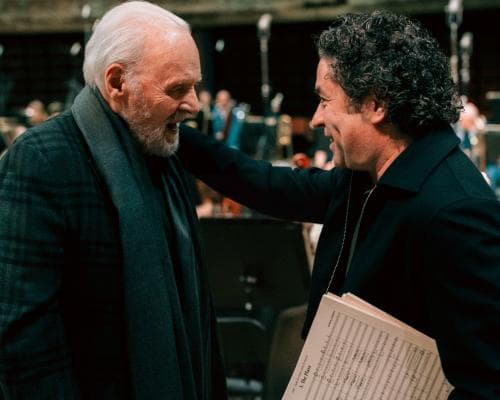
There is a moment in Anthony Hopkins’s new album, Life Is a Dream, when the music does something unexpected: it stops being the work of a celebrated actor and becomes the work of a man who has been quietly composing all his life. At 88, Hopkins has finally allowed us into this private world, and he has done so in the most luxurious way imaginable — with Gustavo Dudamel, the LA Philharmonic’s outgoing music director, at the helm, and the Philharmonia Orchestra in full voice. The result is not a vanity project but a revelation: a collection of melodies that feel as though they have been waiting decades to be heard.
The album opens with a Fanfare and March that is pure Technicolor — a splash of brass and strings that could score a golden-age Hollywood epic. It is easy to forget, listening to the sweeping lines and the confident orchestration, that this is a debut. Hopkins’s cinematic instincts are everywhere: in the Khachaturian-flavored Two Pieces for Orchestra, in the lively 1947: Suite for Orchestra that recalls one of the hottest summers on record, and in the tender Stella Aria, dedicated to his wife. But there is also a deep Welsh soul here. My Fatherland, with its six traditional tunes and four songs sung in Welsh, would not be out of place at the Last Night of the Proms, yet it feels intimate, like a memory of Margam, the Port Talbot suburb where a young Hopkins first fell in love with music.
The craftsmanship is impeccable, but what truly distinguishes Life Is a Dream is its honesty. Hopkins has said he writes from the heart, and you believe him. The 1947 suite is a love letter to his childhood — to the streets and mountains around his home, and to an unforgettable visit with his father to the Plaza cinema. You can hear the wonder in the music, the way a boy might hear an orchestra for the first time and never recover. That sense of discovery is preserved here, rendered in a spacious, state-of-the-art recording that lets every instrument breathe. Soloists Sergio Tiempo on piano and Gregorio Nieto on cello add a level of refinement that makes the album feel less like a debut and more like a masterclass.
For collectors of cultural artifacts — those who acquire first editions, rare pressings, or the last works of a great artist — Life Is a Dream is a fascinating addition. It is not merely a celebrity crossover; it is a genuine composer’s voice, one that has been honed over a lifetime of listening. Hopkins’s influences are clear: Khachaturian, Myers, the great film composers. But he filters them through his own sensibility, creating something that feels both timeless and personal. In a market where so-called ‘late-career’ projects are often cynical, this album is the opposite: a gift, offered with grace.
What does this signal about luxury taste? It suggests a shift toward depth over novelty, toward the enduring over the ephemeral. The ultra-wealthy have long collected paintings and sculptures; now they are increasingly drawn to the intangible — to experiences, to music, to the stories behind them. Life Is a Dream is not just an album; it is a narrative, a piece of Hopkins’s life offered to the listener. For those who appreciate easy-on-the-ear melody and good old-fashioned craft, it is a treasure.
As Hopkins approaches his ninth decade, this album feels like a summation — but not a farewell. There is a vitality here, a joy in creation that suggests more may come. For now, we have Life Is a Dream: a work that proves it is never too late to share what you have always carried inside. And for the discerning listener, it is a rare privilege to be invited into that private world.