Where the Sierra Meets the Sky: A Slow Walk Through Andalucía’s White Villages
A self-guided ramble through the rugged Sierra de Grazalema reveals a side of southern Spain the crowds never see—whitewashed pueblos, Moorish echoes, and the quiet thrill of moving on foot through a landscape that feels both ancient and alive.
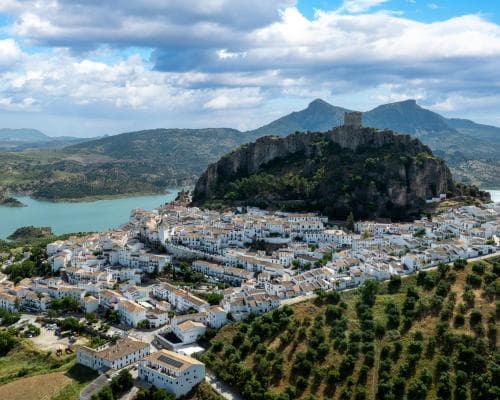
The wind is in from Africa—or so Joni Mitchell insists, and who are we to argue? My wife and I step out of Zahara de la Sierra into the Sierra de Grazalema natural park, and the morning air carries a warmth that feels like a whisper from across the strait. The butterflies drifting over the flower-spangled verges, the turtle doves purring in the olive groves, the booted eagle circling overhead—all of them summer visitors, blown in from a continent that feels both impossibly close and utterly other. Yesterday, we stood in Zahara’s castle museum, high above the terracotta rooftops, learning how the recapture of this hill town was a turning point in the Reconquista—the 15th-century campaign that returned southern Spain to Catholic rule after seven centuries of Moorish influence. Now, with a laminated map on a lanyard and a route app on my phone, we are walking into that history, one limestone ridge at a time.
This is day two of the White Villages of the Ronda Mountains tour, a self-guided seven-day route from On Foot Holidays that unfolds across 51,695 hectares of protected parkland. The company’s modus operandi is deceptively simple: they carry your luggage, hand you a GPS-tracked app, and set you loose on footpaths that have been walked for centuries. There is something profoundly luxurious about that—not the luxury of silk sheets or a private butler, but the luxury of being utterly unencumbered. Your only job is to walk, to look, to listen. The nightingales do the rest. As we wind along lush river valleys, their song spills out of the undergrowth, and I understand why the Moors called this place the Garden of Granada.
The villages themselves are the real stars. Each one—Zahara, Grazalema, Benamahoma, El Bosque—clings to the hillside like a handful of sugar cubes dropped from a giant’s pocket. Their whitewashed walls are blinding in the midday sun, their alleys so narrow you can touch both sides with outstretched arms. In Grazalema, the highest village in the park, we stop for café con leche in a plaza where the only sound is the clack of dominoes. The route is not gentle; it climbs and drops with the kind of determination that makes you feel every one of your years in the quads. But the effort is rewarded with views that stretch all the way to the Mediterranean on a clear day, and with the knowledge that you are walking the same paths that smugglers, shepherds, and soldiers used before you.
What makes this journey feel so contemporary is the way it subverts the usual luxury-travel calculus. There is no five-star hotel, no helipad, no private chef. Instead, the indulgence lies in the curation—the careful selection of small, family-run hotels and guesthouses where the owners know your name by the second night. One evening, we sleep in a converted olive mill with a terrace overlooking the valley; the next, in a 16th-century manor house where the breakfast jam is made from the owner’s own quince trees. The price is modest by the standards of this desk—a few hundred euros a night, all told—but the value is incalculable. You are paying for time, for silence, for the rare and increasingly precious experience of being somewhere that cannot be reached by car.
The deeper significance of this kind of trip is that it signals a shift in how the ultra-wealthy are beginning to think about travel. The era of the trophy hotel is not over, but it is being joined by a quieter, more elemental desire: to be absorbed into a place, not just to visit it. Walking tours like this one are the antithesis of the Instagram safari. There is no moment of arrival, no dramatic reveal. Instead, the landscape unfolds gradually, the way it was meant to be seen—at the pace of a heartbeat, not a helicopter blade. For the traveller who has seen everything, who has traded the Maldives for the Matterhorn and the Seychelles for the Serengeti, the next frontier is not a new destination but a new mode of being. It is the willingness to be a pilgrim rather than a passenger.
And where do the wealthy go next? Not farther, but deeper. They are seeking out places like the Sierra de Grazalema—places that are not on any concierge’s speed dial, where the luxury is not in what you have but in what you can leave behind. The white villages of Andalucía are not undiscovered, but they are unspoiled, and that distinction matters more every year. As we descend into El Bosque on the final day, the scent of orange blossom trailing behind us, I realise that the most valuable thing this journey has given me is not a tan or a stamp in a passport, but a memory of walking through a landscape that felt both ancient and entirely my own. Joni Mitchell may have been singing about something else, but she was right: you don’t know what you’ve got till it’s gone. The trick is to go before it is.